The name now seems slightly faded, even fusty: John Philip Sousa. Old music from a distant era.
Don’t let that fool you. At one time, Sousa marches were the grandest, biggest, brightest and liveliest music in the country, and indeed the Western world.
The Sousa Band was popular beyond belief. It played 15,623 concerts between 1892 and 1932 before audiences averaging an estimated 3,200 attendees each. That adds up to some 50 million Sousa Band concertgoers in the United States, the UK, France, Germany, Belgium, Holland, Austria, Poland, Russia, South Africa, Australia, and even New Zealand.
It may be that Sousa today is only trotted out for July 4th and other patriotic holidays, but his marches are a substantial chunk of our American musical heritage, along with such disparate types as folk, classical, jazz, musical theater, and various strains of popular song. The arrival of the 250th anniversary of America’s founding warrants a look at the music made by a man who once called himself the “Salesman of Americanism.”
Made for the Military Band
John Philip Sousa was born in Washington in 1854 to a father of Portuguese descent and a Bavarian-born mother. His father, a trombonist in the U.S. Marine Band, secured lessons in voice, violin, and the major wind instruments for his son, who repaid him at age 13 by attempting to run away and join a circus band. In response, dad apprenticed his son to the Marine Band, where young John spent eight years studying every band instrument—woodwinds, brass, and percussion—in their individual capacities as well as their combined strength. His later talent for exploiting the characteristics of woodwind and brass instruments in combination dates to these formative years.
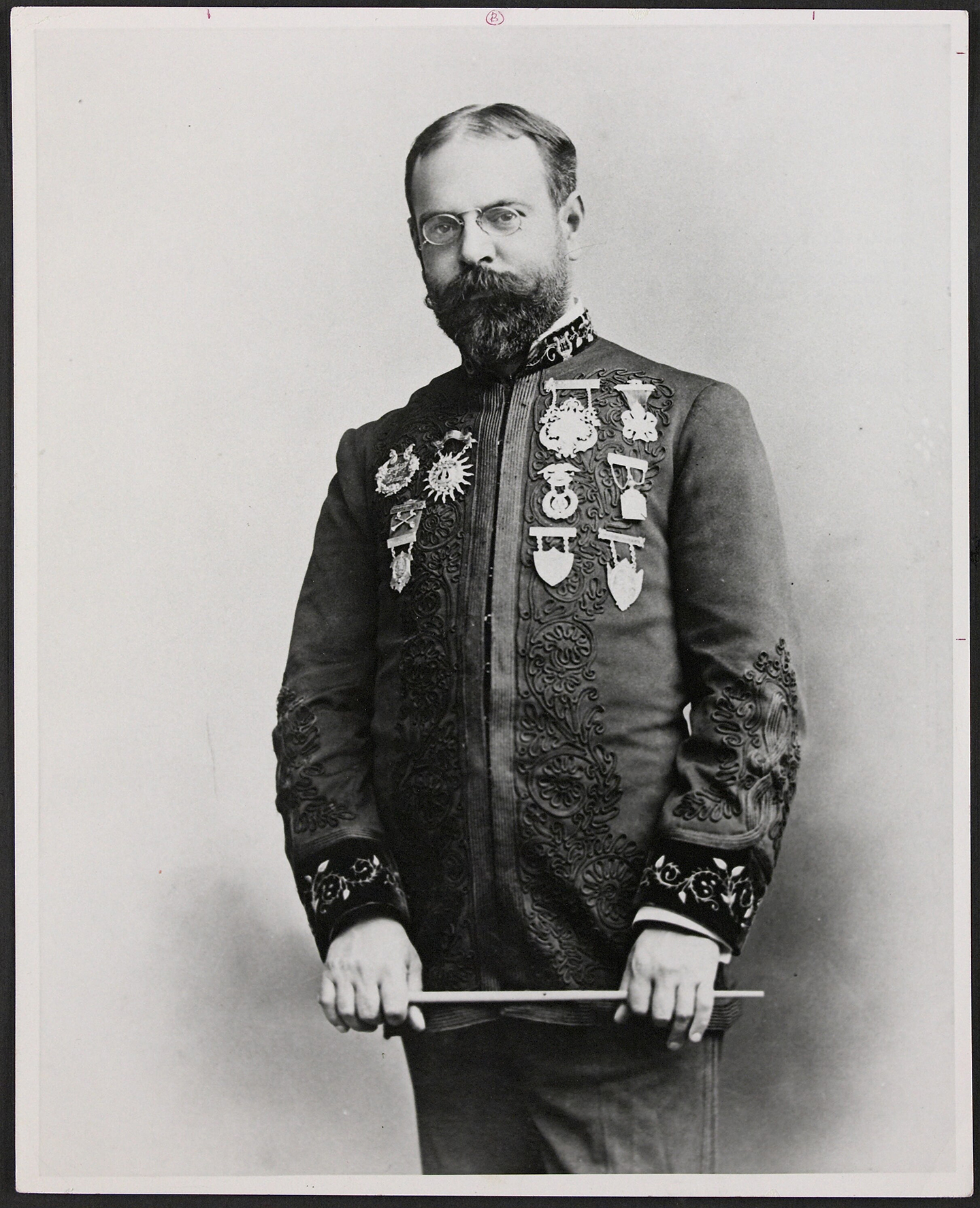 “The March King” John Philip Sousa standing with a baton, circa 1890’s. Library of Congress. (Public Domain)
After five years, Sousa was called back to the U.S. Marine Band, this time as its director. From 1880 to 1892, he shaped what was an underpaid, undisciplined group into a sharply precise and sonically powerful entity that came to be called “The President’s Own” military band.
Naturally, marches began to flow from his pen. He had dabbled in the form, producing a handful of works that are now largely forgotten. During his tenure as Marina Band director, he wrote some three dozen marches, including several of his most enduringly popular numbers. Here is a link to the astounding compilation of Sousa’s complete marches—136 of them—but 129 recorded by today’s U.S. Marine Band, which continues the legacy of high-end marching band performance.
A Selection of Stirring Marches
To hear the best-known pieces from this period, listen to No. 34, “Semper Fidelis.” Titled after the motto of the U.S. Marine Corps, meaning “Always Faithful,” it’s the very archetype of the Sousa march.
After a stirring few measures of introduction, a muscular first strain is heard, giving way at 0:44 to the “break-up strain,” measures intended to bridge the opening and final strains. The final strain is typically the most tuneful part of the march, and the part people remember. In “Semper Fidelis,” this begins at 1:25.
Sousa was especially adept at crafting memorable final strains due to his experience conducting and composing operettas. This tune, played by cornets and trumpets, is repeated twice, joined in counterpoint by woodwinds (1:42) and then by trombones (1:58). The march ends with a coda (2:13), though this isn’t necessarily the case in other examples.
Additional enduring marches from Sousa’s Marine Band period include No. 37, “The Thunderer,” which follows more-or-less the outline above, but with a second “break-up” strain between iterations of the lyrical final strain; No. 38, “The Washington Post”; and No. 40, “The High School Cadets.”
Both “Semper Fidelis” and “Washington Post” are in 6/8 time signature, lending them a bouncy feel. “The Thunderer” and “High School Cadets” are in cut-time, a two-beat meter that has a more decisively “into the ground” feel. Sousa alternated between these two throughout his career.
In 1892, Sousa retired from his position with the Marines and founded his own organization. The Sousa Band flourished for four decades, its popularity reflected in enormously successful American and international tours. It even earned its leader the label of “The March King.” Among the most beloved marches from the Sousa Band period are No. 48, “The Liberty Bell,” No. 51, “King Cotton”; No. 52, “El Capitan”; and then of course, his crowning masterpiece, No. 53, “The Stars and Stripes Forever.” The background story explains the patriotic title.
In 1896, Sousa and his wife were on a European vacation when the news came that his business manager had died. While sailing back to the United States, Sousa began to hear a march in his head. He knew vaguely that it had something to do with the importance of returning home. By the time the ship reached port, the march was finished in Sousa’s mind, taking its title from the sight of the American flag as the ship pulled into New York harbor. All he had to do was write it down.
Although his later marches never quite achieved the popularity of his earlier work, Sousa continued to command large audiences until his death in 1932. And today, he continues to be a major figure in the history of American music.
What arts and culture topics would you like us to cover? Please email ideas or feedback to features@epochtimes.nyc.