Gustav Mahler’s life swung between opposites: composer and conductor, Jew and Catholic, nature-lover and urbanite. One dichotomy characterized his entire composing career: symphony and song.
Song came first. Born to a large, lower-class family in Bohemia (now the Czech Republic) on July 7, 1860, Mahler wasn’t the child prodigy typical of classical music mythology. Neither a virtuoso pianist nor a composing wunderkind, Mahler tried his composing hand at age 16 with a rather perfunctory Piano Quartet that’s rarely played today. Chamber music wasn’t his strength.
He then switched emphasis to vocal music with “Das Klagende Lied” (“Song of Lamentation”) for vocal soloists, choir, and two orchestras—one onstage and one off, written between 1878 and 1880. The work presages his mammoth symphonies of later years. Then came a raft of lieder, or art song: three lieder in 1880, a collection of five songs called “Lieder und Gesänge, Vol. I,” written 1880 to 1883, and four “Songs of a Wayfarer,” 1884–1885. All of this was, in a way, prelude to what was coming.
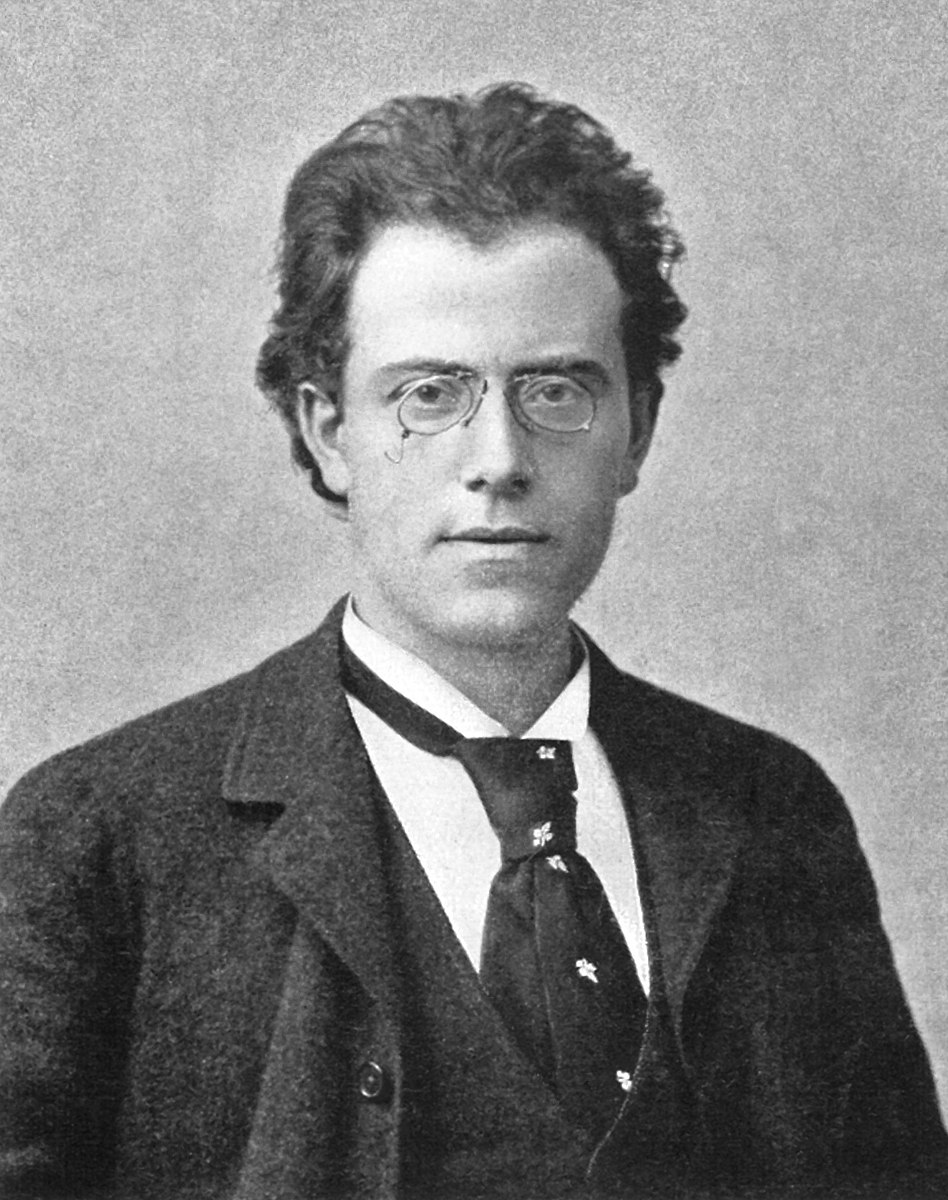 An 1892 photograph of composer Gustav Mahler. (Public Domain)
Sometime in late 1887, Mahler embarked on composing his Symphony No. 1. Its instrumentation was like no other symphonic works of the time. The typical Beethoven-era orchestration consisted of woodwinds in pairs, four horns, two or three trumpets, sometimes trombones, two or three timpani played by one person, and maybe a pair of cymbals.
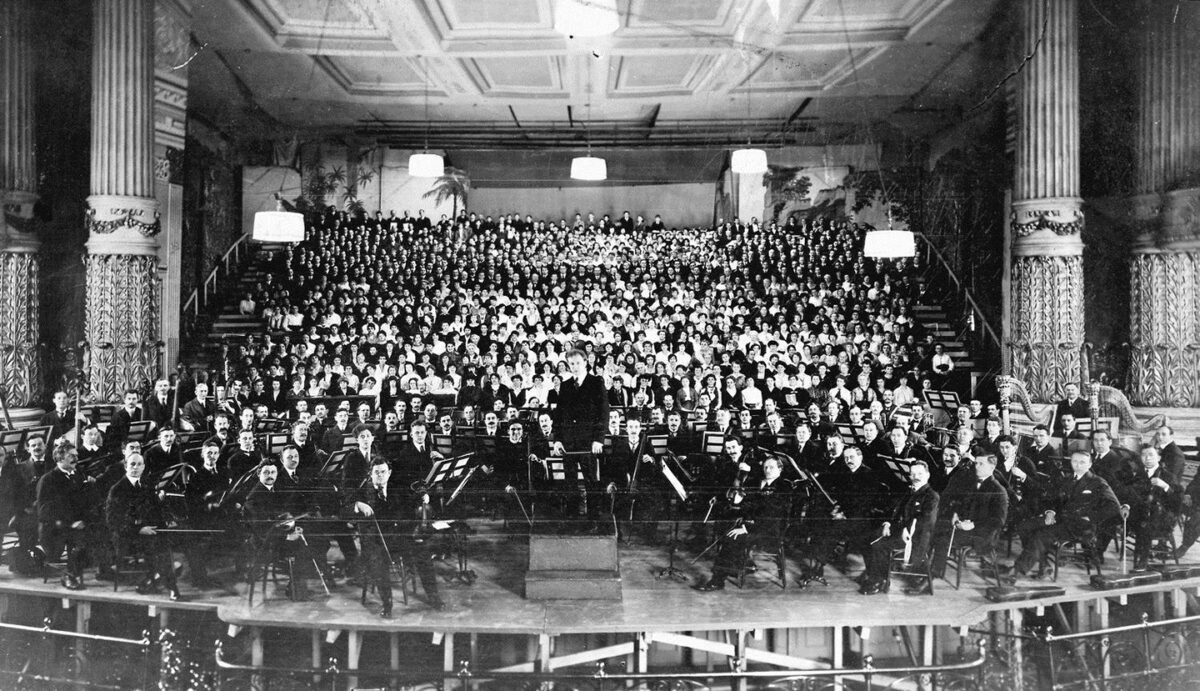
Contrast this with Mahler’s orchestra: four flutes, oboes, and clarinets, with numerous doublings; three bassoons, the third doubling contrabassoon; seven horns; five trumpets; four trombones; one tuba; six timpani played by two different timpanists; bass drum, cymbals, triangle; and tam-tam; harp; and the usual bowed strings—first and second violins, violas, cellos, and double basses.
The number of bowed strings would, of course, need to be much larger than the usual contingent that is combined with mere pairs of winds instead of the quadruple-plus winds, brass and percussion of this orchestration.
Credit goes to Hector Berlioz for turning the symphony orchestra into an epic canvas of expression. The expansion started with Berlioz’s “Symphonie Fantastique” (1830) and reached a peak with his “Te Deum,” written in 1849, which had quadruple woodwinds, horns and trumpets or cornets; six trombones, and expanded percussion. Wagner’s thickening of the brass in his music-drama orchestrations also contributed to the symphony orchestra’s growth.
With such large forces at hand, Mahler could have painted any musical picture he wished. The one he wished to paint was the glory and terror of nature.
Listen to the 1966 recording of Mahler One with Leonard Bernstein conducting the New York Philharmonic. Bernstein essentially introduced Mahler to American audiences.
A Storytelling Symphony
The first movement, marked, “Slowly, dragging, very restrained throughout,” opens with a single note (“A”) sounded and passed around the orchestra, until at last we hear the distinctive sound of the cuckoo from the clarinet (1:48). Mahler called this the “awakening of nature from a long winter’s sleep.” At 3:29 comes the first of several quotes from the composer’s song repertoire. Even in this first symphony, Mahler remained a song composer of sorts, presenting the melodies he’d written for voice in orchestral garb.
The song’s words begin “I walked out this morning onto the meadow.” Though there is no singer for these words, the melodic delight in nature comes through orchestral colors, punctuated by the sound of the cuckoo. At 4:46 the words to the tune are “A fine world! A fine world!” The song is developed throughout the remainder of the movement.
The second movement, called “Blumine,” or “Flower Piece” was included in the work’s premiere in Budapest in 1889, and in two subsequent performances. After that, it was dropped and is occasionally performed as a separate piece today. The work’s second movement as it now stands (at 15:10) is marked, “Moving strongly, but not too quickly.” It’s a landler, or German folk dance.
The third movement (23:26) is the most controversial, as it introduces a sardonic element of the composer’s personality not heard in the earlier movements. It begins on a solo double bass—not a usual solo instrument—playing the tune Americans know as “Are you sleeping, Brother John?” but in a minor instead of major key. The effect is dark and strangely eerie.
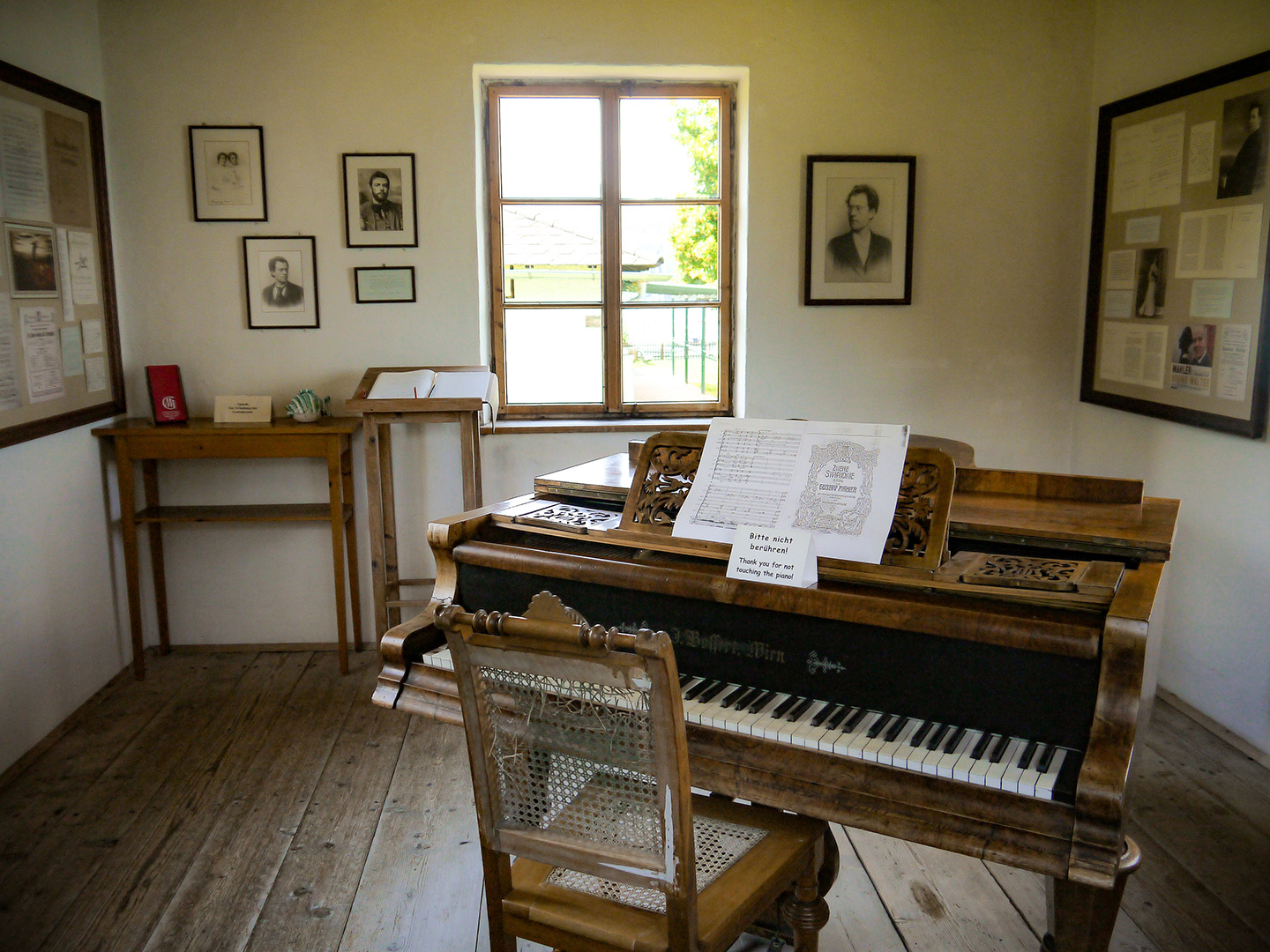 The composing hut of Gustav Mahler at lake Attersee in Austria. (Color edited photo by Thomas Ledl/CC BY-SA 3.0 AT)
The keys of the movements so far have been D major, A major, and D minor, all closely related. Suddenly, with the opening crashing chord of the fourth and final movement (33:45), listeners hear the darkly remote F minor. Mahler described this opening as “a sudden outcry from a deeply wounded heart.” Nature contains beauty, but also tragedy. After a long struggle, the finale returns to the brightness of D major.
Throughout the latter stages of composition on Symphony No. 1, Mahler also worked on his second symphony. Throughout the birth of these gargantuan orchestral masterpieces, Mahler worked at the craft of conducting. He would compose nine symphonies and the single movement of a 10th, and become the most sought-after conductor on the planet. Eventually he brought his art to the United States, where he worked as music director of the New York Philharmonic.
Mahler died in 1911, just short of his 51st birthday, leaving a legacy unmatched by many who lived much longer. His symphonies were slow to catch on, but are today an indispensable part of the orchestral repertoire.
What arts and culture topics would you like us to cover? Please email ideas or feedback to features@epochtimes.nyc