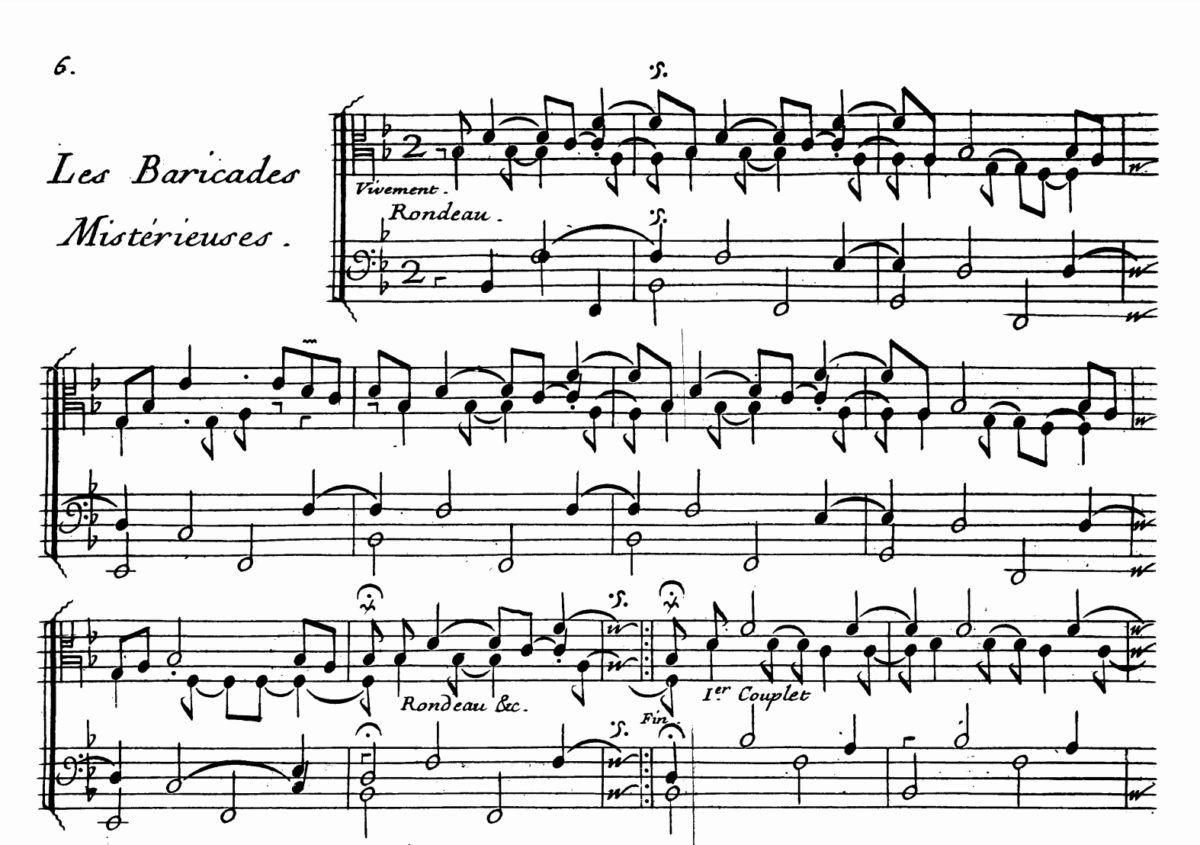
What musical composition has four parts that blend into one, feels heavy and light at the same time, and is constantly shifting, like the patterns of a kaleidoscope?
“Les Barricades Mystérieuses” or in 17th-century French, is “Les Baricades Mistérieuses.”“The Mysterious Barricades” is unlike any other piece of baroque music you’ve ever heard. It isn’t even like any other piece by its composer, François Couperin.
Couperin (1668–1733) came from an illustrious musical family, inheriting from his father Charles the position of organist at a prominent Paris church. The liturgical works he composed there caught the attention of no less than J.S. Bach, who copied them in manuscript.
However, Couperin’s greatest fame came as a harpsichordist and composer for that instrument. Between 1713 and 1730 he produced four thick volumes containing more than 230 pieces for harpsichord, the most prominent keyboard instrument of the day. “Les Baricades Mistérieuses” appeared in the second volume.
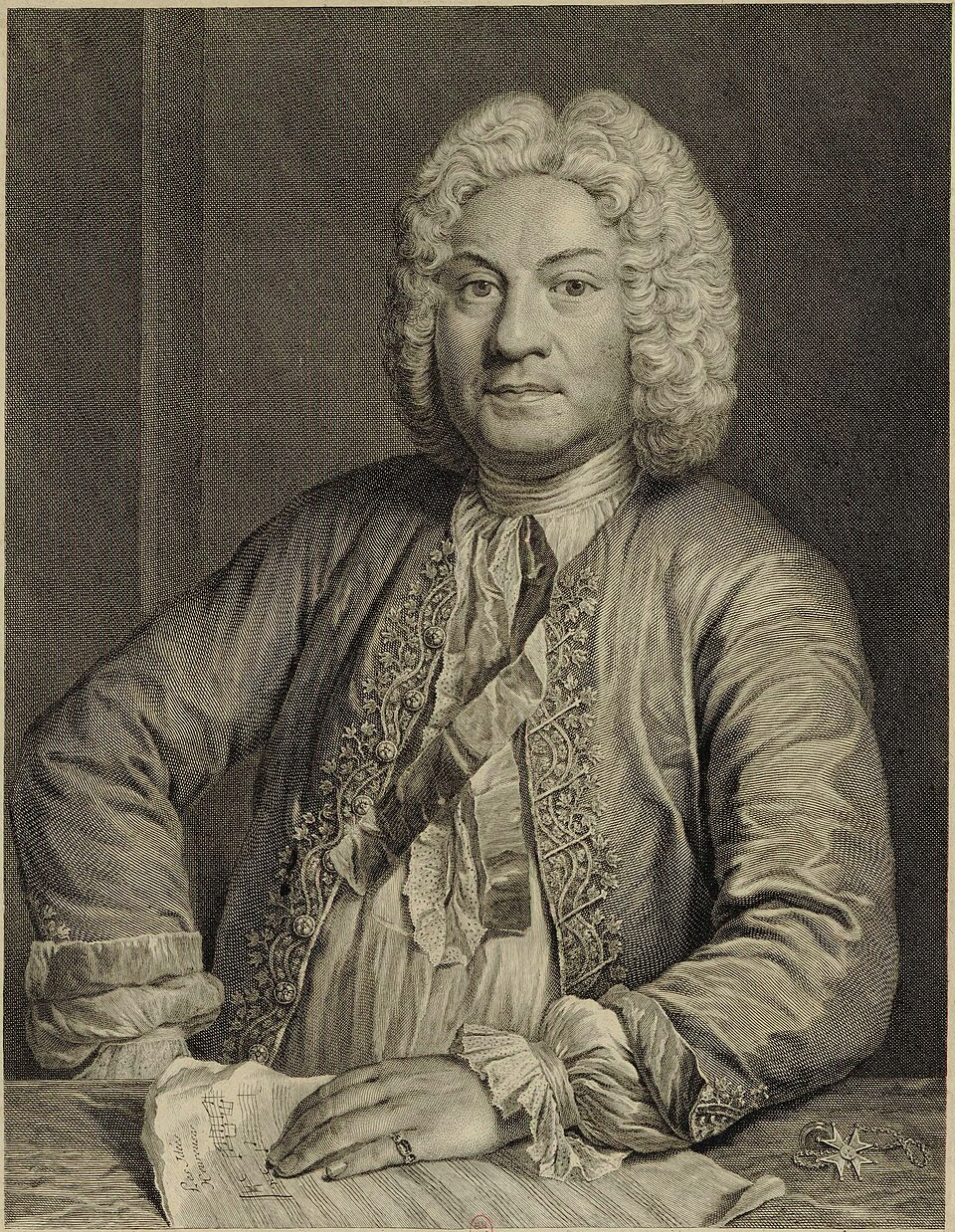 “F. Couperin, after painting by Andre Bouys,” 1735, by Jean Charles Flipart. (Public Domain)
A Something Song
In B-flat major in a swiftly moving two-beat frame marked “Vivement” (“Lively”), it’s in five-part rondo (or “rondeau”) form: A-B-A-C-A. Yet the sections resemble and elide with one another to such an extent that it seems the piece is a whole-unto-itself, without separate parts.
The title is apt. The more you hear the piece, the more it seems that something is hidden. In low register, the right hand is written in bass clef in most editions. Each hand plays two parts that interact both with each other and with the pair of voices in the other hand. The effect is so mesmerizing that we can excuse the hyperbolic enthusiasm of Scottish music analyst and commentator, Tom Service:
“The four parts create an ever-changing tapestry of melody and harmony, interacting and overlapping with different rhythmic schemes and melodies. The effect is shimmering, kaleidoscopic and seductive, a sonic trompe l’oeil that seems to have presaged images of fractal mathematics, centuries before they existed.”
Who or what is being barricaded? There have been many guesses, none of them confirmed to be Couperin’s intention. The composer left no clue. Could Couperin have been philosophizing on the separation of reality from our knowledge of it? Might it refer to the distance between people and their ambitions? My musicology professor at the University of Arizona, the late French baroque scholar James Anthony, once offered what he called “the quintessentially French” answer to the puzzle. He said: “These are the barricades to a woman’s heart.”
Today, “Les Barricades Mystérieuses” is played on the harpsichord, piano, and guitar. It’s even performed in arrangement by instrumental ensembles of strings, woodwinds, and brass. We’ve chosen a piano performance (not the jangly harpsichord) because it produces the greatest clarity for the contemporary ear. Listen to Eva Szalai at the Franz Liszt Academy of Music, Budapest, Hungary.
What arts and culture topics would you like us to cover? Please email ideas or feedback to features@epochtimes.nyc