Music that imitates the sounds of nature has been a part of human experience since at least 12,000 years ago, when hunters carved bone flutes sounding like birds’ songs to draw them to their killing ground, discovering along the way that they also sounded pretty.
The recent history of Western art music, that is, “classical” music, is rich with the efforts of composers to suggest natural sounds. Antonio Vivaldi (1678–1741) famously captured the sounds of passing seasons in the cycle of violin concertos he called “The Seasons.” The “Summer” concerto alone manages to employ themes uncannily reminiscent of birdsong, a flowing stream, and a raging storm. Gioachino Rossini (1792–1868) conjured the racing horse beneath an escaping Willliam Tell in the overture to his opera.
Camille Saint-Saëns (1835–1921) imitated a whole zoo in “Carnival of the Animals.” His menagerie included a lion, hens and roosters, an aquarium stuffed with fish, kangaroos, an elephant, wild donkeys, an aviary, and a swan. In the 20th century, the Armenian American composer Alan Hovhaness (1911–2000) wrote something called “And God Created Great Whales,” though in that work he didn’t exactly imitate the sound of whale songs, but rather incorporated a recording of them blended with orchestra.
In my opinion, American composer Ferde Grofé (1892–1972) takes first prize for the gutsiest musical illustration of an animal. The piece is“On the Trail” from his “Grand Canyon Suite.” The animal: the lowly mule.
 (L–R) Superintendent Tillotson, Robert Fechner, and Paolo Sperati riding mules on their way to the North Rim via the Kaibab Trail, July 22, 1934. (Public Domain)
A Little Background
He was born Ferdinand “Ferde” Rudolph von Grofé to German parents who emigrated to New York City when he was an infant. His father died young, but his mother took little Ferde, age 7, back to Europe for proper musical training. Maturing into manhood in the United States, Grofé worked all manner of odd jobs—milkman, truck driver, usher, newsboy, and elevator operator—all while playing piano for $2 a night in a piano bar.
His fortune changed when the Paul Whiteman and His Orchestra, a major jazz ensemble of the time, hired him as pianist and arranger. Grofé’s reputation was made when he landed the job of orchestrating George Gershwin’s “Rhapsody in Blue” for Whiteman in 1924.
Arranging was all well and good, but Grofé’s central ambition was to write original works for orchestra. He took his biggest step toward that goal with the “Grand Canyon Suite.” He later wrote about what made him write the piece:
“In writing ‘Grand Canyon Suite’ I drew from notes I had made during my constant visits to the rim of the mighty work of nature. I had watched the Canyon in all seasons, in all its moods. And my findings were on paper, notes in hieroglyphics that were later transcribed into musical notes.”
Grofé visited the Grand Canyon as early as 1916 and started sketching musical possibilities in 1922, though he didn’t start writing the final score until 1929. Upon the suite’s premiere in 1931 by the Paul Whiteman’s orchestra, Grofé became a sought-after composer and conductor of his own works.
Geographical themes held Grofé’s interest. Between 1931 and his passing in 1972, he composed “Death Valley Suite,” “Hollywood Suite,” “Hudson River Suite,” “Niagara Falls Suite,” and “Hawaiian Suite,” among other scores. Nothing he wrote, however, achieved the popular status of the “Grand Canyon Suite,” which continues almost a century after its premiere to appear on symphony orchestra programs, both pops and classics.
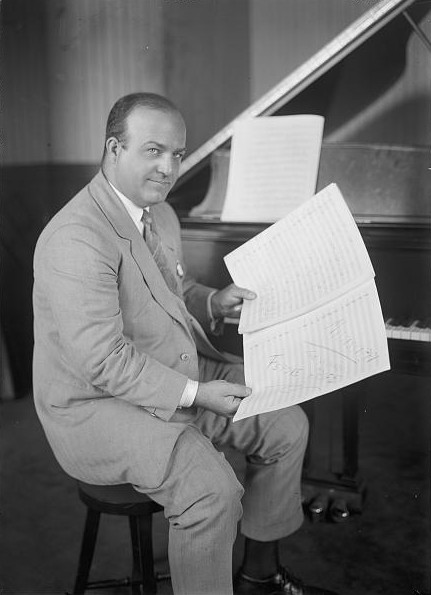 Composer Ferde Grofé in 1925. (Public Domain)
The Music
The suite is in five parts: “Sunrise,” “Painted Desert,” “On the Trail,” “Sunset,” and “Cloudburst.” Here is a recording of the entire suite. Our focus is on “On the Trail,” starting at 11:05. (Listen)
Having portrayed sunrise with sustained notes and a birdsong on the piccolo, followed by an impressionistic evocation of the Painted Desert, the composer gives us the centerpiece of the suite, “On the Trail.” In it, we ride down into the canyon and sample the beauty of its flora and fauna along the way.
The movement opens with the braying of the mules that escort us into the canyon. Later, it’s musically illustrated by Grofé’s distinctive and unabashedly cute clip-clopping of temple blocks to a jagged 6/8 melody. But first, we are given an extended violin solo that presages the trip, an imagined period of preparation.
The mules have their sweet song, however angular and even squeaky, and the violin sings it. To be sure, they are indeed mules, not “burros” as many sites incorrectly state. “Burro” is just Spanish for “donkey,” which these are not. Donkeys can be ornery and unstable. Mules are donkeys crossbred with horses, which produce a more docile animal.
The violin references both the jaunty tune that depicts the mules and the yearning melody that will at length play over it as the imaginary traveler—you—enjoy your steep descent. The violin concludes its extended solo on a very high note, and at 12:38, we are at last on the trail to the bottom of the canyon. On the way, the oboe plays the piquant mule theme, accompanied by the hollow clip-clop of temple blocks. At 13:12, the rhythm accelerates until we come to a temporary halt.
But things pick up and we are off again at 13:51. This time, the jaunty tune finds its balance in an expansive melody from the French Horn that floats over it, a portrait, it would seem, of the journeyer’s inner state. We shortly reach the canyon’s bottom and at 15:06 we are greeted by the gentle flow of the Colorado River. We dismount and the inner song sings strongly in us.
All too soon, it’s time to return, so we remount to the familiar music of our bumpy trail and begin the climb. Yet reflection is in order, which comes in the form of a delicate celesta solo at 17:15. We make our way back up to the rim with a final bumptious outcry from the mules.
Musical imitation of nature has its limits, but it‘s also fun and it allows us to connect music to life experience. I live in Arizona and I’ve been to the Grand Canyon several times, but I never had the fortitude to ride a mule to the bottom. Thanks to Ferde Grofé, I can make the musical journey anytime.
What arts and culture topics would you like us to cover? Please email ideas or feedback to features@epochtimes.nyc