Let tyrants shake their iron rod,
And Slav’ry clank her galling chains,
We fear them not, we trust in God,
New England’s God forever reigns.
Religious congregations and soldiers of the Continental Army sang these words in the years of the American Revolution, defying England’s advancing forces. The song: “Chester,” a choral piece written by a young Bostonian today recognized as America’s first choral composer, William Billings.
Billings (1746–1800) was a tanner by profession and a self-taught musician. His compositions are often rough-hewn, and musicologists sometimes categorize it as “American primitive.” But they have a simple power that lift them. It made “Chester,” in particular, a song that rivaled “Yankee Doodle” for popularity during the War of Independence. Musicologist Hans Nathan said of Billings’s music, “There is freshness, a naive vigor about it.”
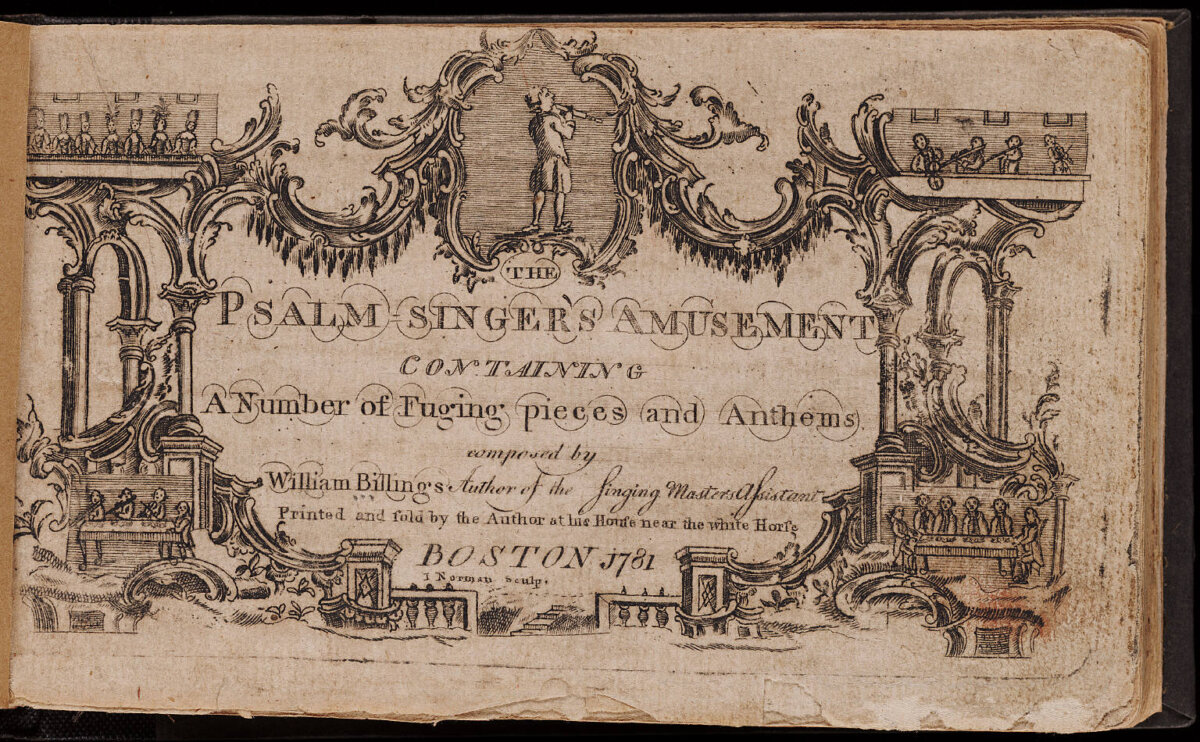
“Chester” was first published in 1770 in Billings’s “The New-England Psalm-Singer,” printed by his friend, Paul Revere. The Lexington and Concord were still five years off, but revolutionary sentiment was already growing in New England. It consisted of two verses: the first one, above, and this, the second:
“What grateful Off’ring shall we bring?
What shall we render to the Lord?
Loud Halleluiahs let us Sing,
And praise his name on ev’ry Chord.”
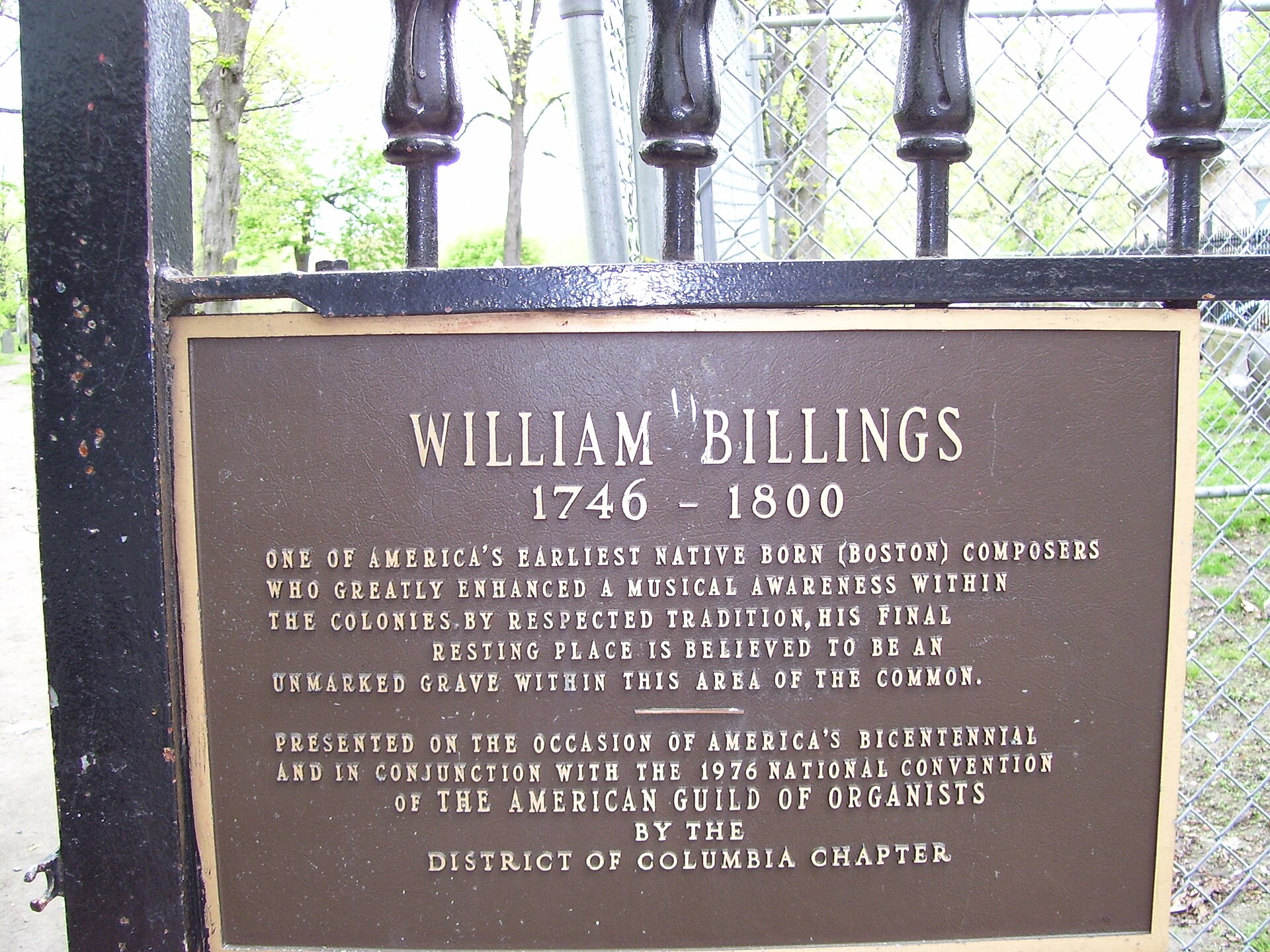 The grave memorial plaque for William Billings, who died in poverty and was likely buried within the town common. (Swampyank/CC BY-SA 3.0)
Billings published a second version in 1778, adding three verses more specific to the war that had by that time broken out. The first of these names specific English generals as enemies and is rarely sung today. The other two became the second and third verses of most performances, with the previous final verse remaining in place. This is the version that caught on with the troops and became America’s first patriotic anthem.
The melody is strong and straightforward. It lasts only 16 measures per verse, but within that space spans a heroic octave. It owes part of its feeling of defiance to the fact that it starts on the fifth, or dominant, of the home chord, the highest note in the triad, then ascends fanfare-like to the octave of the home tone.
Here is the Boston Camerata, embellished by fife and drum, singing the 1778 version, minus the verse about Cornwallis and company.
The words were apparently written by Billings himself. The inner verses read as follow:
When God inspir’d us for the fight,
Their ranks were broke, their lines were forc’d,
Their ships were Shatter’d in our sight,
Or swiftly driven from our Coast.
“The Foe comes on with haughty Stride;
Our troops advance with martial noise,
Their Vet’rans flee before our Youth,
And Gen’rals yield to beardless Boys.
A note about the title: It has nothing to do with the Massachusetts town of Chester. It was the curious 18th-century practice to give generic place names to hymns so that other lyrics could be sung to the tunes without confusion. Another Billings choral piece is called “Africa,” yet it has nothing to do with Africa.
Billing wrote much more than “Chester.” You can find many of his works on YouTube. One I suggest as an example of the composer’s expressive range is the choral canon, “And Jesus Wept,” found here: (Listen)
“Chester” has inspired American composers over the years. Its best-known paraphrase comes in the second movement of William Schuman’s “New England Triptych.” It’s a set of variations on Billings’s theme, by turns noble, march-like, dance-like, and triumphant. Here it is, performed by the United States Marine Band: (Listen)
What arts and culture topics would you like us to cover? Please email ideas or feedback to features@epochtimes.nyc