



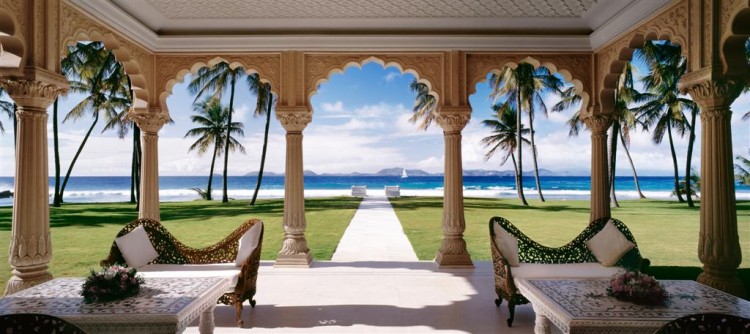
As a child, Scott Frances drew and painted a lot. He grew up in New York City in a post-World War II Jewish home filled with mid-century modern designed objects. Both his parents were journalists. In addition, mom was a decorator.
Frances did not want to be a photographer. Life just prepared things that way. Now he is an acclaimed photographer of architecture and design.
Frances is currently displaying a selection of his images in an exhibition in New York called MonoVisioN, which is also the title of his book.
While viewing his exhibition and looking at the large images ranging from 2 1/2 feet to 8 feet wide and from 3 1/2 feet to 5 feet tall, you find yourself circling the space repeatedly—to look at the images again and again.
Harmonious Composition
The images are well-balanced and meticulously composed. They attract with their vivid or soft hues and with their atmosphere of calmness or movement. As a viewer, you can imagine yourself there, and you want to be there—inside those images. What strikes one the most is the array of light expressions, each visually embracing the objects it portrays.
“I am a big believer in quality and elegance and beauty. I don’t believe these are arbitrary things. I believe there is a standard for what is and isn’t beautiful,” Frances said in an interview with The Epoch Times.
Traditional art aims at achieving harmony in tones and balance between lights and darks. A thoroughly thought-out, balanced composition is most desirable, creating an attractive and pleasing painting that enriches the viewer.
Although Frances’s art doesn’t depict objects of traditional art, he has similar goals: “Hardly anything I am shooting is ancient. This is all modern design, and it is still out there. I am trying to almost deify it, to honor it.”
Modern Skills
While looking further at Frances’s images, another feeling slowly impels the viewer’s awareness, and one asks oneself whether these images blur the line between photographs and paintings.
“I am para-painterly [meaning near-painterly],” Frances said.
Traditional artists painted in natural light and used oil paints and brushes. The old-world artist achieved his final painting by layering his pigments on canvas. He made changes as he went along. Comparatively, Frances composes his images with harmonious tonalities, using only natural light, achieving his delectable final images with modern paintbrushes from a graphics-editing program.
“That’s the paradox. It’s as far away as you can get from Renaissance paintings in a sense, you know; it’s [as] technical as you can get and [as] inorganic as you can get. There is no linseed oil, no pigments, no bristle brushes. There is no canvas.
“At the same time, it’s totally a hand-raw skill. It takes hours and hours and hours of working in Photoshop with the computers, assembling these different exposures and painting back-end and drawing lines,” Frances said.
Similarly as a fine art painter builds up his painting with layers of paint onto canvas, the digital photographer works his layering prior to printing. The layers of applied paint are replaced by layers of exposures, the pigments by pixels, the brush by the stylus, and the canvas by the screen.
“Paradoxically it is the return to the old-world skills and arts because all digital imagery has to be processed. And Photoshop is basically rooted in these old-world tools. They even use the same names. You have brushes, and you have layers.
“In the end, you are taking the information, and you are rendering them [the images] with color pallets and brushes and applying them in different layers with different transparencies to them, and you are building it back up,” Frances said.
Frances gives an example of layering: “I am shooting maybe 60 pictures, and the camera is not moving, but the people are moving all over the place. So I will take the girl in the green dress from one of the pictures and the man in a wheelchair from another and the man in the pink shirt walking as a blur from another exposure. They were all there. They were separated by seconds.
“I am not taking the guy in the pink shirt from the left and putting him on the right. I am taking him from his picture. And that is the only thing I am taking from his picture.
“Then I am layering it with the picture of the girl in the green dress, and then I am layering that with the picture of the guy in the wheelchair, and then I am laying that on top of just the scene by itself with no one in it.”
This reminds one of painters like Norman Rockwell, who took many images to create highly realistic paintings. In this sense, Frances describes himself as para-painterly.
Natural Lighting
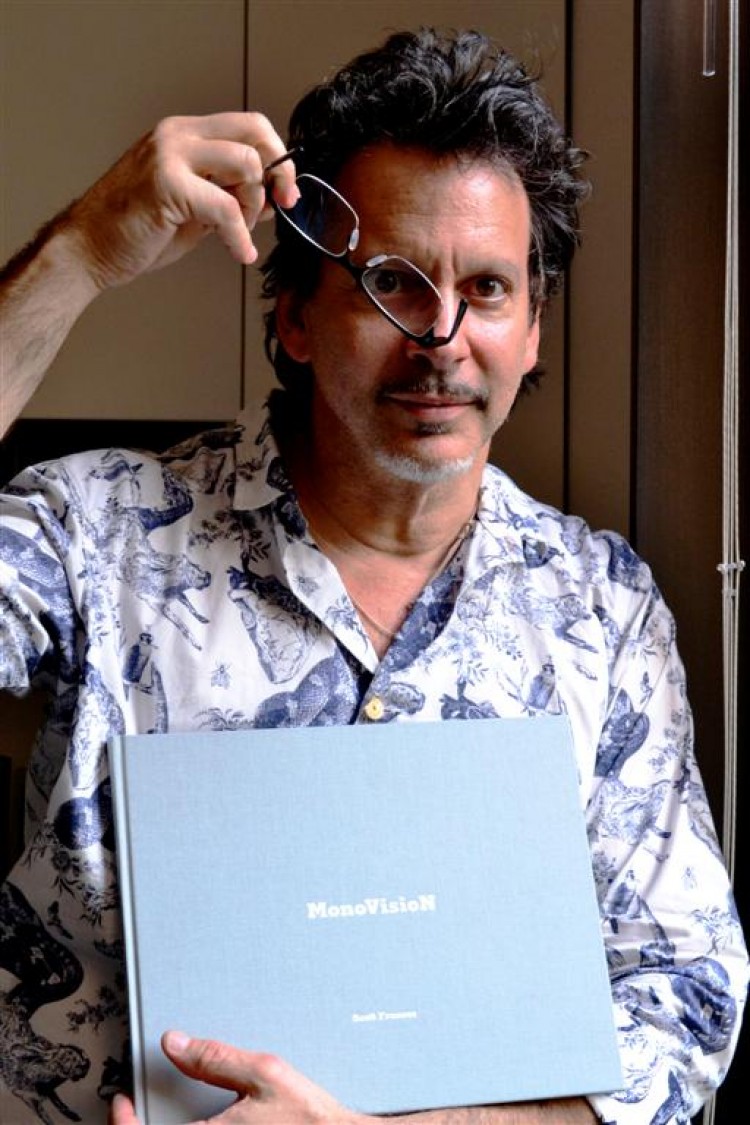
In his book, Frances mentions Vermeer, a Dutch painter renowned for his masterly use of light in his work. Vermeer often placed his subjects near a window.
Frances feels his work has become “more about the quality of the light than anything else,” as he writes in his book.
When asked for a photo for this article, Frances stood by the window and opened the blinds to let natural daylight illuminate his face from the side.
Frances uses natural light and shies away from artificial lighting. “I am interested in capturing the atmosphere and the effects of nature. Whether it’s time passing or weather changing or seeing how light plays off of different surfaces, I think artificial lighting destroys that,” he said.
Similarly to layering different people from the same place, Frances layers images from the same place but with different light exposure into the final image: “In my case, my camera is on a tripod; it does not move. I am taking multiple images of the same scene.
“Because the contrast is so high, the sky is 50 times brighter than the shadow: One exposure for the sky, another for the shadow, another exposure for the mid-tones.”
While a fine arts painter creates the final image captured in his mind out of different aspects he has seen, the digital photographer takes images of his object with a multitude of light exposures and creates the final image through working with the software.
After walking with the designer or architect around the site and discussing what is important or not, Frances may spend a whole day there observing the place: “I think spaces do have their best time; they have their own spirit. Some are clearly quiet and meditative and soft and natural, and those should be shot during a very soft daylight.
“Some are very bold and energizing, and maybe that is an appropriate space of strong contrasts and shafts of lights coming in. Since I don’t supplement light anymore, what I try to do is control the time of day. I choose to shoot a room and where the light comes from,” Frances continues.
Frances uses the means available in the place itself to direct the light, for example by covering some windows: “I force the light to come from certain places—and never from the front, never from behind, always from the background or from the side—because it gives the most dimension and shape to objects.”
Although Frances determines everything—the brightness, the composition, and what’s in an image—he gives the viewer the feeling of being free: “The viewer will look at it and feel free to walk into, and wander around in, and choose things to look at.
“Now, the truth is I am really forcing him to look at things, but that’s not the experience one has; the experience is not being forced. The experience is maybe seduced a little bit, but I think they [the images] are gentle. There is no hammer on the head.”
Continued: True Images
