



In 1357, King Charles IV—who ruled over the lands of the present-day Czech Republic—ordered that a bridge be built across the Vltava River as it flowed through Prague. The medieval stone overpass was finally completed early in the 15th century. It was decorated with 30 statues and monuments, most in the baroque style, all of which have since then been replaced by replicas.
As the only means of crossing the Vltava River until 1841, the Charles Bridge provided the most important connection between Prague Castle and the city’s Old Town and adjacent areas. It made Prague important as a trade route between Eastern and Western Europe. Also, the bridge is located on the historic coronation route of the Bohemian kings.
In the world of architecture, perhaps nothing is more utilitarian than a bridge. Yet just because these spans are built to fill a function doesn’t mean that they have to be ordinary in design or don’t have interesting stories to relate. In fact, some of the world’s most prominent architects have used their creative minds to turn structures constructed to fill a very practical purpose into virtual works of art.
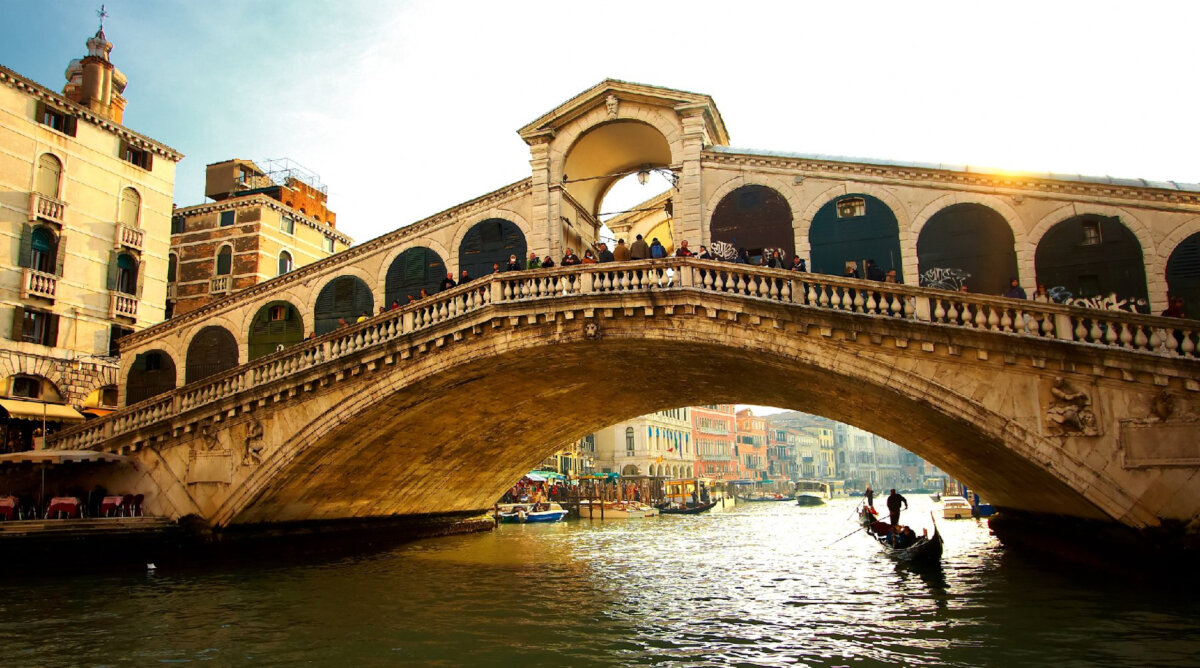
Venice’s Rialto Bridge, built during the 16th century, is the oldest link over that city’s Grand Canal. The stone arch structure crosses over the narrowest point of the Grand Canal in the heart of Venice. It replaced a wooden pontoon bridge that was designed in 1178, rebuilt in 1255 and 1264, and, after several collapses, it was eventually replaced by the Rialto Bridge.
The breathtaking Nescio Bridge, which carries pedestrians and cyclists over the Amsterdam-Rhine Canal in the Netherlands, won three major awards in a two-year span. The curved, steel suspension bridge, designed by Wilkinson Eyre, is also distinctive because it is the longest single cable suspension creation in the Netherlands.
Crossing the Zubizuri footbridge in Bilbao, Spain, designed by Santiago Calatrava, is like stepping onto a work of art. This stunning white conduit gracefully arches over the Nervion River. The name “Zubizuri” means “white bridge,” and its unique curved design resembles a sailboat floating above the water. The Zubizuri connects Bilbao’s Ensanche district with Calle Campo de Volantin, making it both beautiful and practical.
In addition to being a masterpiece of modern architecture, Abu Dhabi’s Sheikh Zayed Bridge, designed by Zaha Hadid, is an engineering accomplishment that many believe is the most complex bridge ever built. Its curved arches evoke undulating sand dunes, and a dynamic lighting design flows subtle colors across its spine. The road decks are suspended from symmetrical steel arches, creating a wavelike form with a fluid silhouette.
Waves are also an important part of the story of the Puente de la Mujer (“Woman’s Bridge”), a foot span in the commercial district of Buenos Aires, Argentina. It is a cantilever swing bridge, a section of which rotates 90 degrees to allow water traffic to pass. Calatrava also designed this bridge, describing it as representing the image of a couple dancing the tango.
One claim to fame of the Szechenyi Chain Bridge, designed by William Tierney Clark, is that it has appeared in a number of popular films, including “I Spy” and “Walking With the Enemy.” Another is that it was the first permanent bridge across the Danube River in Hungary, connecting the Buda and Pest neighborhoods. Decorations that adorn the structure are made of cast iron, leading to the fact that it is most commonly referred to as the “Chain Bridge.”
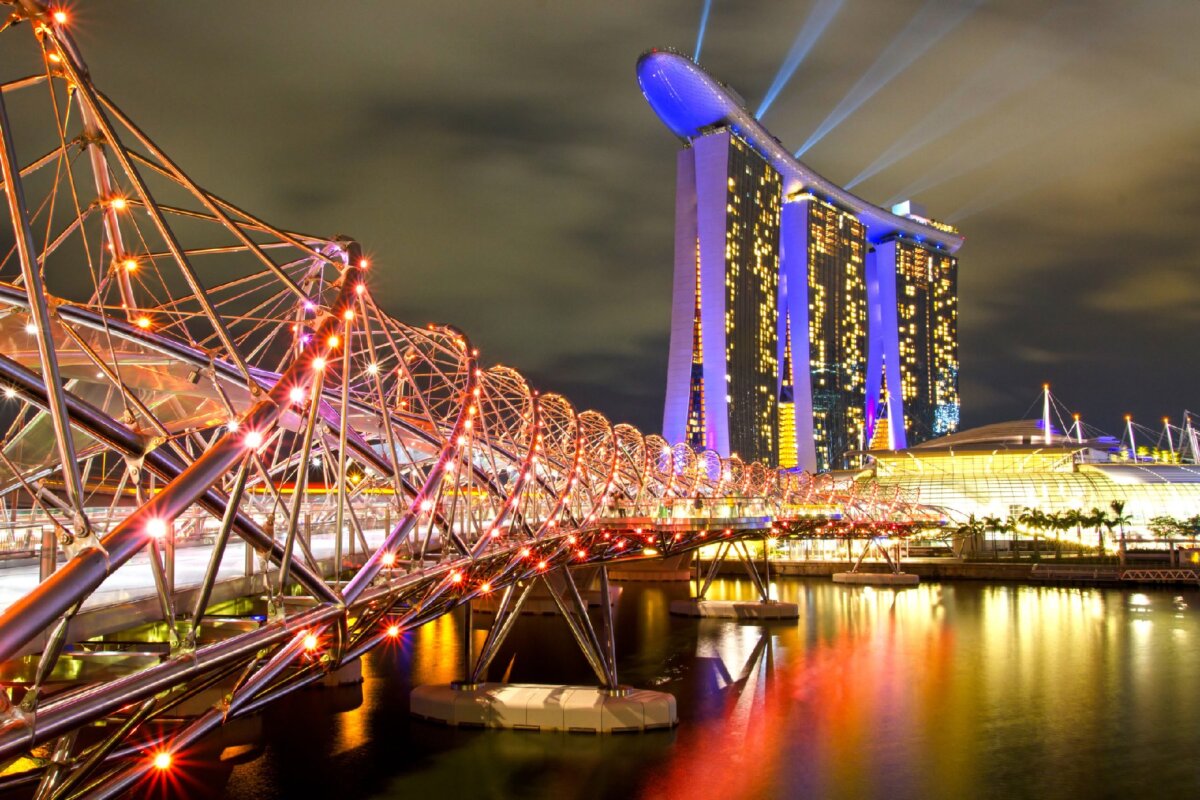
Ornamentation along the Helix Bridge that twists through the heart of Singapore includes fritted glass and perforated steel mesh, which are incorporated into shaded spots for pedestrians. The bridge, designed by Philip Cox, has four viewing platforms sited at strategic locations that provide views of the Singapore skyline and events taking place within Marina Bay. At night, it is illuminated by a series of lights that highlight the spiral-like structure.
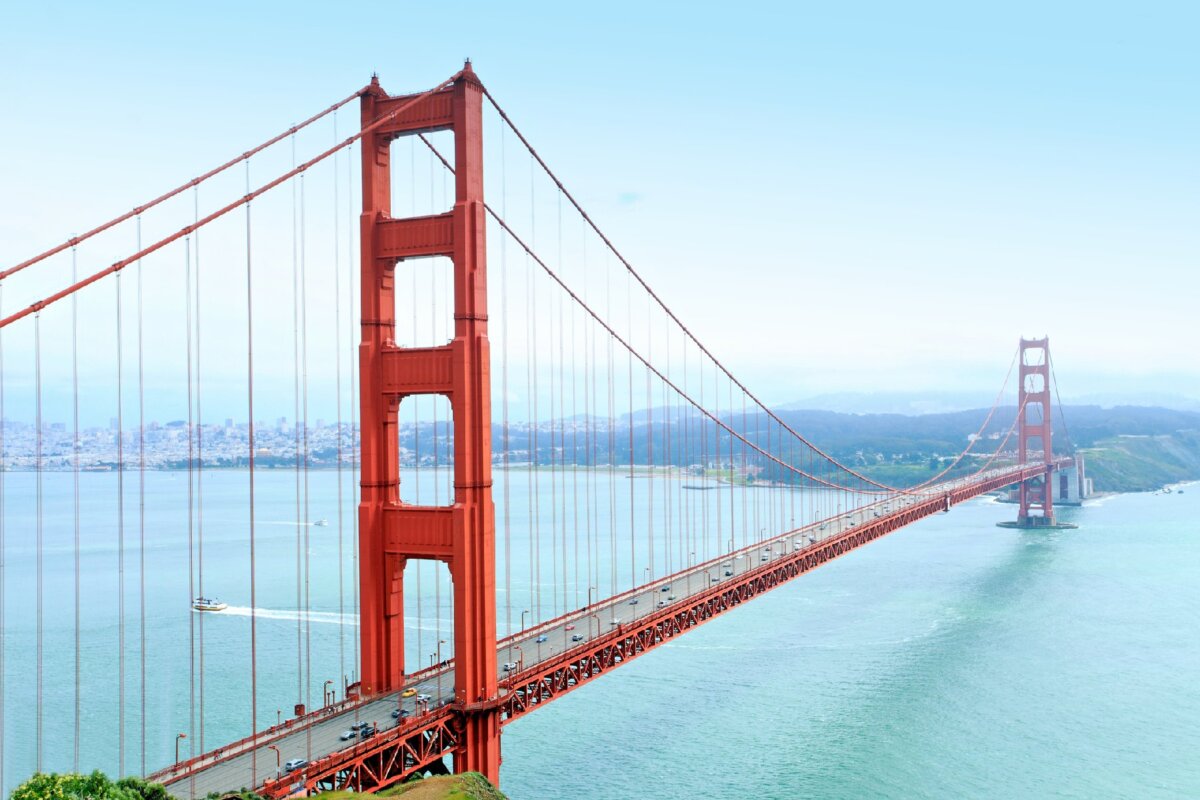
San Francisco’s Golden Gate Bridge, primarily designed by Joseph Strauss and Charles Alton Ellis, is among the most recognizable man-made handiworks in the world. It spans the one-mile-wide strait connecting San Francisco Bay and the Pacific Ocean. It has been recognized by the American Society of Civil Engineers as one of the Wonders of the Modern World and is believed to be the most photographed bridge anywhere.
We end with an iconic structure that is renowned primarily for its intriguing history. When the Brooklyn Bridge in New York City was completed in 1883, many people were terrified after a panic on the structure turned into a stampede, leaving 12 people dead. To prove that the bridge was safe, officials paraded 21 elephants across the span. Today, roughly 150,000 vehicles and pedestrians use it to cross the East River every day. The bridge was designed by John A. Roebling.
When You Go
Check out the following website for more information: worldfamousthings.com/famous-bridges-in-the-world
art-facts.com/famous-bridges.
Dear Readers: We would love to hear from you. What topics would you like to read about? Please send your feedback and tips to features@epochtimes.nyc.
