




Of all the girls in all the world’s paintings, only one has inspired a novel, a film, and an exhibition attracting 650,000 visitors, all the while evading every attempt to be identified. When Johannes Vermeer’s “Girl With a Pearl Earring” (circa 1665) was initially auctioned in 1696, its title was simply “Een Tronie in Antique Klederen, ongemeen konstig,” or “A tronie in antique dress, uncommonly artful.”
The term “tronie” originates from the Dutch Golden Age and refers to a painting of a fictitious character rather than a portrait of a specific model or patron. Although many tronies were painted from live models, their artistic intention was to create a hypothetical, idealized subject without any obligation to attribute it.
Therein begins the irresistible mystery. With 11 children and massive debts, Vermeer did not live a life of luxury and could not afford to hire professional models. His paintings were often modeled by his children, servants, or whoever else was available and willing to sit for free. Who, then, inspired the girl and the earring?
The Thunderclap of Fate
By autumn 1654, the Dutch Golden Age had changed the very nature of creating, buying, and selling art. In a republic without a monarchy, where a thriving merchant class could afford to decorate their homes, the need for massive, complex paintings of historical and mythological scenes yielded to a new demand for more relevant settings of daily life. These were called “genre paintings.”
In the city of Delft, just outside The Hague, the most prominent artist navigating this cultural transition was one of Rembrandt’s brightest pupils, Carel Fabritius. His evolution shows a clear departure from portrayals of Lazarus, John the Baptist, Hera, and Mercury to titles such as “A Young Man in a Fur Cap” and “The Goldfinch.”
Sadly, his chapter in history was cut tragically short when a massive stockpile of more than 80,000 pounds of gunpowder exploded during a routine inspection. Known as the Delft Thunderclap, the blast was heard 90 miles away and destroyed a large portion of the city and its artists. Vermeer survived the explosion and, in the following years, was recognized for his talent and elected head of Delft’s Guild of Saint Luke. His artistic evolution followed a similar trajectory, beginning with a few history paintings, followed by two landscapes, more than two dozen genre paintings, and a few tronies.

The original green background had faded entirely to black, and it was so dirty that Vermeer’s signature had completely disappeared from view. The listing described the painting as being in a “horrible state of neglect,” with its artist unknown. Its rise to stardom is in large part due to the attendance of Victor de Stuers, an art historian and preservationist, who recognized it as a possible Vermeer and convinced his friend and neighbor, Arnoldus Andries des Tombe, to place a bid. The masterpiece sold for what would be $35 today.

Revealing Tears
One hundred fifty years and several major restorations later, the girl’s features were clearer and brighter, but her identity remained a mystery. Several propositions have been put forth to explain the peculiarities of her appearance. Until the Mauritshuis renamed it in 1995, the painting was known as “The Girl With the Turban.” Her clothing was often described as Turkish, although in 17th-century Europe, anything originating from the Ottoman Empire could be described as Turkish. She looks back at us over her shoulder. Her eyes and lips appear moist. Her mouth is slightly open in an expression of surprise or some other vulnerability. The sum of so many characteristics not appropriate for a formal portrait of that time explains the original designation as a tronie but provides no clear motivation for the painting’s commission.
The theory popularized by Tracy Chevalier’s novel of the same name and subsequent film adaptation suggests that Vermeer painted his maid and, in doing so, sparked a romantic chemistry. Her narrative is supported by the evidence that several of Vermeer’s paintings depicted the familiar lives of maids and that the painting, soon after its completion, became the property of the novel’s antagonist, Vermeer’s most frequent patron, Pieter van Ruijven. Chevalier’s story provides not only an explanation for the girl’s remarkably intimate expression, but also a magnetic dialogue between the artist and his muse that reveals glimpses of the genius behind his process. What her concept did not account for is the less romantic possibility that the girl was Pieter van Ruijven’s daughter.
New research has revealed that the majority of Vermeer’s surviving paintings were commissioned not primarily by van Ruijven but by his wife, Maria de Knuijt. In 1665, she willed Vermeer a sum of 500 guilders ($35,000–$45,000 today). The couple belonged to the Remonstrant Church, which is depicted in Vermeer’s painting “The Little Street” (1658).
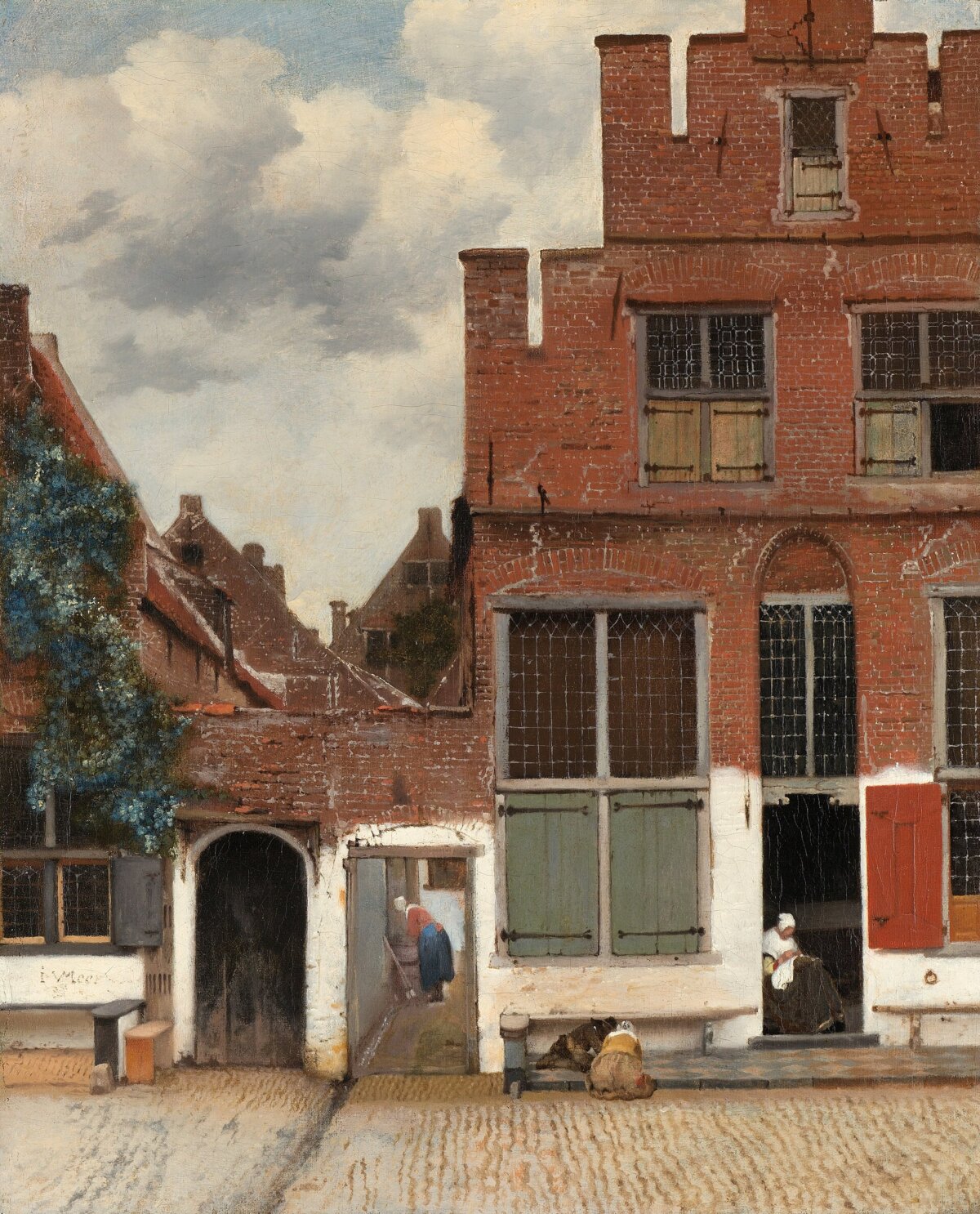
If the girl with the pearl earring was meant to be Mary Magdalene, it would suggest a dramatic return from Vermeer’s more frequent genre paintings to a sacred setting. Curators and historians have yet to reach a consensus on this explosive theory. What is not contested is that before the painting’s disappearance after the 1696 auction, its last known owner was Jacob Abrahamsz Dissius, the husband of Magdalena van Ruijven. Because Vermeer left behind no journals, students, or dedications, the girl’s identity may never be proven. Yet surviving records from 1696 indicate as many as nine completed Vermeer paintings are still at large. With more discoveries may come more evidence to confirm whether the painting’s muse and owner were once the same girl.
What arts and culture topics would you like us to cover? Please email ideas or feedback to features@epochtimes.nyc.
