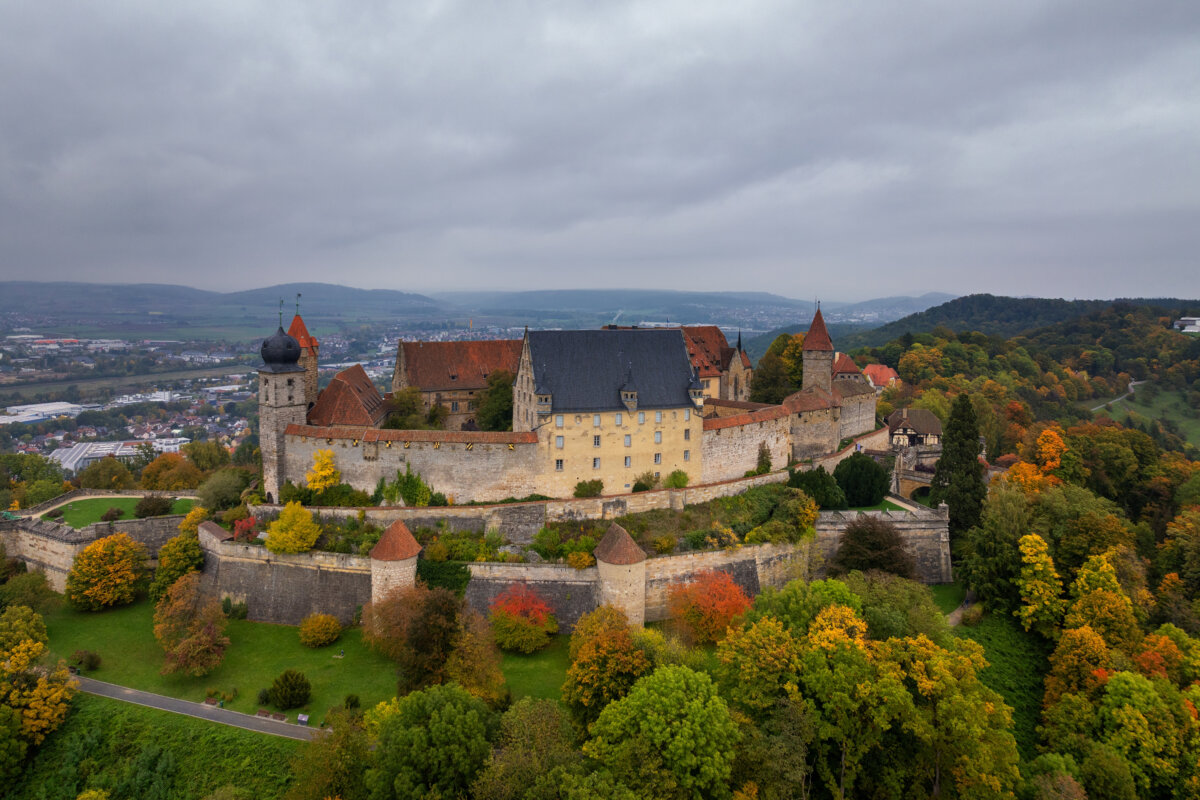
From this aerial vantage point, Veste Coburg’s architecture is defined by its three layers of defensive walls and prominent watchtowers. Panoramic views of the countryside surrounding Coburg, Germany, are enjoyed by anyone visiting the site. (makasana photo/Shutterstock)
Although many centuries have passed since Veste Coburg was built in the Upper Franconian region of Bavaria in Germany, it perseveres as a reminder of quality workmanship and medieval style. Named “Veste,” meaning fortress, and “Coburg,” which signifies the village of its location, the structure looms large on a hill almost 1,500 feet high.
It began as a military fortress, but the structure became a full-fledged castle that included a palace residence for the electors, or leaders, of Saxony, as well as numerous dukes who later lived there. Besides the fortified walls of medieval fortress architecture, the complex added castle-like structures over the years, including towers topped with concave conical roofs and an onion dome.
The famed castle is well-known for its rich history. In 1530, Veste Coburg provided protection from Catholic authorities for the father of Protestantism, Martin Luther. Today, it is owned and managed by the state of Bavaria and open to the public as a museum. On exhibit are art objects, paintings by masters such as Rembrandt van Rijn and Albrecht Dürer, a large collection of arms and armor, and various historic artifacts.
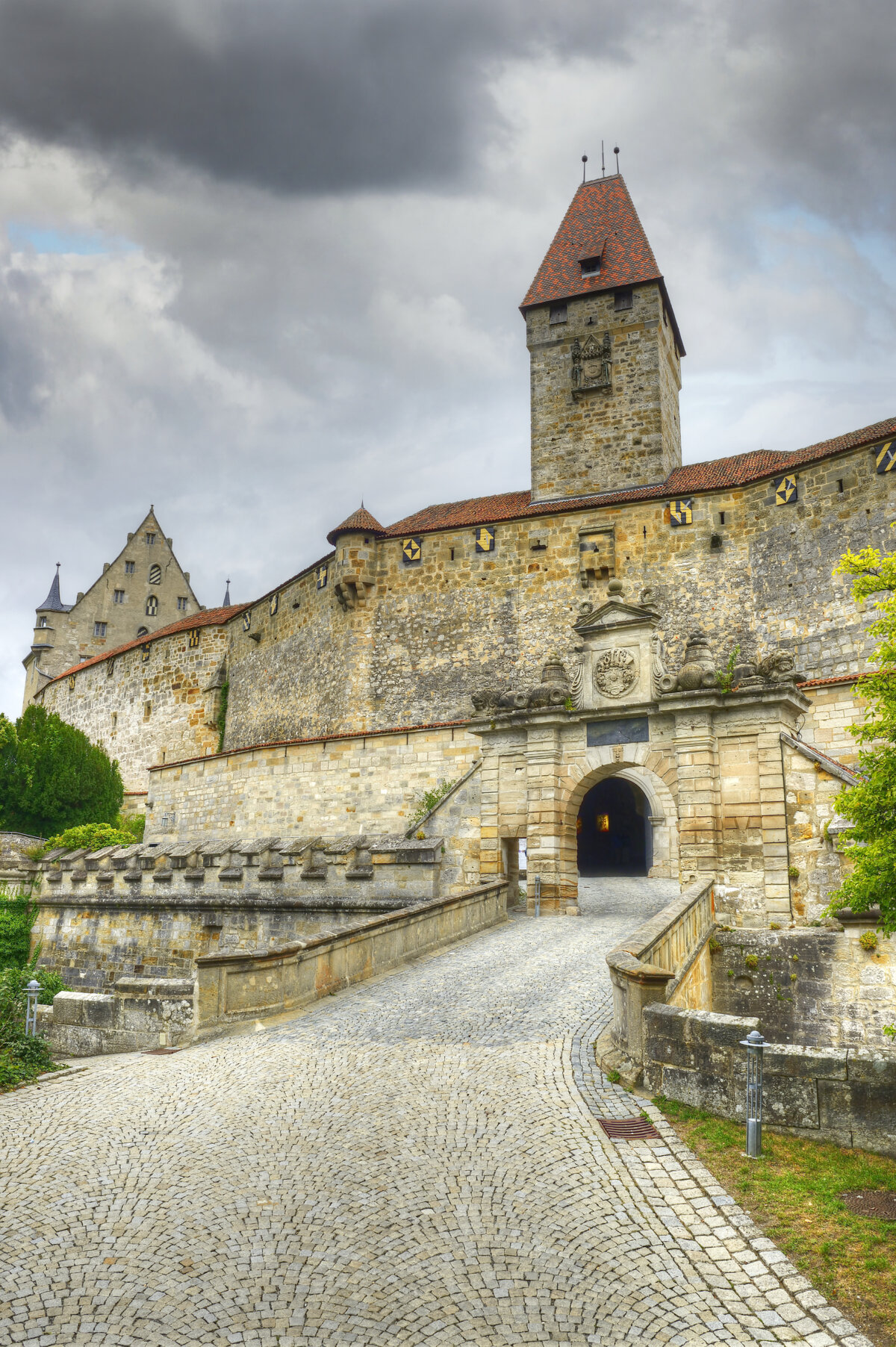
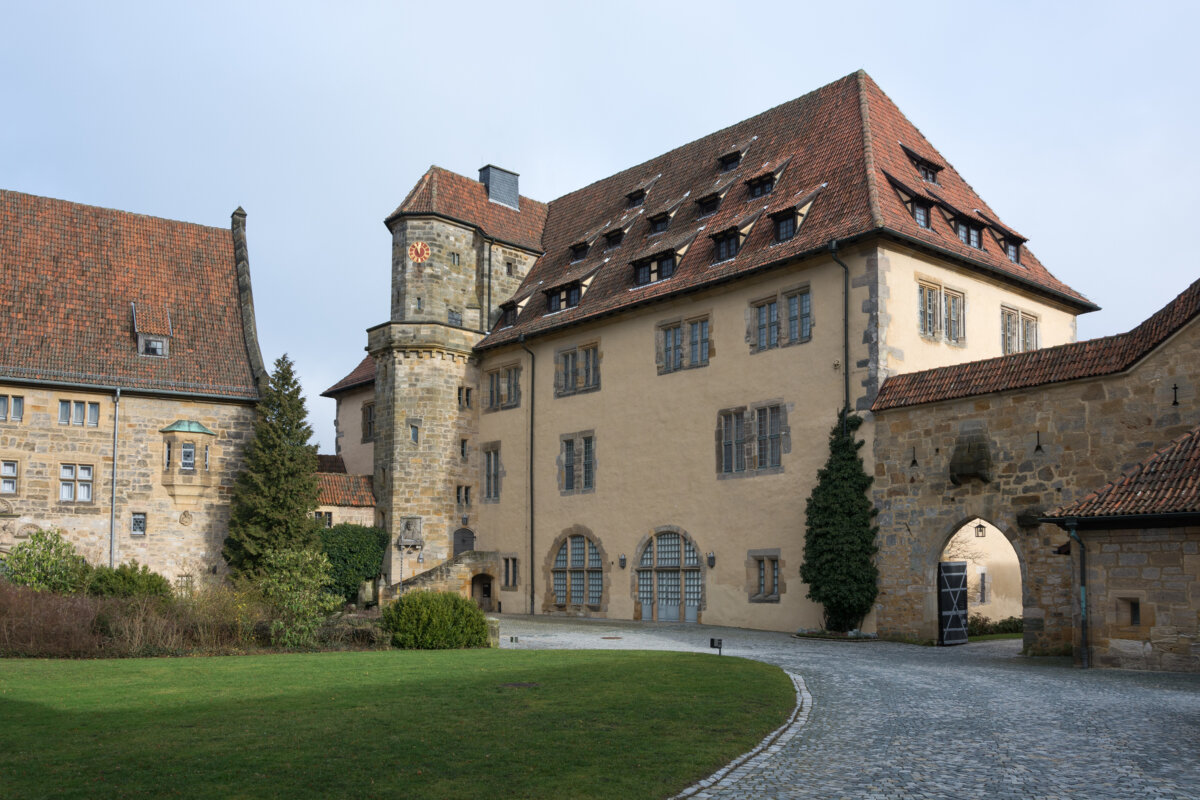
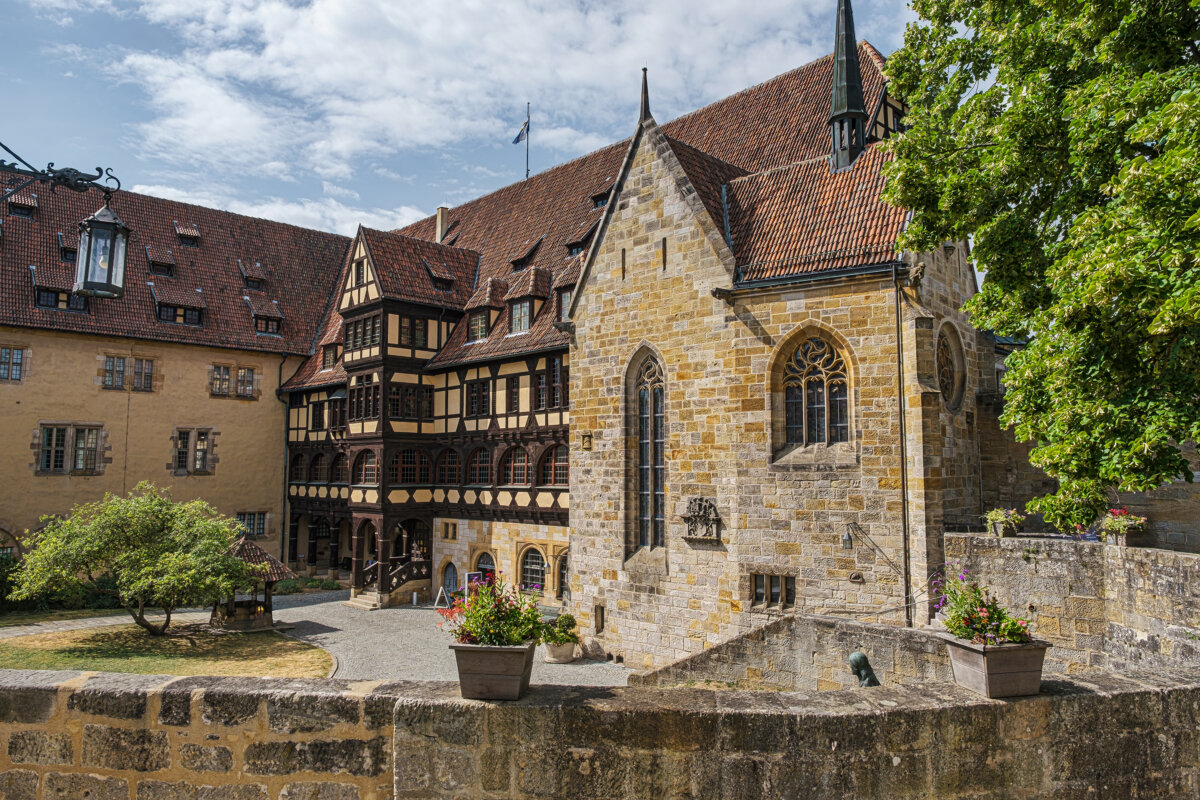
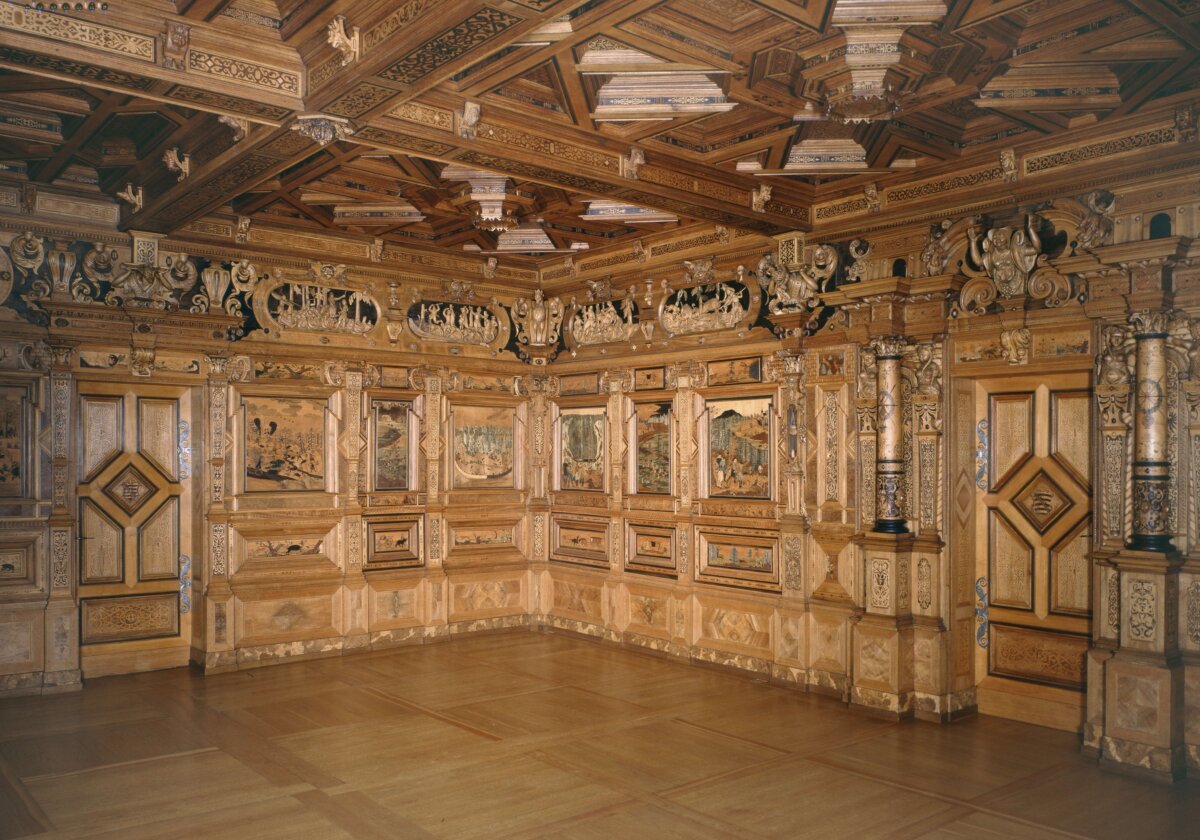
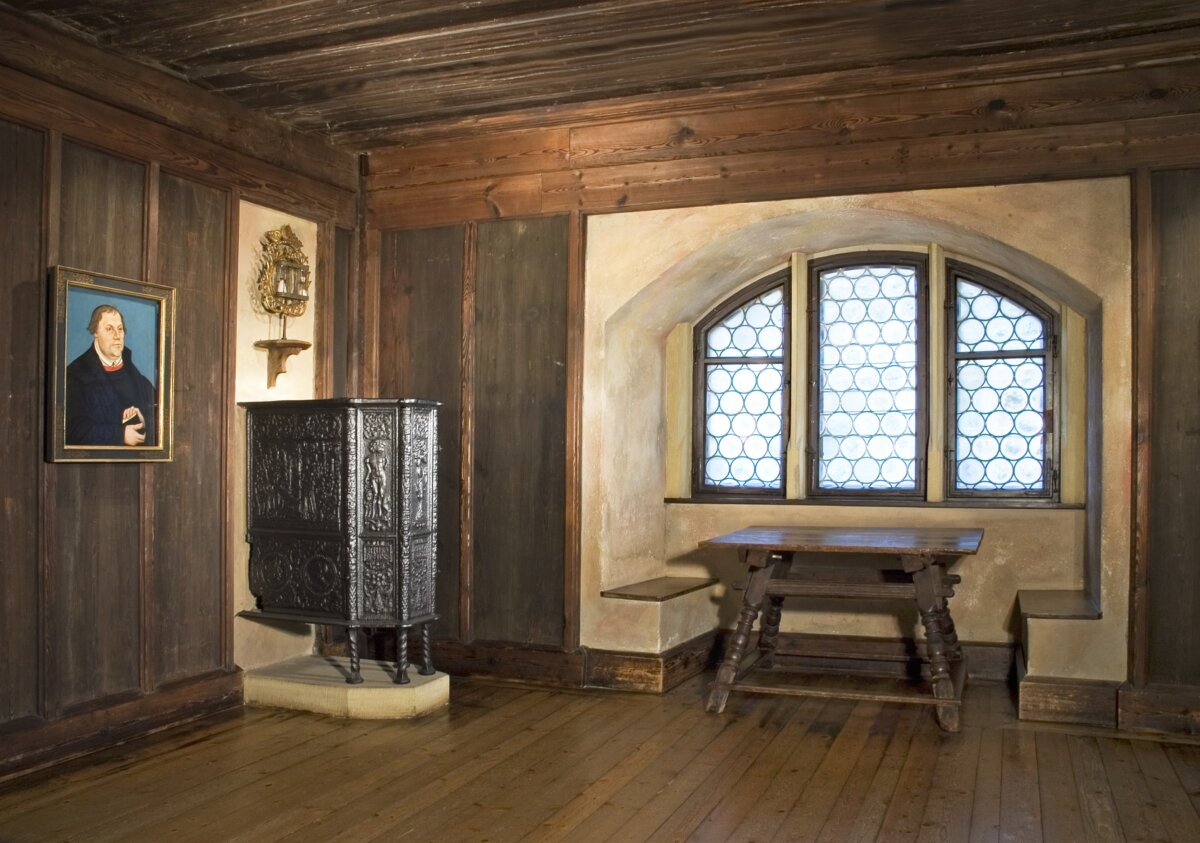
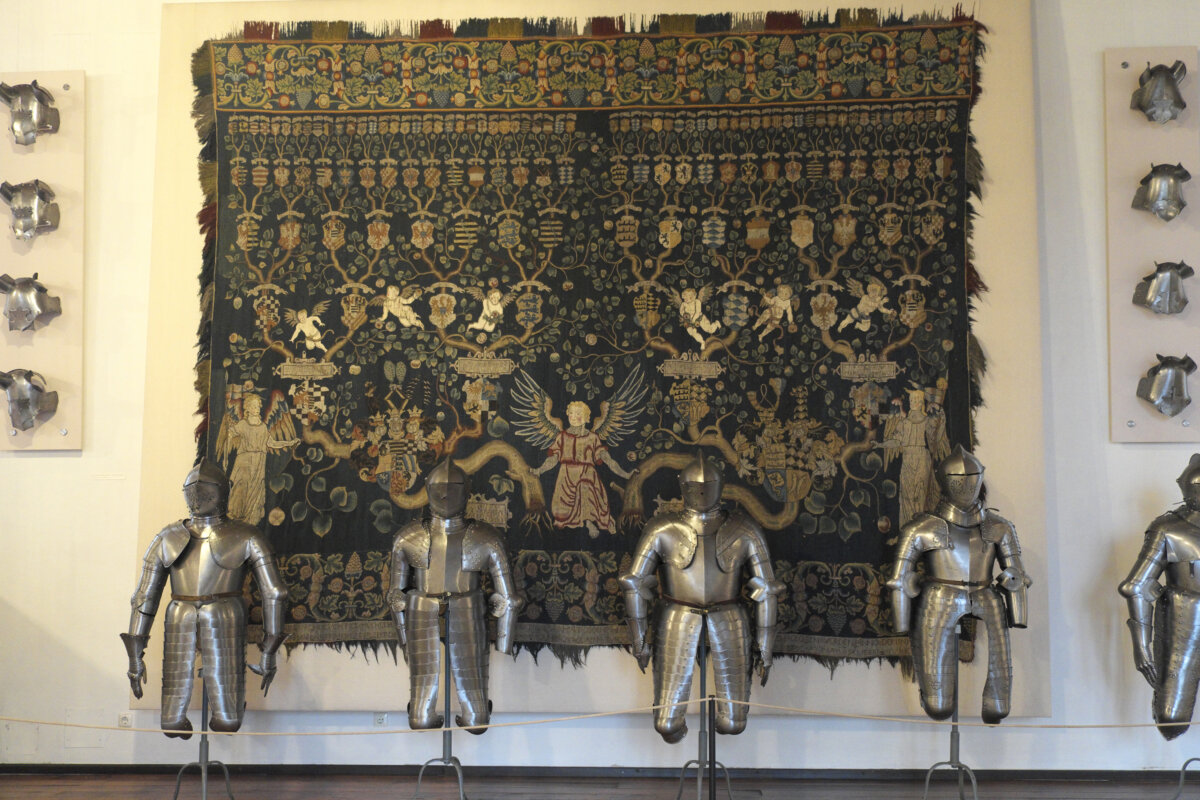
The tower entrance and bridge, where the main drawbridge was once located, are constructed of a vast quantity of stones. Visitors must pass through a triumphal arch decorated with ornate baroque-style sculptures representing military accoutrements such as cannon balls, and lions, which denote strength and divine protection. These flank a classical pediment sporting a crest. To the left of the entrance is one of Veste Coburg’s original structures, which formerly housed its arsenal. (Pecold/Shutterstock) Over the past few hundred years, the facades and interior courtyards of Veste Coburg were renovated to convey less of a fortress-like presence and more of a neo-Gothic one, with Victorian design details. The wall arch provides a nod to the neo-Gothic, while the garret windows in the roof of this residential structure within Veste Coburg are decidedly Victorian in design. (Tors/CC BY-SA 3.0 DE) Veste Coburg’s current, 19th-century-built chapel replaced the original. Its stone-block construction features Gothic-style arch windows, a steep-pitched roof, and loophole (arrow slit) windows. Beside the chapel is an early classic German mortar-and-timber Fachwerkhaus-style dwelling. This building currently houses many museum items. (Harald Lueder/Shutterstock) Referred to as the Hunting Room because of the 60 panels of inlaid wood exhibiting various hunting scenes, this notable area inside Veste Coburg showcases the technique of marquetry, involving wood pieces inlaid and arranged in a pattern. The 17th-century marquetry wall panels coordinate with the equally extravagant, deeply coffered marquetry ceiling that features an octagonal design, as well as the marquetry floor. (Kunstsammlungen der Veste Coburg/ CC-BY-SA-4.0) Veste Coburg served as a refuge in 1530 for Martin Luther, who famously spurred on the Protestant Reformation. In this room, he translated parts of the Bible into German so that laypeople could read it, not just Catholic priests or bishops. The simple table that Luther used is on display in this sparse room, along with an intricately carved headboard. The portrait of Luther that hangs on the wall was painted by 16th-century artist Lucas Cranach the Elder. (Kunstsammlungen der Veste Coburg/ CC-BY-SA-4.0) Inside Veste Coburg is a collection of 16th-century plate armor. The backdrop and wall decor is an expansive tapestry that features religious imagery. Tapestries are one of the oldest forms of textile expression; often, they were constructed with wool thread woven tightly to form a medieval or Renaissance-era scene. (GFreihalter/ CC-BY-SA-4.0)
What arts and culture topics would you like us to cover? Please email ideas or feedback to features@epochtimes.nyc.
A 30-plus-year writer-journalist, Deena C. Bouknight works from her Western North Carolina mountain cottage and has contributed articles on food culture, travel, people, and more to local, regional, national, and international publications. She has written three novels, including the only historical fiction about the East Coast’s worst earthquake. Her website is DeenaBouknightWriting.com