



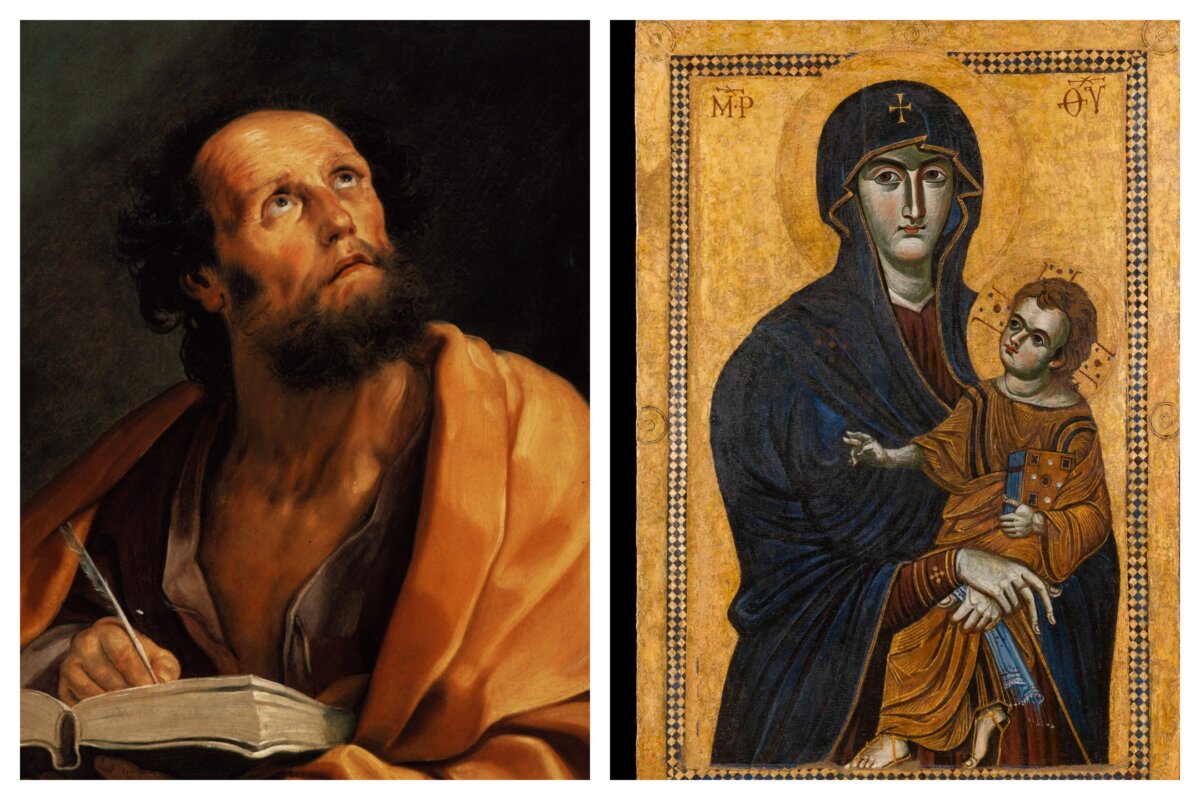
Two things can inhibit us from fully understanding high art. One is that fine art is not meant for easy, simple consumption. We have to learn how to interpret it. Just as a pop song is easier to listen to than a symphony, or just as one would sooner turn to a light novel than an epic poem, higher works require greater understanding and mental effort but yield greater rewards. The other impediment connecting with a work of high art is that we are sometimes put off by the limitations of art itself in depicting its object, particularly when it comes to sacred art.
The feeling of shame in not understanding great works is not a new predicament. In George Eliot’s “Middlemarch,” one of the characters, Dorothea, feels the same sensations on beholding frescoes and paintings in Rome.
She says, “It is painful to be told that anything is very fine and not be able to feel that it is fine — something like being blind, while people talk of the sky.” She adds, “I should be quite willing to enjoy the art here, but there is so much that I don’t know the reason of—so much that seems to me a consecration of ugliness rather than beauty.”
Perhaps many feel the same about sacred art, that it seems a “consecration of ugliness” in depicting the divine. What ought to be portrayals of man’s highest thoughts can seem simplistic or underwhelming. At times, this gap between expectation and reality is due to the artist’s intentional symbolism, and it is always due to the limitations of art itself.
A Not-So-Modern Problem
Renaissance poet Vittoria Colonna spoke to this feeling in her sonnet “Mentre che quanto dentro avea concetto” or “While his Inner understanding […]” (Sonnet 45 in “Sonnets for Michelangelo,” edited by Abigail Brundin).
Colonna was an Italian poet who lived from 1492 to 1547. Her writings often focus on her spirituality. In Sonnet 45, she considers one of the paintings of the Madonna in Rome.
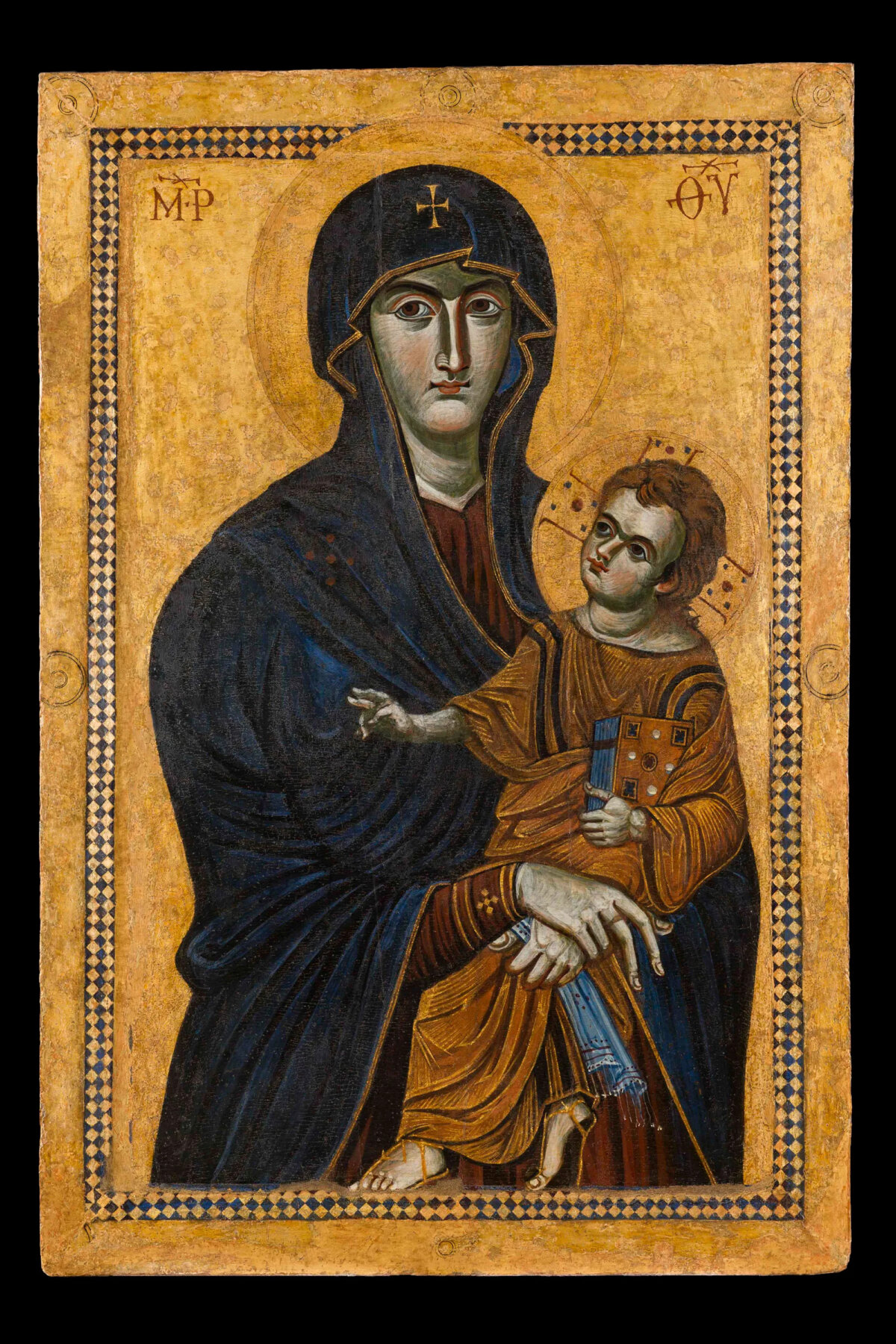
Several paintings in Rome are believed to have been painted by the biblical St. Luke. One of the most famous is the “Salus Populi Romani” in the Basilica of Santa Maria Maggiore. It may have been this work that Colonna had in mind as she wrote the following sonnet:
While his inner understanding of the
mysteries of God conferred nobility upon Luke’s virgin,
he mustered all possible skill
to render true to life that sweet holy countenance,
but his breast was so full of the immensity of
his concept that, like a vase overfilled with water
that cannot easily flow out, the great design
Came forth bit by bit, partial and imperfect.
Some shade of her sweet and grave air was captured,
Yet she is not lifelike, perhaps because he scorned
The polished lights and haughty shades of artifice.
It is enough that her gentle air, her humility,
when we gaze upon it, turns our hearts to God,
Inflames and moves them, cleanses them of gloomy shadows.
In the poet’s eyes, St. Luke’s Madonna appears partial, imperfect, and not lifelike. She who brought the Author of Life into the world seems lifeless. Though God gave St. Luke the artistic inspiration, the idea behind the work was too immense for the artist to fully express. It came forth imperfectly from him, an imperfect vessel.
The vessel, like the vase in Colonna’s metaphor, is perfectly full, just as the artist is completely filled with the idea behind his inspiration—the mystery of the Incarnation. However, though the vessel is full and serves its proper function, it can’t encompass that which fills it. In contrast to the Incarnation, St. Luke was unable to perfectly give material form to his idea. The power to do so belongs exclusively to God.
The artist can therefore capture some aspects of the Madonna, but not her entirety. Moreover, as an artistic choice, her sweetness, gentleness, and humility are shown better in the work’s simplicity than they could be in grand, dramatic hues and shading.
While art is capable of more, the artist didn’t choose to use more. The Madonna isn’t lifelike, but realism wasn’t the artist’s intention. With fewer brushstrokes, the artist is better able to symbolically render spiritual realities. If he were trying to recreate the physical being, greater detail would serve this purpose, but instead he strives to depict the virtues of one who now dwells in heaven.
The image is merely a tangible sign of what it signifies. The image of the “Salus Populi Romani” is not worshiped; rather, it points beyond itself to that which is worshipped according to the faith. Its purpose isn’t to hold us stationary but to conduct us further in our spiritual growth. Ultimately, it “turns” and “moves” our hearts to God.
As Daniel Fliege wrote: (my translation)
“Vittoria Colonna’s conception of art—at least of painting—can thus be described as neoplatonic: given the impossibility of artistically representing the divine mysteries, it is incumbent upon art to redirect the spectator to that which is higher, to the Platonicideal and so to the Christian God: ‘it is enough that … [it] turns our hearts to God’ (vv. 12–13). In other words, art is a means through which the artist expresses the inspiration God confers on him, and the spectator is redirected to the origin of this inspiration, namely God.”
The image is a reflection of divine beauty, and as a mere reflection, it refers the beholder elsewhere—to the higher form of what it tries to depict.
Despite the painting’s imperfections, Colonna notes that it has value in itself beyond what it signifies. The final line shows that the painting has an effect on the beholder beyond just turning one’s sight to something higher. It “inflames” our hearts and “cleanses them of gloomy shadows.” When received properly, art and beauty increase our love and provide the mind with worthy objects of contemplation.
To receive the works well requires humility, the willingness to grapple with the mystery they depict, and an understanding of the purpose behind the artist’s decisions. Colonna, for example, encountered the work of art by sympathizing with the artist’s intentions.
She muses that the reason behind the lack of realism in St. Luke’s painting is “perhaps because he scorned/The polished lights and haughty shades of artifice.”
That we fully understand the mystery in sacred art isn’t only impossible, but also unnecessary and perhaps not even preferable. The mystery is to be entered into, not solved. Through what is beautiful, our minds can be conducted to the contemplation of truth and goodness.
What arts and culture topics would you like us to cover? Please email ideas or feedback to features@epochtimes.nyc
