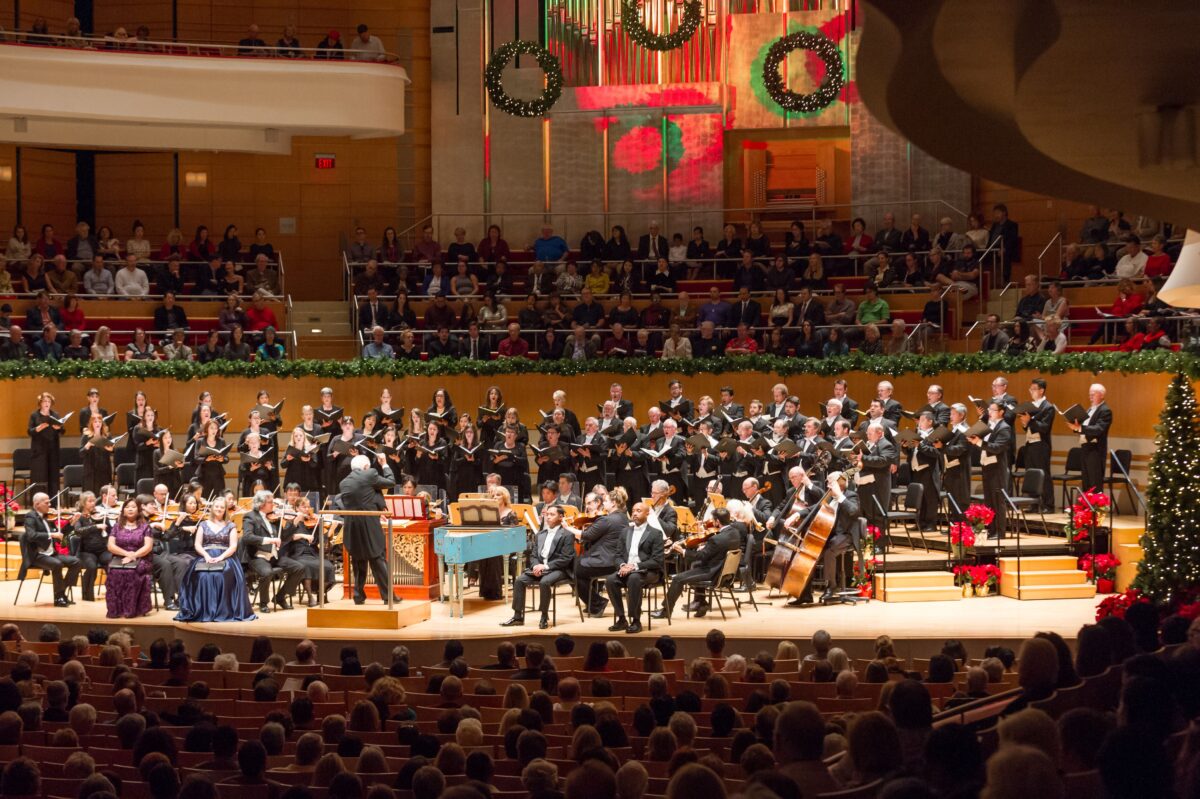
The great Russian poet Apollon Maikov admonishes us to “listen with all your soul.” He wanted us to know the secrets nature might tell through the sounds of the wind, the forest, and the sea. But listening to great music promises even more: the “revelation higher than all wisdom and philosophy” that Beethoven spoke of.
In Handel’s time, listening with all one’s soul was a simpler matter than it is today. To hear a large orchestra and chorus was a great and rare occasion; his public heard “The Messiah” and deeply believed the words “Hallelujah! For the Lord God Omnipotent Reigneth.” People knew that another performance wouldn’t take place for months, or even years. What they heard was different from what we hear, for they listened with Bach and Vivaldi in their minds, while we have the additional sounds of Brahms and Tchaikovsky in ours.
Circumstances alter how we listen. Most certainly, Berliners on March 28, 1945, heard Beethoven’s violin concerto as never before; their great city, their great culture, lay in ruins, and a vengeful Russian army approached just miles away. One wonders what that music meant to them, sitting in a miraculously preserved concert hall with no heat and no light but that coming from the music stands. The room was packed, the applause overwhelming, and the audience members were offered cyanide capsules from little baskets as they left the theater. My very dear friend (and publicist) Alix Williamson was there.
The significance of “The Great Gate”: It stands for Russia, its culture, and its religion. What deeper meaning must Mussorgsky’s “The Great Gate of Kiev” have assumed when, in Carnegie Hall, the audience rose to its feet at the announcement of a Russian victory at Stalingrad, the turning point of World War II? A significance formerly quiescent in these pieces was thrust to the surface of the mind and the heart.
A Loud World

Whatever Maikov thought the soul might be, it faces formidable distractions today. Virtually all music is available to us at all times; we can listen again and again, daily, hourly, if we choose, to whatever we choose. Perhaps this ability has diminished our inclination—even our ability—to listen as attentively, as reverently, as in the past.
Our attitude toward classical music has taken on a more congenial, more informal tone. Now, recordings make it possible to invite Brahms and Schubert as guests in our house; it’s a domestic affair rather than a public celebration of like-minded people. Respect of the masters is compromised by such an easy domesticity. In a recent review, a critic said he listened to Richard Strauss’s “Four Last Songs” while in his bathtub. Likely, the words “and my soul, unobserved, will float about on untrammeled wings in the enchanted circle of the night” lost some of their power in that setting. Perhaps when the Vienna Philharmonic is playing, listeners should sit up and forego all other activities, whether it be bathing, sweeping the floor, or having dinner.
Hearing the best moments of Tchaikovsky, Puccini, and Mozart in movie soundtracks, television comedies and soap operas, or commercials for automobiles and eyeliners has set barriers between us and these sublime works. These may be part of the reason that even the greatest masterpieces have become music to be talked over.
A sports event bears witness to this. Sound engineers arranged for the last movement of Beethoven’s “Ninth Symphony” to be performed on television with an orchestra in Europe and a chorus in Japan—a symbol of brotherhood, one supposes. Yet as I watched, I heard voices converse over the music: “Isn’t it great, Janet? Europe and Japan making music together!” “Yeah, Bob, this is really exciting; what a great event!” A win for technology, perhaps, but this exemplifies how the announcers, educated and smooth-tongued as they were, heard Beethoven.
The abundance of the musical feast that technology offers subjects a music lover to the temptation of gluttony. We have heard Verdi’s operas, Bach’s cantatas, Beethoven’s symphonies 100 times more often than any music lover of their times. Does all this listening expand our understanding and move us more deeply? Or have our excesses perhaps stifled their sounds and dulled their significance? How much can a mind metabolize or assimilate before it becomes satiated, turning to fat rather than muscle, leaving one jaded and stupefied?
Reclaiming the Sublime
Listening to music any old time, promiscuously, indiscriminately, erases the line between the sublime and the banal. Consider our holiday’s musical fare: Bach’s “Easter Oratorio” and Irving Berlin’s “Easter Parade,” or “O Magnum Mysterium” and “Have Yourself a Merry Little Christmas.” There is a story of a poor young boy buying a classic in a bookstore. The merchant tries to interest him in a fashionable best-seller, but the boy tells him: “I am poor. I can only afford the best.” Life is short. Better to spend our hours wisely—only on the best.
Long before the advent of recordings, American society was undergoing a dramatic change. Our Pilgrim Fathers and our transcendentalists were slowly ushered aside to make way for our capitalists. “Getting and spending” have become the “raison d’etre” of the mighty as well as the humble, leaving little room for ideals and for the ultimate questions such as “Why am I here?” and “How should I live?”
Serious music, which, after all, is about ideals and the great questions, began to fall on disinterested ears. Concert attendance began to decline. In the mid-20th century, musicologist Sigmund Spaeth offered a prognosis and cure. The corruption of ideals did not enter the picture; poor education was the problem. The solution was to have the young memorize themes by setting them to nursery rhymes and to teach them that music was “fun.” One of his popular books, “Fun With Music,” suggests that the best approach to our musical canon is to trivialize it—a poor alternative to listening with all one’s soul.

The exodus of the public from concert halls and the inattention of its remnants were partially mitigated by publicity and promotion that focused on the beauty of the most recent international prize winner and his or her astonishing technical abilities; poetry became a secondary issue. The attractive musical athlete who can sprint to the double bar of the fast passage in the shortest time has deafened many a listener to whatever music the laureate might be playing.
There are new obstacles for those born after the internet and the smartphone. These younger people have entered a new world in which a screen seems more real than the life going on around it. Scientists tell us that the young suffer from an inability to exert prolonged mental effort—a reduced attention span. Constant notifications and multitasking make it impossible to concentrate on a single idea and constantly prompt the mind to look for distractions. These new-world citizens hear music in an altered, fragmented way. Their attention is too truncated to grasp the broad phrase of a Bruckner symphony, to hold it in the palm of their hands and see it whole from the first note to the last.
Even in a hallowed venue such as Carnegie Hall on one recent evening, cellphones were so active and whispering so incessant that in the middle of a song the distinguished tenor Jonas Kaufmann signaled the accompanist to stop. He said to the crowd, “I want to give you everything, but please, you must play by the rules.” One wonders what those listless people were hearing during the recital they were, in truth, not attending.
With great music, there is no compromise. Much is required of the listener: abstinence from the junk music of pop culture; listening only to what one considers the best; listening only when one can pay full attention; and skepticism of performers who are a little too rich and glamorous.
Ultimately, these requirements are ethical. “Listen with all your soul.” If you cannot, it is best not to listen at all.
What arts and culture topics would you like us to cover? Please email ideas or feedback to features@epochtimes.nyc
A previous version of this article misspelled the name of Jonas Kaufmann. The Epoch Times regrets the error.