
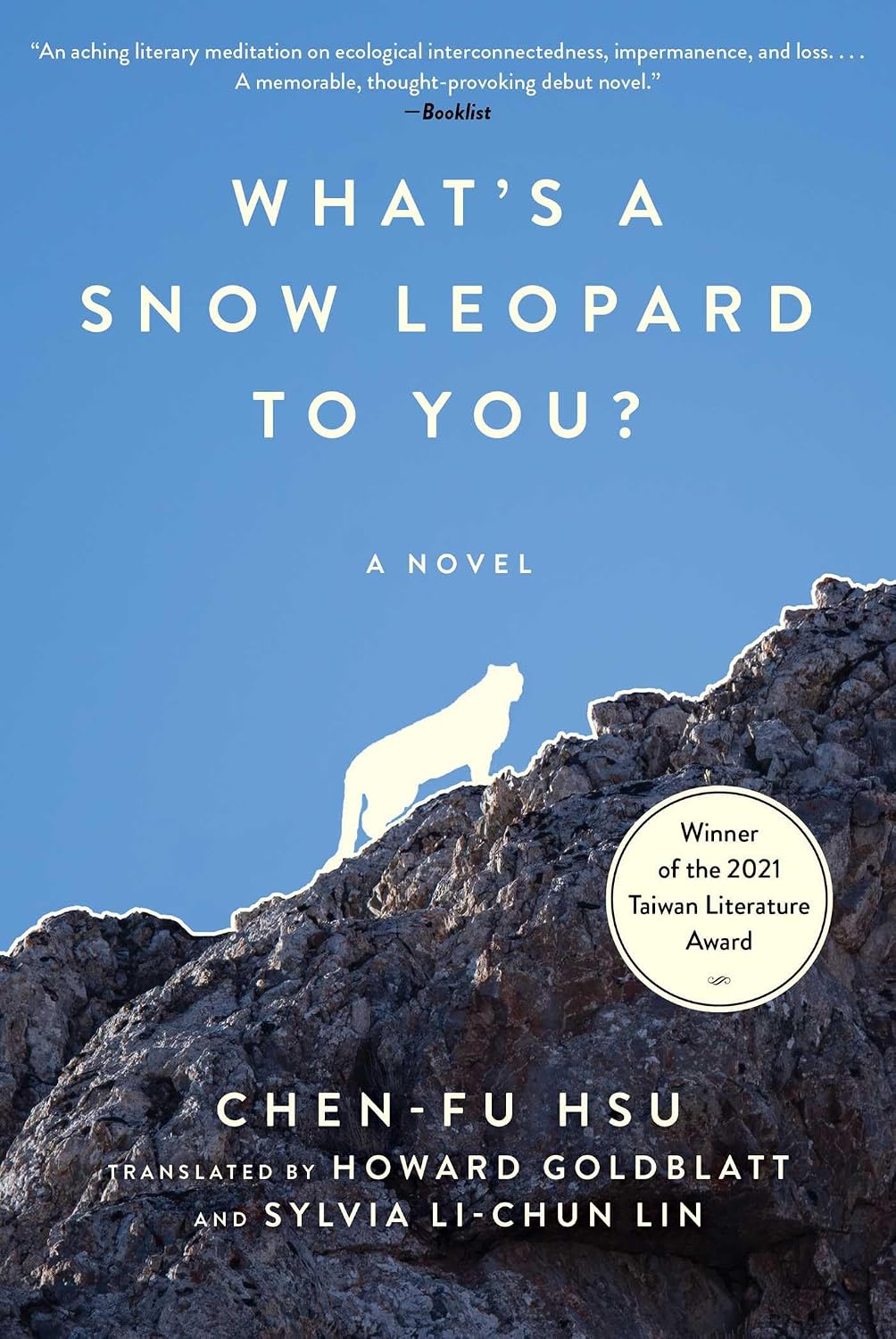
Contemporary Taiwanese literature is a rare commodity in the American book market, which makes the upcoming publication of Chen-Fu Hsu’s 2021 novel “What’s a Snow Leopard to You?” an exciting arrival.
Focused on Tibet today, the book offers a profound meditation on the preservation of traditions amid a politically and environmentally challenging landscape.
Hsu’s work is also enchanting in its ability to plumb a sense of wonder and even humor in the least likely of settings. The author achieves a remarkable feat. He presents a work that’s user-friendly and complex at the same time, resulting in a story that entertains and provokes the reader.
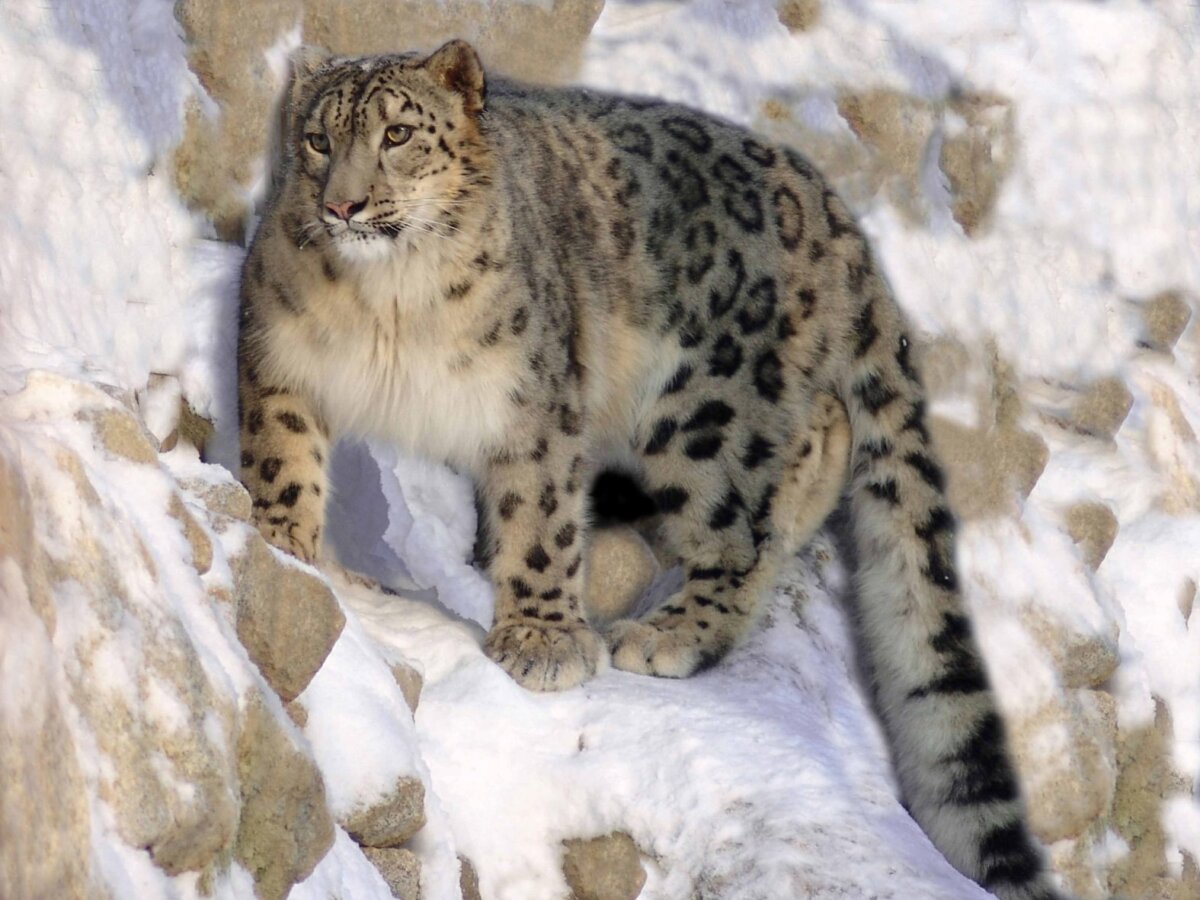
A Shadowy Presence
The book’s narrator is an unnamed Taiwanese naturalist who embarks on several research journeys into Tibet. His initial trip involves the pursuit of the snow leopard, the most mysterious animal of the region. The Tibetans he encounters have either experienced very brief sightings of a snow leopard or are only aware of its presence from stories passed down by previous generations.
The book’s early chapters detail the sense of frustration experienced by the narrator. His repeated attempts to locate the snow leopard come to naught, although he’s close to his quarry. At one point, a fresh coat of snow betrays the great feline’s paw prints from just minutes earlier. The narrator is excited to realize that the snow leopard was so close and might have been watching him.
Shortly afterward, the narrator encounters a sheep herder, who asks if he saw a snow leopard. The narrator didn’t; with a twinge of jealousy, he silently hopes that the herder also didn’t see the animal. However, the herder observed a snow leopard emerge into the open for a few seconds, which gives the narrator no sense of pleasure.
Initially, it’s easy to fear that Hsu’s work will devolve into a Himalayan version of the reality TV show “Finding Bigfoot,” with its endless chase after a significantly elusive creature that never comes into unfettered view.
Nevertheless, as the book progresses, the narrator’s quest for the snow leopard slowly gives way to an appreciation of the wider ecosystem surrounding him and the Tibetan culture that quietly thrives in this setting.
He initially invests a good deal of time searching for something that isn’t in clear sight. Then, the narrator belatedly realizes how he’s missed the human and ecological drama that surrounds him.
The Chinese Occupation
During the narrator’s travels, he’s confronted by train inspectors. They confiscate several of his books because they deal with Chinese human rights abuses in Tibet. The inspectors allow him to keep a Japanese-language book; he describes this as “Taming Sheep” by Udagawa Ekai, a Zen monk who traveled through Tibet in the post-World War II years.
Ekai’s long-lost journal bears witness to the turmoil created by the Chinese occupation in the 1950s through the terror of the Cultural Revolution, recording its horrors with cogent eloquence.
Hsu alternates between the narrator’s view of the Tibet he encounters and passages from the fictional monk’s work. The result is a sharp juxtaposition. Readers learn of the brutality of the Mao Era’s Communist Chinese assault on the Tibetan culture, alongside the subtle yet vigorous efforts by the Tibetan people to maintain their heritage amid the pressures forced on them by the Beijing machine.
Truly Remarkable Writing
There are several passages within “What’s a Snow Leopard to You?” where Hsu’s vivid sense of surroundings creates jolting emotions. Perhaps the best sequence has the narrator driving a too-old “microvan” that breaks down on an isolated road just as an evening snowstorm is unfolding.
Racing against time and weather to fix the vehicle, he realizes that the radiator is damaged. He improvises a solution by driving in short spurts for a few minutes and then stopping to refill the radiator from his mineral water bottles. The resulting sequences are both harrowing and perversely funny.
Another memorable passage is a villager’s recollection from several decades earlier of the capture of an elderly and injured snow leopard. The animal was brought to the village bound and bleeding, with the people standing in shock as it quietly suffered before them.
“The leopard’s innocent, childlike eyes moved from one stunned face to the next, blinking painfully at each one, seemingly on the verge of tears,” Hsu writes.
The author’s attention to detail is as sharp as his often unexpected wit. Consider this exchange between a café owner and a customer: “She handed him a plate of sliced beef and two steaming bowls of noodle soup, and he thanked her in a way that could have meant several things.”
“What’s a Snow Leopard to You?” encompasses the full range of the Tibetan experience. The religious traditions, the ecosystem, the arts, and the food of the Tibetans are vividly described, taking the book far beyond mere travelogue observations into a richly immersive odyssey.
Perhaps the most remarkable aspect of this book is realizing that Hsu is a first-time author. If a novel as rich and compelling as this can be created as a debut presentation, one can hardly imagine what memorable future works Hsu will produce.
‘What’s a Snow Leopard to You?: A Novel’
By Chen-Fu Hsu, translated by Howard Goldblatt and Sylvia Li-chun Lin
Arcade: Sept. 22, 2026
Hardcover, 288 pages
What arts and culture topics would you like us to cover? Please email ideas or feedback to features@epochtimes.nyc.