




Frequent travelers have all heard it before: That city is a beautiful, wonderful place filled with magnificent treasures, but don’t venture into that neighborhood. Especially after dark.
This kind of advice is entirely well-intentioned and has certainly kept me out of trouble in many situations. But here’s the thing: I’ve found some of my very best travel tales on the “wrong” side of the tracks. How can we balance this?
The first thing is to heed local advice. Those folks are rarely wrong. There are ways to explore the city’s vibrant core without taking excessive risks. Here are a few stories from the road—and tips I’ve learned along the way.
Go on a Tour
This is, by far, the very best way to experience areas that would be otherwise more or less inaccessible to non-locals. For example, if you’ve been to the legendary coastal city of Rio de Janeiro, the same insight is proffered over and over. That is, stay on the main tourist beaches—those stretches of South American sand that are even celebrated in song (hum along with me)—and Sugarloaf and Corcovado.
But the favelas? Those low-income residential districts that climb away from the sea on steep streets? You’re told to never, ever venture there.
“You can get shot for just walking the streets as a stranger, as an unknown dude in that part of town,” one guy told me, rather gravely. It’s true that drugs and violence and all those bad things can be a reality in these districts.
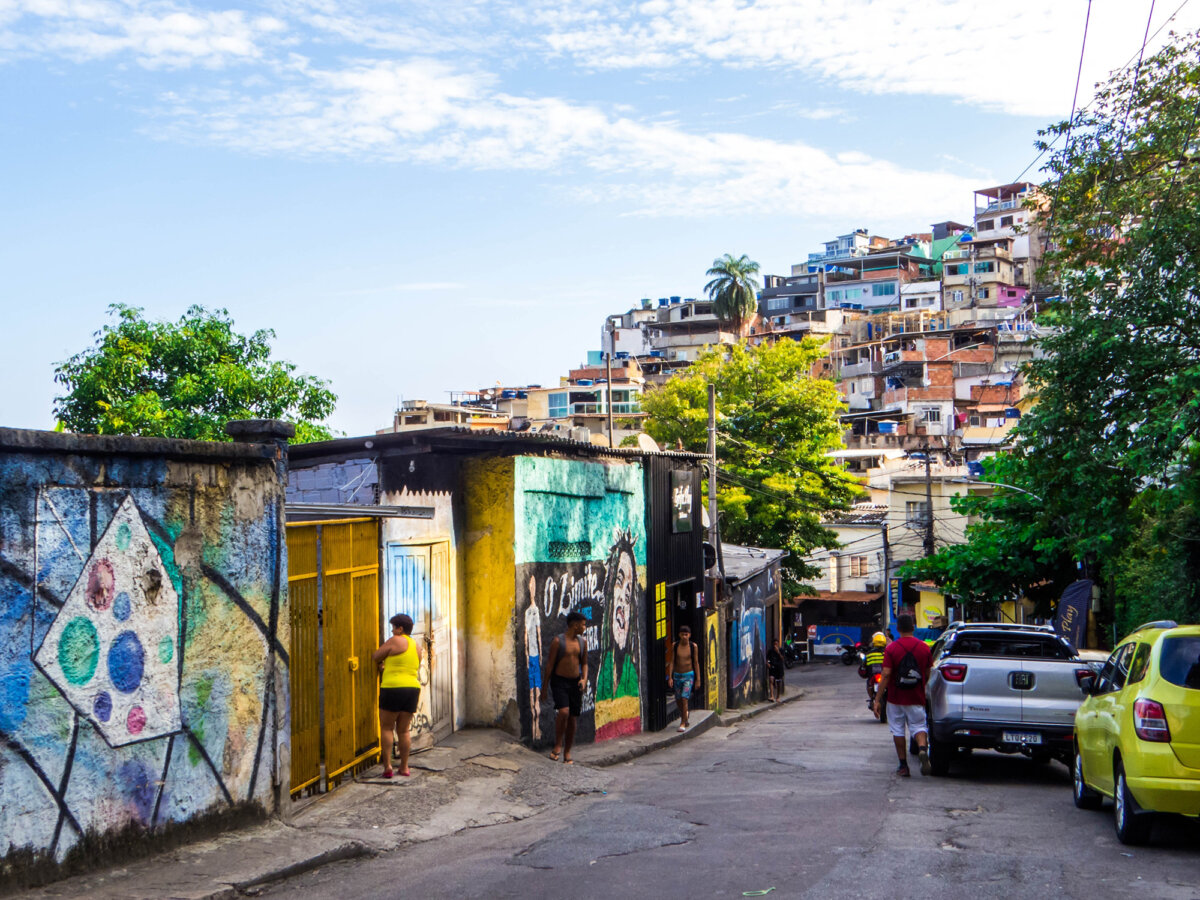
But you should still go—and I did. It’s an opportunity to catch a glimpse into the everyday lives of real Cariocas. This is the place where they live, work, eat, and sleep. After all, what’s the point of travel if not to truly experience a culture at ground level, in its truest form?
Still, be careful. My tour was small, fewer than 10 people, and was led by a local who had grown up in that particular favela and seemed to know literally everyone we encountered. So, through her, we chatted with shopkeepers and laborers and the lady selling fruit on the corner. We learned a lot about Rio that would’ve remained hidden if we’d just stuck with the hordes of tourists at Christ the Redeemer (which you should visit, too).
Take Commonsense Precautions
People often tell you that if you’re headed to the far side of the tracks, don’t wear any flashy bling or carry a thick wallet in your back pocket.
Now, I don’t own a single piece of jewelry (watch or otherwise) worth stealing. But still, if I have plans to venture somewhere a little dodgy, I’ll pocket my phone, some cash, and the minimal amount of ID and cards possible, usually just an ATM card and a single credit card. The reasoning is, the less you carry, the fewer things there are to have stolen (or in my case, lose) along the way.

Order a Taxi (or an Uber)
You won’t find many cities more magnificent than Cape Town, South Africa. Its skyline is backdropped by the rise of Table Mountain, which is particularly scenic when the summit isn’t obscured by the infamous “tablecloth,” a thin layer of cloud. It also features cove after cove of white, sandy beaches lapped by the cold, blue waters of the South Atlantic.
But after dark, in the wrong place, this dreamy place can turn into a nightmare. While staying in an upscale hotel near the waterfront, I consulted the concierge about two gin bars I was planning to visit that night. They were only a few blocks apart—a five-minute stroll, 10 at most.
I could walk it, right?
“No,” he said. He shook his head emphatically. But, I objected, I feel a little weak hopping in a cab to ride just a minute or two.
“You’ll feel even weaker when a guy holds a knife to your throat and takes all your money,” he responded.
Needless to say, I took the advice. The ride cost less than $1. I made sure to have the first bar call a trusted driver to take me to the second. Both establishments were fabulous. I returned to the hotel safe and sound with a hearty “thank you” to the concierge.

Trust the Locals
For most travelers, Manila—the sprawling capital of the Philippines—is just a way station en route to the paradise beaches of Palawan and Boracay and so many other islands. But Manila, with its distinct districts each boasting their own identity and a pretty cool, walled old town, is definitely worth exploring.
Except for, you know, the neighborhood I accidentally found myself walking around one night. It was years ago, long before eSIMs and easy roaming and Google Maps. I’d disembarked a commuter train at the wrong stop but didn’t realize that I was in the wrong place until I was thoroughly lost. Just from the looks in the eyes of passersby, this was not a good spot for an outsider to be wandering around at night.

Even in dangerous neighborhoods, most of the people aren’t trying to rob or otherwise harm you. And in this case, the residents banded together to help. One woman walked me over to another who spoke better English. That woman led me to a bicycle taxi that, for reasons I’ll never understand, was shaped like an orange. The driver pedaled me to the closest pay phone, which happened to be outside a McDonald’s. And I called the hotel for a pickup. It took a village of friendly local residents to help me, and I’ll never forget it.
Don’t (Always) Believe the Hype
“Sir, are you taking a picture of us?!” the man exclaimed as he rushed toward me. The sun had long set and night was well underway in the historic Egyptian metropolis of Alexandria. Venturing out after dark in a Middle Eastern city is something that many would call risky. But snapping photos of the slices of life I encountered along the way—men drinking tea and watching a black-and-white television in a little open room in a back alley or a little kid riding a pony at a bright little family fun fair—is maybe even riskier.
As it turned out, both were perfectly safe. The man who rushed over, asking about the photo, just wanted to make sure that I got a good shot. And the guys watching TV invited me in for a cup of tea. They didn’t speak English, and I knew exactly one word of Arabic, so it was a brief encounter.
“Shukran,” I said, setting down my cup and making my exit. The men nodded back warmly. It was a slightly strange encounter, but a nice little chance to hang with real Egyptians, doing what they do on a Saturday night in the back lanes of an ancient city.
