



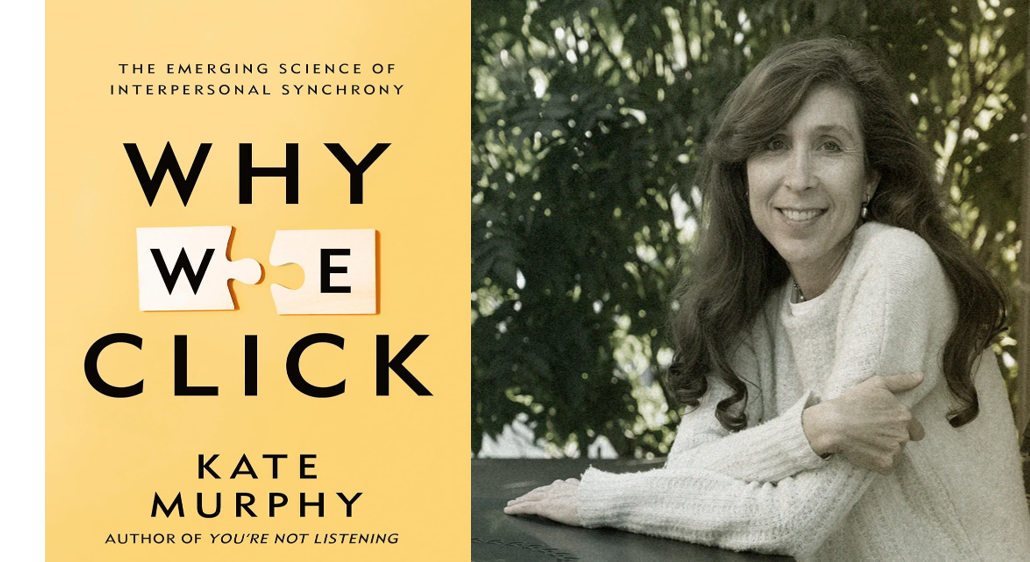
Readers will enjoy the fascinating insights into human nature in “Why We Click: The Emerging Science of Interpersonal Synchrony.” Specifically, why do we find it easy to connect with some people, but nearly impossible to do so with others?
Though she’s not a scientist or academic researcher, author Kate Murphy’s background in journalism has given her the ability to unpack and interpret complex ideas from the fields of psychology, neuroscience, and social science.
She enjoyed great success with her first book, the bestselling 2020 “You’re Not Listening.” It examines how people rarely listen anymore and the negative impact that has on relationships. It became required reading in interpersonal communication courses in high schools and colleges worldwide.
Murphy breaks down the scientific phrase, “interpersonal synchrony,” defining it as the almost magical way humans experience an immediate chemistry with certain people. It’s an unconscious act, she wrote, “to fall into rhythm with one another.”

Not only do facial expressions and gestures move in sync, but so do emotions, moods, and attitudes. Albert Einstein had a famous way of expressing this phenomenon, calling it “spooky action at a distance,” when it was really “subatomic particles behaving as one.”
Syncing Together
Those that sync together can do great things together. This theory explains why like-minded people find greater success in a team dynamic than working alone. We see it in functioning governments, cultures, and companies.
With poetic elegance, Murphy writes, “We are all tuning forks roaming the planet, picking up vibes and finding resonance with those we encounter.” She uses the example of two of her neighbors. One was cheerful and made everyone smile in their interactions, and the other had a more powerful intensity “even when talking about the weather.” This made others avoid her, some by hiding in their house, or ducking behind bushes. “It felt too much like work,” which was how one neighbor described it.
Every social interaction creates a rhythm and, when it works, there’s a release of the pleasure hormones, oxytocin and dopamine. When it doesn’t, people will assume more closed positions, like crossing their arms. When they leave the person, they may feel more tense and fatigued. “You’re basically,” Murphy explains, “swimming against the tide of your physiology.”
Decreasing Opportunities
Social media and door delivery apps decrease opportunities for connection. When a lack of synchrony occurs on a regular basis, it can trigger social isolation and loneliness. It can also make us ill, both physically and emotionally.
While the excessive use of social media and online activity has been to blame, that’s just part of the problem. We’re lessening our interaction with others in our “frictionless economy,” like when ordering a cup of coffee through an app rather than having a conversation with the barista.
Murphy uses historical context to make a point about how quickly the body can decide whether there’s chemistry or not. In the chapter titled “Love at First Sync,” she discusses the findings that “it takes less than thirty seconds for both men and women to decide whether they are interested in another person.”
She then segues into speed dating rituals from a century ago where eligible bachelors in high society made formal visits to the homes of women of marrying age, staying no more than five minutes. This was considered a reasonable time to decide if an official date would be forthcoming. In the 1990s, a Jewish rabbi re-introduced the speed dating idea to his members, but upped the meeting time to 10 minutes.
Dating Apps in Decline
With lots of humor, Murphy shows that we don’t have to take everything about dating so seriously. Dating apps have lost much of their appeal since 2022 as members weren’t “feeling it” online and increasingly exaggerating their profiles. While the app may think two are a perfect match, their eventual in-person meetup can turn disastrous, Murphy says, leaving the daters wishing they’d stayed home to watch Netflix.
In another area of human interaction, the COVID-19 pandemic revealed our desire and preference for face-to-face communication. Because of the lockdown, meetings and social events were held via Zoom, or other video platforms. Consequently, the term “zoom fatigue” became a new complaint.
Murphy explains the social signals absent during these meetings. They caused stress on the brain and made users feel unusually tired or uneasy. On a lighter note, the desire to add emojis in texts comes from our longing to include some sort of facial element to the conversation.
Speaking of facial elements, there’s a marked change in how we communicate with those who have had any kind of facial cosmetic procedure like fillers or facelifts. Because the person with the procedure’s facial expression cues are diminished, it leaves the other person “unsettled and uncomfortable” without knowing why.
Murphy’s book is a lighthearted take on an all-too-common human experience. The chapter titles are casual, which makes this read less like a textbook and more like an enjoyable bedside companion.
Some readers who prefer more statistic-heavy prose may find Murphy’s approach lacking. She does explain that, in some areas, more behavioral research is needed; there isn’t an answer for every conundrum she’s encountered. But readers will be informed, entertained, and perhaps leave them wanting to know more.
There are plenty of conversation starters for book clubs, classrooms, or family dinner tables. Readers can become more aware of how they interact with others, and use what Murphy has outlined to improve and maybe even repair relationships.
This is more than simply a book to educate. Murphy has done a remarkable job at bringing clarity to an issue that has been ignored or misunderstood in a time when many are looking for more connection.
It’s fascinating that people subconsciously mirror and facially react to others with movements and expressions. People pick up the speech patterns, posture, and tone of voice of others. It’s like an invisible dance going on between partners.
For those in love, or parents with their newborns, it’s said their two hearts beat like one. Conversely, when there isn’t an immediate connection with someone, people can chalk it up as a problem with the rhythm, and not anyone’s fault.
Murphy may have created another manual for understanding the world and how we unconsciously communicate with each other. It’s not a new concept.
In a blog she paraphrases the Greek philosopher Plato who said that “what we are really seeking are those whose internal rhythms harmonize with our own—the people with whom we effortlessly click.”
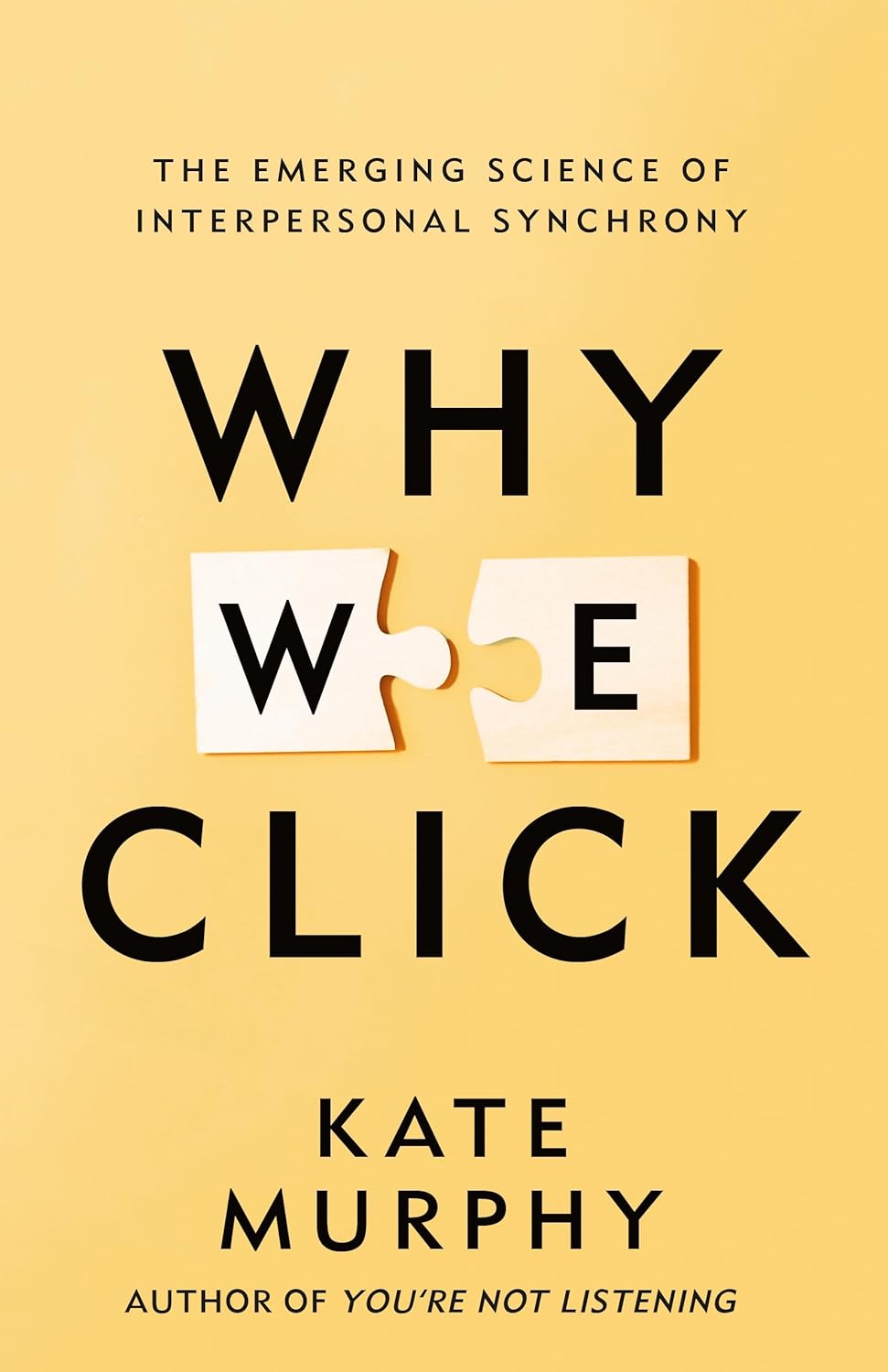
‘Why We Click: The Emerging Science of Interpersonal Synchrony’
By Kate Murphy
Celadon Books, Jan. 27, 2026
Hardcover, 320 pages
What arts and culture topics would you like us to cover? Please email ideas or feedback to features@epochtimes.nyc
