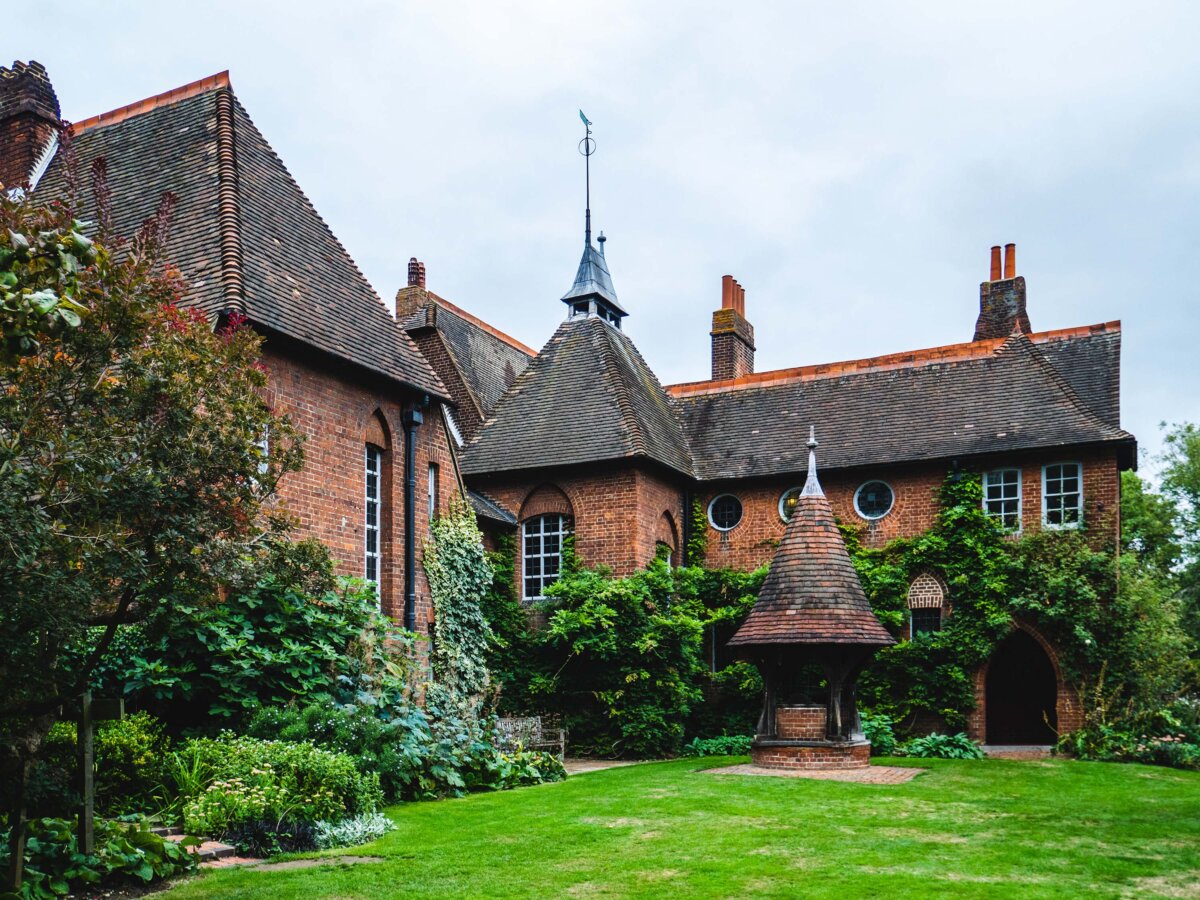
It’s hard to escape William Morris, whose dynamic botanical patterns have been commercially sold for over 160 years and show up on everything from bedding to phone cases. His influential designs began with wallpaper and eventually extended into textiles through his firm, Morris, Marshall, Faulkner & Co., which focused on traditional, handcrafted work. The firm eventually became Morris & Co. What few know is that these designs were inspired in part by his countryside home, sitting on an orchard and meadow.
Completed in 1860, Red House, so named for its red brick, was built for Morris and his new wife, Jane, who wanted a country retreat close enough to central London for commuting while still offering refuge from city life. At a time when Victorian buildings often favored elaborate decoration, Red House offered something refreshingly different.
The architect Philip Webb, a close friend of Morris’s, constructed Red House as a practical yet picturesque home. Rooms were arranged around the needs of everyday domestic life rather than a rigid formal plan, giving the home its distinctive asymmetrical layout. Stained glass by Edward Burne-Jones, embroidery by Jane Morris and Elizabeth Burden, and an array of furniture, textiles, and murals filled the rooms. In 2013, conservation work even revealed a hidden Pre-Raphaelite wall painting in the master bedroom.
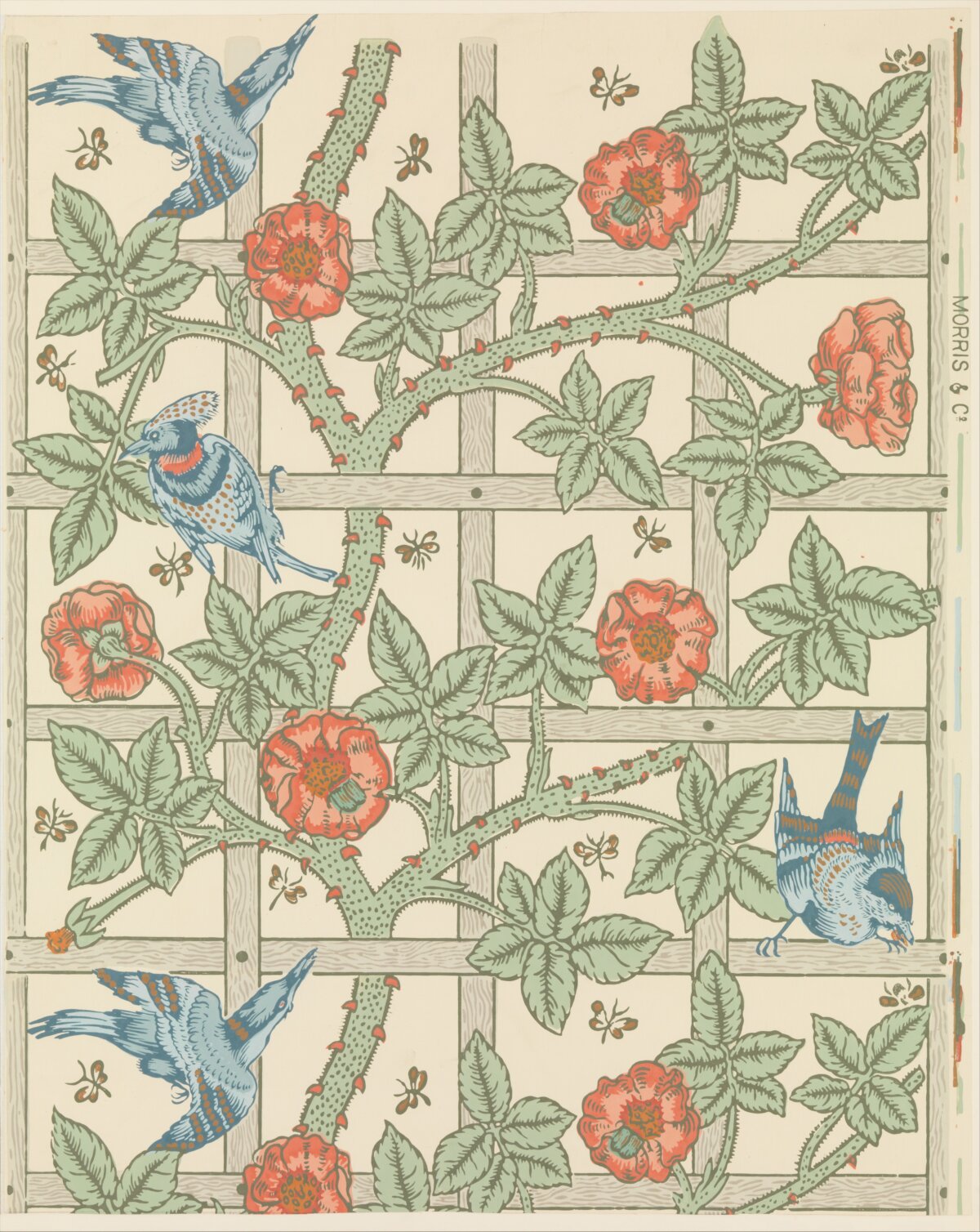
Red House was also a gathering place for Morris and fellow Pre-Raphaelites, including Burne-Jones and Dante Gabriel Rossetti, whose collaboration there embodied Morris’s belief that architecture, furniture, and decoration should work together rather than be mass-produced separately. The National Trust, Europe’s predominant conservation charity, suggests that early Morris & Co. patterns, like Trellis, were probably inspired by the garden at Red House. Although Morris lived at Red House only a few years, its influence outlasted its original purpose as a family home.
Today, Red House remains one of Britain’s most significant examples of 19th-century architecture, preserved as a Grade I-listed landmark by the National Trust. A Grade I listing designates a building or structure of exceptional architectural or historic interest in the UK, the highest level of heritage protection, reserved for only about 2.5 percent of all listed buildings. Visitors can experience the house as both a historic home and an artistic environment, with many original features, from stained glass to decorative artwork, still intact. More than that, Red House stands as a lasting symbol of the Arts and Crafts movement, its rejection of industrial production, and its embrace of human craftsmanship, proof yet again that Morris’s presence is everywhere.


What arts and culture topics would you like us to cover? Please email ideas or feedback to features@epochtimes.nyc.