



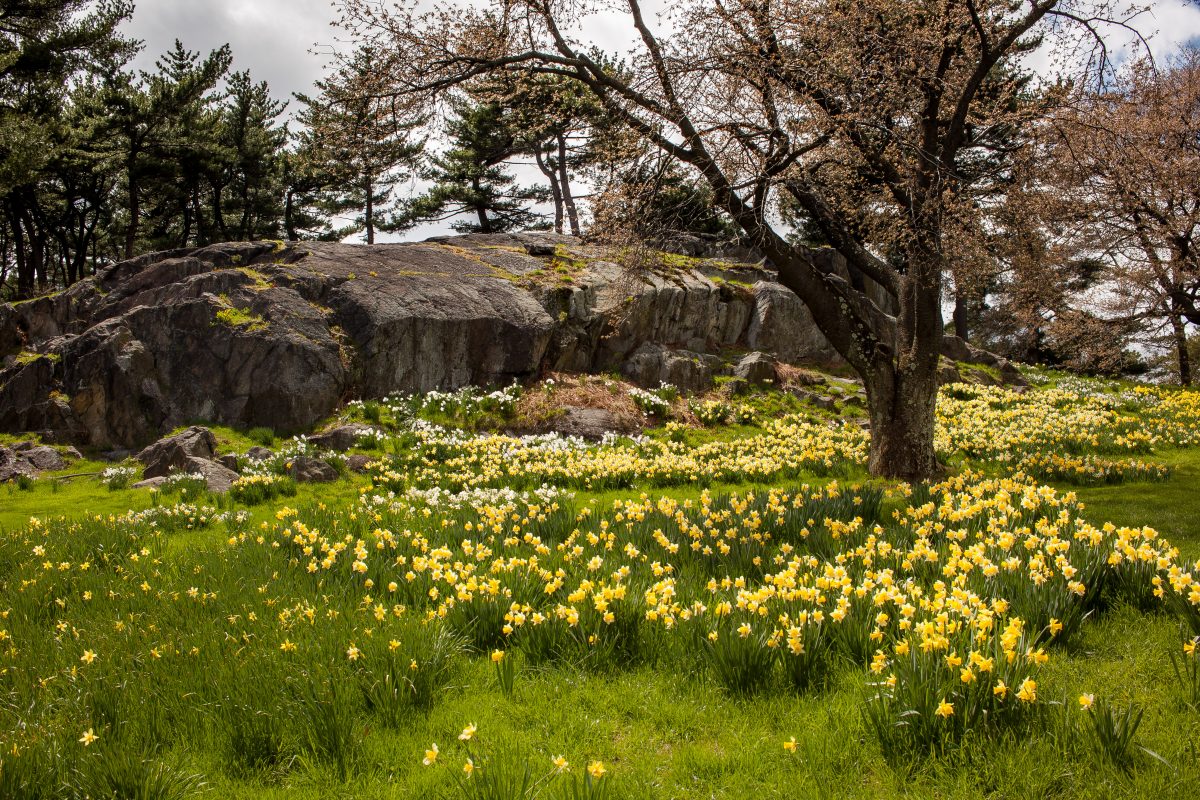
I wandered lonely as a cloud
That floats on high o’er vales and hills,
When all at once I saw a crowd,
A host, of golden daffodils;
Beside the lake, beneath the trees,
Fluttering and dancing in the breeze.
Continuous as the stars that shine
And twinkle on the milky way,
They stretched in never-ending line
Along the margin of a bay:
Ten thousand saw I at a glance,
Tossing their heads in sprightly dance.
The waves beside them danced; but they
Out-did the sparkling waves in glee:
A poet could not but be gay,
In such a jocund company:
I gazed—and gazed—but little thought
What wealth the show to me had brought:
For oft, when on my couch I lie
In vacant or in pensive mood,
They flash upon that inward eye
Which is the bliss of solitude;
And then my heart with pleasure fills,
And dances with the daffodils.
Daffodils are a type of flower known as spring ephemerals. True to this description, they usually bloom for about six to eight weeks—the first to flower in the spring and then to die back to dormancy by early to mid-summer.
The poets, however, felt differently. William Wordsworth (1770–1850) noted an eternal quality to the golden trumpets that herald spring’s arrival. At a cursory glance, his poem “I Wandered Lonely as a Cloud” is a simple expression of delight in their beauty. However, it actually contains a profound reflection on the relationship between beauty and memory.
Wordsworth is considered the father of English Romanticism. The Romantics responded to the Enlightenment idea that only verifiable things are true and that knowledge requires practical demonstration. Materialism, the belief that everything we know or experience has its cause and explanation in physical matter and the laws governing it, became increasingly influential.
 Portrait of William Wordsworth, 1798, by William Shuter. (Public Domain)
In contrast, the Romantics sought a return to a spiritual apprehension of the world. They posited that imagination allows people to grasp the whole of a thing, including invisible realities. They also considered memory a source of knowledge and happiness. The antidote to rational dehumanization and the overstimulation of modern life was to focus on the ordinary and return to closeness with nature. Instead of believing that all things were knowable through reason, the Romantics believed that the sublime in nature couldn’t be encompassed by the human mind; it was simply a mystery to be entered into.
In “I Wandered Lonely as a Cloud,” Wordsworth infuses novelty and a sense of wonder into the commonplace daffodil. In their multitude, the daffodils no longer seem small and fleeting but instead assume a majesty comparable to stars or the sea. The speaker is arrested by the sublimity of the sight. Rather than giving it a glance of passing admiration, he beholds it: He “gazed—and gazed,” bestowing on it particular care and attention that indicates not only emotional impact but also intellectual receptivity.
However, even with this intense observation, the speaker says he had “little thought/ What wealth the show to me had brought.” The point of the poet’s deepest pleasure in the poem isn’t when he’s before the daffodils, but rather when he recollects them in the “bliss of solitude.”
The initial beauty the speaker observed leads to the revelation of truth over time through contemplation. In his 1800 essay “Preface to Lyrical Ballads,” Wordsworth wrote:
“Poetry is the spontaneous overflow of powerful feelings: it takes its origin from emotion recollected in tranquility: the emotion is contemplated till, by a species of reaction, the tranquillity gradually disappears, and an emotion, kindred to that which was before the subject of contemplation, is gradually produced, and does itself actually exist in the mind.”
Poetry isn’t simply the immediate feeling written down; instead, the original feeling is mediated through contemplation after the initial encounter with beauty. Similarly, the speaker recalls the daffodils’ beauty in tranquil solitude and contemplates them until that tranquility gives way to powerful emotion: “And then my heart with pleasure fills/ And dances with the daffodils.”
Twice in the poem, the daffodils’ beauty breaks through a bleak emotional state and proves transformative. At the poem’s start, they interrupt the speaker’s lonely wanderings and arrest him, filling the emptiness encapsulated by the image of a solitary cloud in the sky. In the final stanza, they break upon the placidity of the speaker’s vacant or pensive mood and move his heart to pleasure and dancing. The transformative power of beauty differentiates it from mere prettiness.
Moreover, Wordsworth’s poem highlights how beauty always includes an element of shock or surprise. In its encounter with beauty, the soul is startled into wonder and wants to learn more and enter into mystery. In this way, beauty doesn’t produce a passing admiration but rather elevates the mind to continued contemplation.
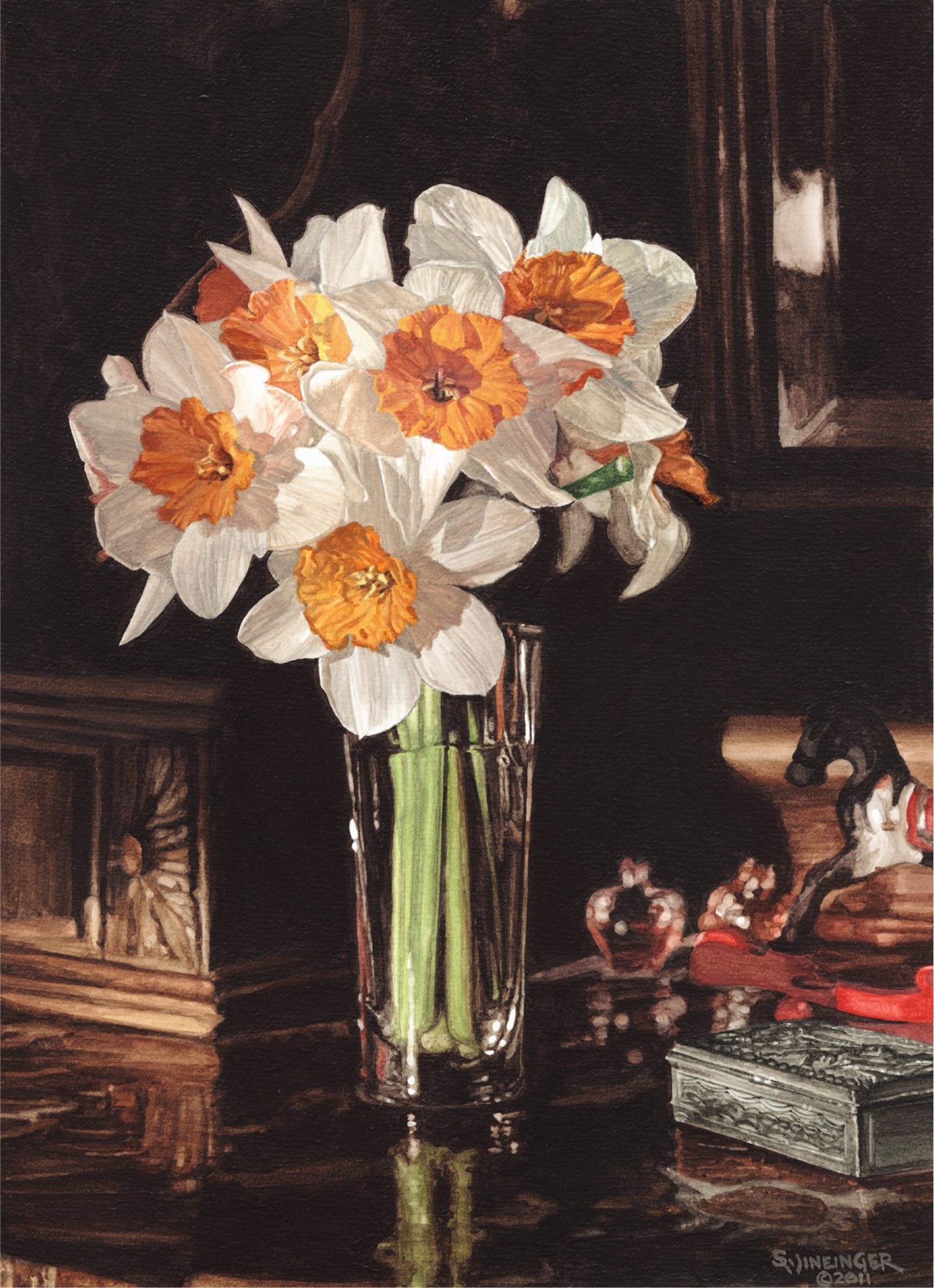 “Morning Sun and Narcissus,” 2011, by Steve Wineinger. Watercolor on cold pressed paper; 20 inches by 14 1/2 inches. (Steve Wineinger)
Beauty sticks, knocking insistently upon the door of memory. It encourages the beholder to grow in understanding over time. Lindsey Brigham Knott observed that for the Romantics, “Memory makes truth by synthesizing one’s outward observations and inward perceptions.” She added that they believed “memory facilitates virtue by evoking an atmosphere or inclination towards goodness in the soul.”
Though the physical eye perceives beauty first, it’s when “inward eye” beholds it that the speaker comes to a fuller comprehension of spiritual realities.
It’s the very vastness of the field of daffodils as compared to the speaker that startles him so suddenly out of his lonely reverie. The immensity of the scene, not a single daffodil, makes a lingering impression in the speaker’s mind. The humility inspired by the scene’s sublimity predisposes his mind to wonderment. Its beauty impresses upon him his own stature in the cosmos, inspiring him to contemplate spiritual realities and enter into mystery.
Like the buried bulb that stores nutrients and grows a roots system over the winter, beauty plants itself in the memory and accumulates new layers of meaning, maturing over time.
What arts and culture topics would you like us to cover? Please email ideas or feedback to features@epochtimes.nyc
