



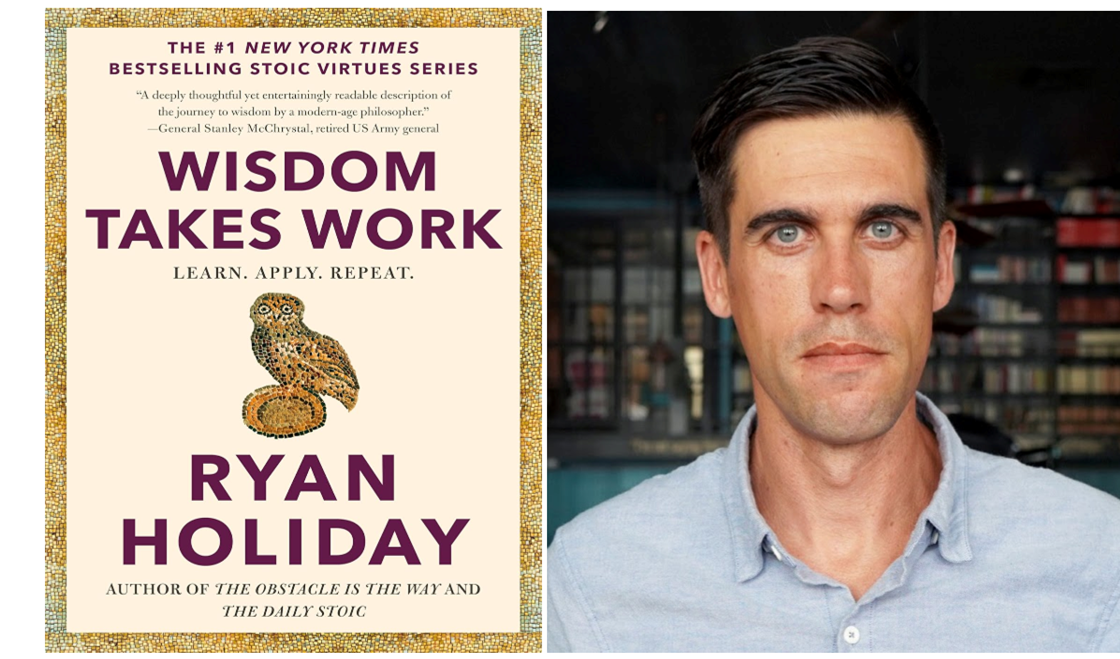
“Wisdom is not a product of schooling but of the lifelong attempt to acquire it,” said Albert Einstein. Though not often attained, wisdom is something to pursue because it can give us, according to Ryan Holiday, the ability to “see what’s in front of us with clarity.”
This is what the author Holiday wants readers to come away with in “Wisdom Takes Work.” If there was any time to be discussing the path to wisdom, it’s now. We’re headed into a new year, which traditionally offers the opportunity to make positive changes. Holiday—bestselling author, philosopher, and student of ancient wisdom—shows us how.
“Wisdom Takes Work” is the fourth in the Stoic Virtues Series and Holiday’s blueprint for sharpening our approach to becoming wiser by the choices we make at work, at play, or at any other time.
The funny thing is, it’s not new material. His advice is culled from the writings of ancient philosophers like Socrates and Marcus Aurelius, who believed that living with courage, justice, temperance, and wisdom “is the door to the good life.”
Orville and Wilbur
There’s a lot going on in this book. Holiday uses fascinating stories from the past and makes them relatable to today’s audience. He breaks wisdom down into the following qualities: “knowledge, education, truth, self-reflection, and peace.”
Readers will see how the decisions made in these stories either forged wisdom or aggravated the situation. They will see the rewards of living a virtuous life. This may help them consider making wiser choices when faced with temptations or obstacles.

In the chapter “Be Curious,” Orville and Wilbur Wright’s father brought home a stick, some rubber bands, and two propellers. His intent was to have them exercise their curiosity. Nothing more. But in the following years, the two achieved a place in history, not for monetary rewards but to satisfy their motivation for discovery.
Since the boys were raised in a house of books of all kinds, by authors such as John Milton and Mark Twain, reading was an important family activity. The boys credited their success to their upbringing and their father’s encouragement to pursue knowledge for knowledge’s sake.
Empathy
In the chapter titled “Practice Empathy,” the author shows how that quality was exercised by Abraham Lincoln and the animal advocate and professor Temple Grandin. For Lincoln, it was through his work as a lawyer that he honed the skill of understanding his opponent’s side. That came in handy as a politician.
During the Civil War, while he detested slavery, he nevertheless worked to understand the stance held by slave owners. In the chapter, we read, “He understood their guilt, their fear.” Lincoln tried to consider their perspective. He considered the other side as well: what it might be like to be owned by another person. Though he never stepped foot in either world, he needed to see their points of view.
Empathy is caring about how others experience their unique worlds. While it was one of Lincoln’s greatest qualities, it didn’t come naturally. It also won’t come naturally to those who wish to incorporate the skill into their own lives.
Grandin’s empathy for animals is well known. That skill prompted her to investigate why animals in local livestock facilities were overly stressed.
By taking pictures to see what the cows experienced, she made changes to improve their lives. She saw that “something as simple as a hose on the ground, or a shadow [might] seem terrifying to them.” It was by putting herself into their experiences that made all the difference.
Another chapter that should resonate with readers is “Watch Your Information Diet.” Holiday considers the constant barrage of news and information we hear throughout our day as “a recipe for losing your mind.”
It takes wisdom to discern what to allow in to reach us. What’s important is being more selective about what we read and where the information comes from.
In these stories, Holiday says wisdom isn’t something that appears naturally with age or status. It’s a deliberate process that’s earned day by day, and year by year, from the choices we make. It’s “a by-product of doing the right thing in the right way at the right time.”
Worth the Effort
This book isn’t Holiday’s first foray into philosophy. He’s authored an impressive roster of books that cover variations on this theme, including some on ego and discipline, and others with daily meditations on wisdom and perseverance.
His biography notes his own journey of self-education, and these books are the realization of that research.
There’s little flourish or embellishment. His chapters are concise and focused; the stories are powerful and their lessons clear.
Wisdom isn’t achieved overnight. It’s not easy. There’s no quick fix or shortcut. It’s about making deliberate and sometimes tough choices to live more thoughtfully with integrity and take responsibility for our actions. It’s built on work performed over time.
The book has many strengths besides the invitation to better our lives. The author uses the examples of others to inspire us. There’s no preaching or moralizing. It invites readers to consider alternative ways to look at the world and the events that come before us.
Little applause will come when wise decisions are made, but the ability to shape an honorable life takes precedence over public acknowledgement. Acquiring wisdom may feel like a futile exercise. As Holiday writes, “We can get wiser, but never wise.” Even so, Holiday emphasizes that “wisdom is worth it.”
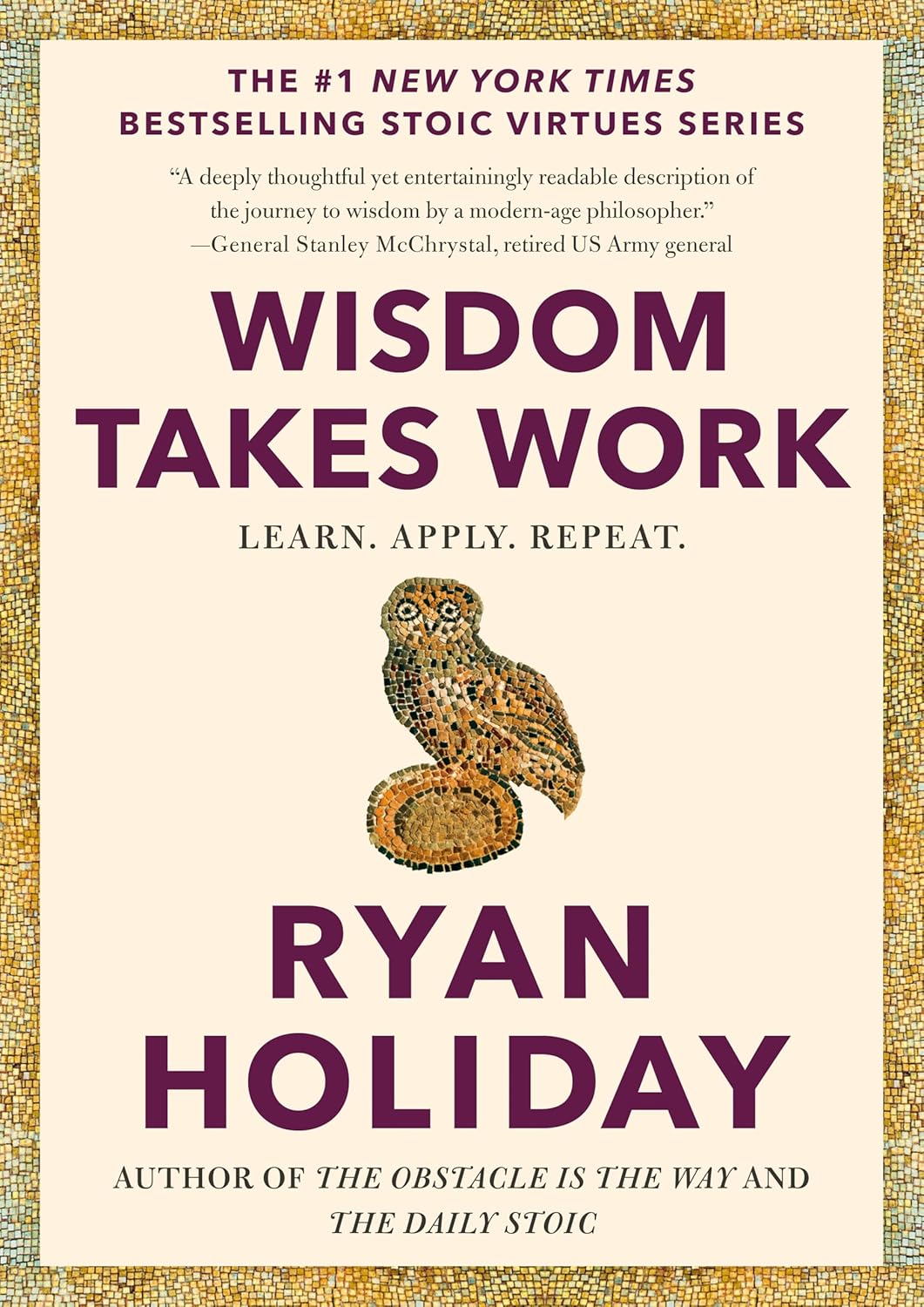
‘Wisdom Takes Work: Learn. Apply. Repeat.’
By Ryan Holiday
Portfolio: Oct. 21, 2025
Hardcover, 400 pages
What arts and culture topics would you like us to cover? Please email ideas or feedback to features@epochtimes.nyc
