



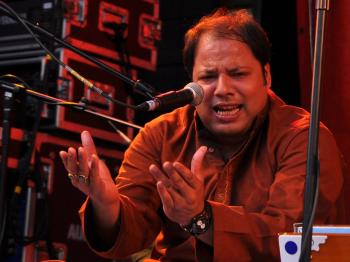
Epoch Times (ET): How do you find it following in the footsteps of your uncle, the late great Nusrat Fateh Ali Khan?
Rizwan-Muazzam Qawwali (RMQ): It is not easy. We must take the tradition and maintain the reputation of the family name.
We cannot change the music because it is traditional and set. The music is as it is. We must keep the music and keep the tradition.
ET: Is there any element of adding to the tradition?
RMQ: Yes. We must maintain the tradition, and the spiritual elements must meet the original format, but on certain songs we can incorporate more contemporary lyrics, though it will still sound traditional. Some songs are more spiritual, others less so. But the original compositions never change.
ET: Is there any improvisation?
RMQ: Yes. There is classical improvisation based on Raga, which is the classical notation and the traditional form in which you sing.
ET: Can you please explain the origins of Qawwali music?
RMQ: Qawwali music originates with the Sufi mystics of Islam, about 1,000 years ago in the Gulf States. It was used as a medium to convey Islam, to carry this message of peace and love. It incorporated elements from other countries as it travelled to the Indian sub-continent.
ET: What language do you sing in?
RMQ: Urdu, Punjab and Parsi.
ET: What role does the audience play?
RMQ: Of course, we play may different patterns and tempos, and the audience responds. We always get a good response, but we are aware when the response is better, and that in turn influences us.
ET: Do you like it when the audience dances?
RMQ: Of course, because that shows that they are enjoying it.
ET: How many people are there on stage?
RMQ: Ten. The two singers, two harmonium players, one tabla player, and five handclapping backing singers. The two main singers lead and everybody else follows.
