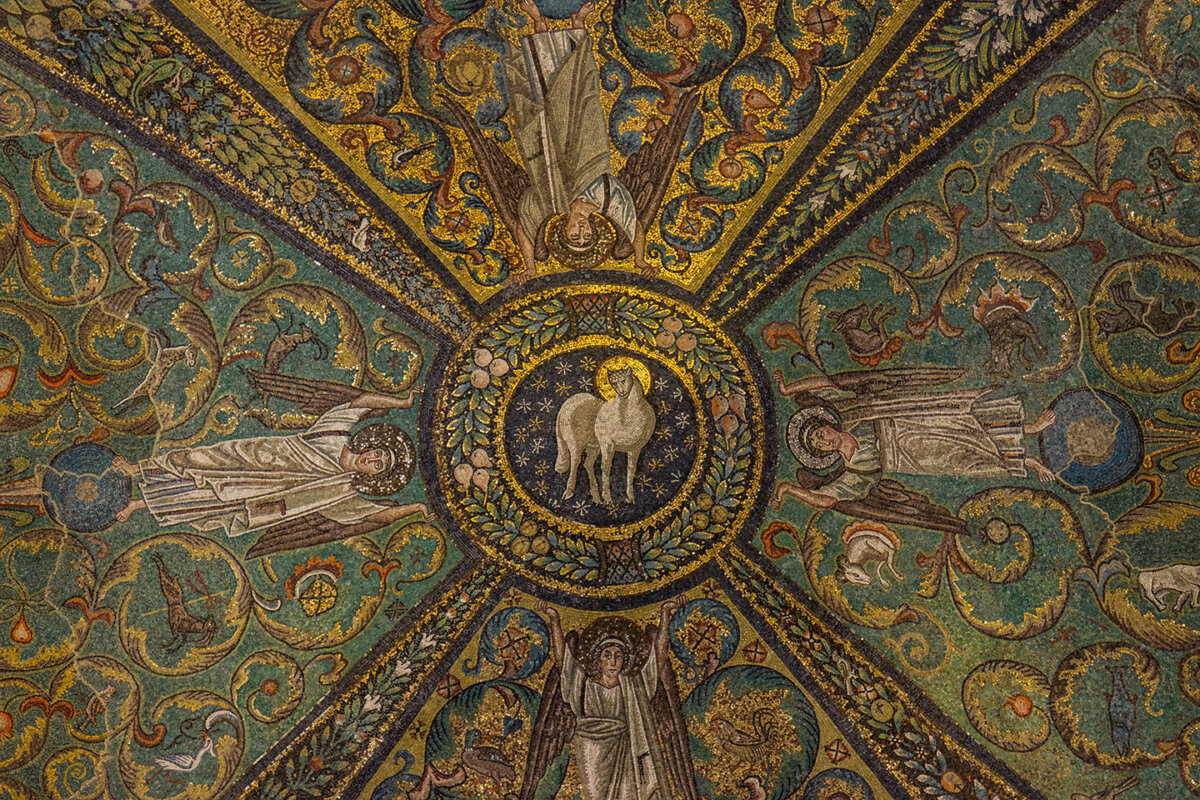
Upon seeing Jesus, John the Baptist declared, “Behold the Lamb of God who takes away the sin of the world” (John 1:29). Christian art often uses a lamb to depict Christ.
An early example of this is in the dome of the presbytery at the Basilica of San Vitale in Ravenna, Italy. The splendid mosaic ornamentation there converges on a depiction of the Lamb of God. Vivid festoons of leaves, flowers, rams, stags, fruit, birds, and stars animate the cross-ribbed vault and the tesserae gleams as if radiating light. The four angels support the central crown of figs encircling the Lamb of God. Rendered in the Hellenistic Roman style, the mosaics at San Vitale are dynamic and richly colorful, an embodiment of the jeweled style of late antiquity.
Zurbarán’s ‘Agnus Dei’
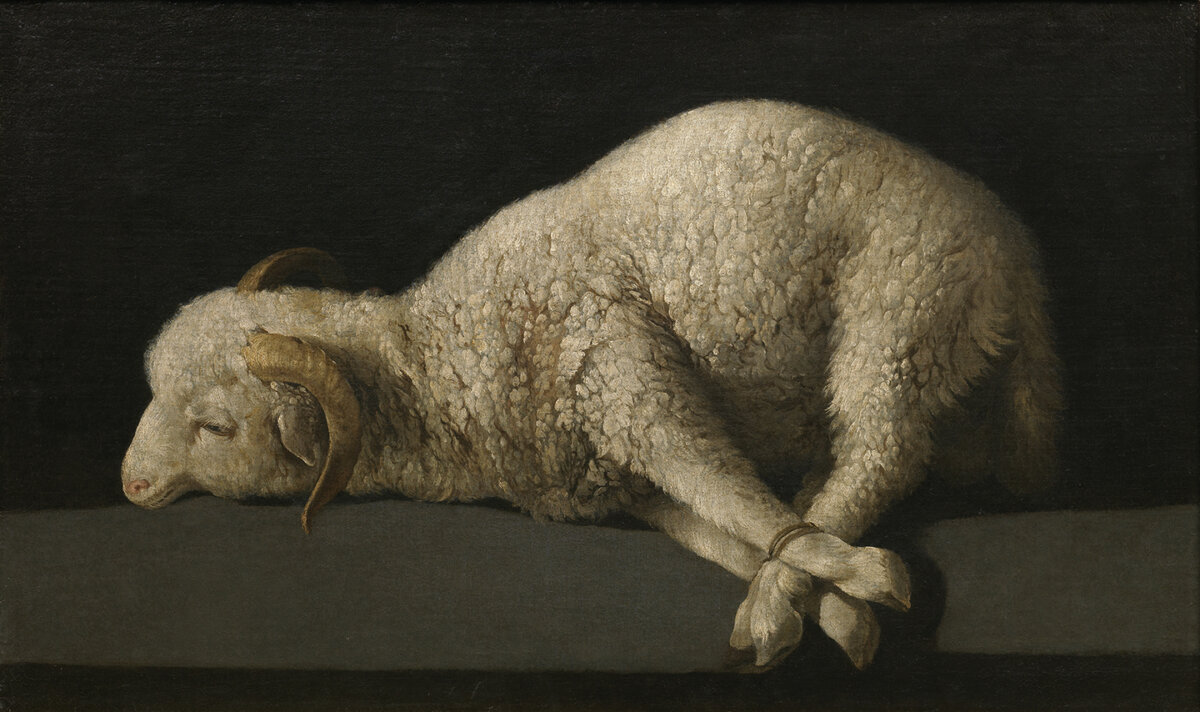
“Agnus Dei,” Latin for “Lamb of God,” is the name of one of the rites used in the Catholic Mass and the classical Western liturgies of Lutheran and Anglican churches.
Francisco de Zurbarán, a Spanish oil painter known for his still lifes and for his religious portrayals of martyrs, nuns, and monks, blended the two genres in his 1635–1640 painting “Agnus Dei.” Nicknamed the “Spanish Caravaggio” for his convincing use of chiaroscuro (an artistic technique characterized by pronounced contrasts between shadow and light), Zurbarán capitalized on this approach to create a composition striking in its starkness.
Between 8 months old and 12 months old, the merino lamb lies meekly with his feet bound in rope, receiving his fate without protest. His eyes are softly downcast, his gaze engrossed in another realm. Zurbarán rendered the textures in meticulous detail, from the lamb’s fleecy wool coat to his white eyelashes and moist pink nose. Yielding gently to his destiny, the lamb is undoubtedly associated with Christ, who was victoriously resurrected after quietly suffering on the cross.
The Sacrifice of St. Cecilia
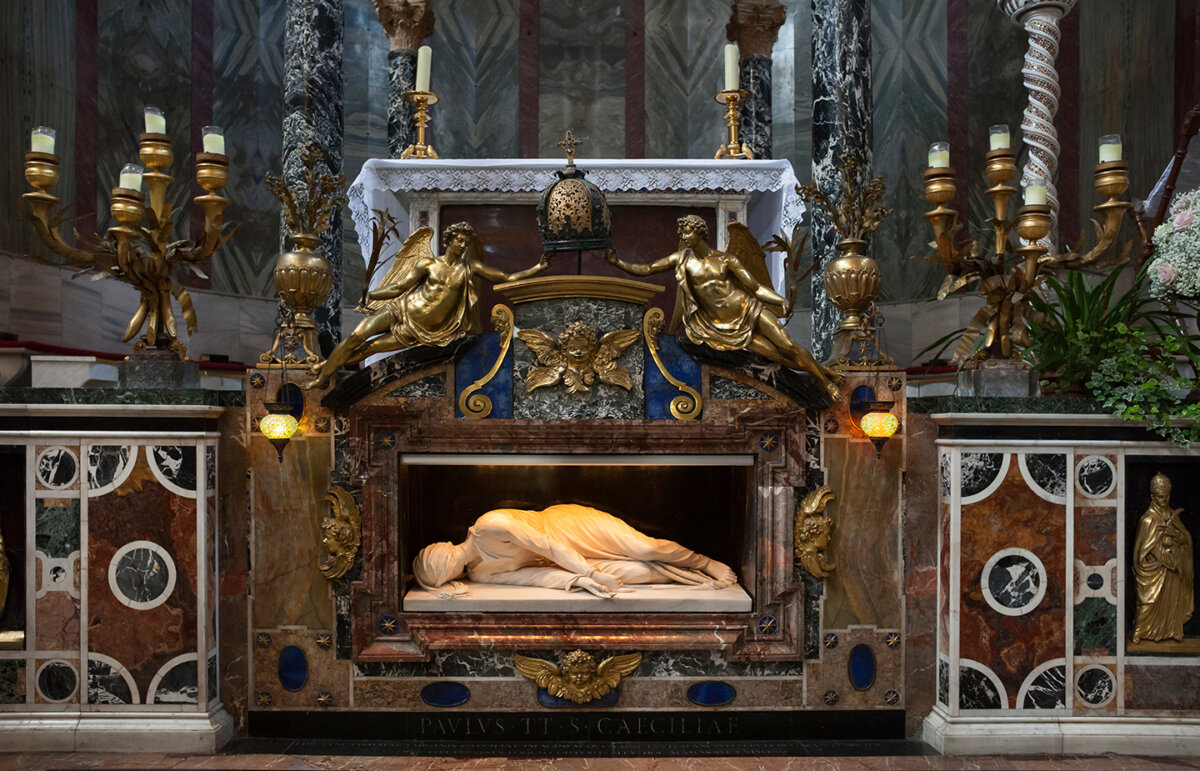
Born in Italy in 1576, Stefano Maderno is best known for his marble sculpture of St. Cecilia. A distinct resemblance exists between the compliant gesture of Zurbarán’s lamb and the sacrificial posture of the martyred saint.
St. Cecilia was a Roman virgin martyr for Christianity, a patroness of musicians and music. She was executed for baptizing her fellow Romans. Her image lives on as a symbol of sacrifice, the divine power of music, and the vanquishing of hatred in the face of persecution. At her forced wedding, according to one account, she “sang in her heart to the Lord.”
Maderno, a master sculptor of 17th-century Rome in the time before Bernini, depicted St. Cecilia after her execution in a marble rendition that is as tragically moving as it is peacefully beautiful. He took inspiration for her pose from the saint’s incorruptible flesh (nondecaying), which was revealed when her tomb was opened in 1599, after centuries of entombment in the catacombs.
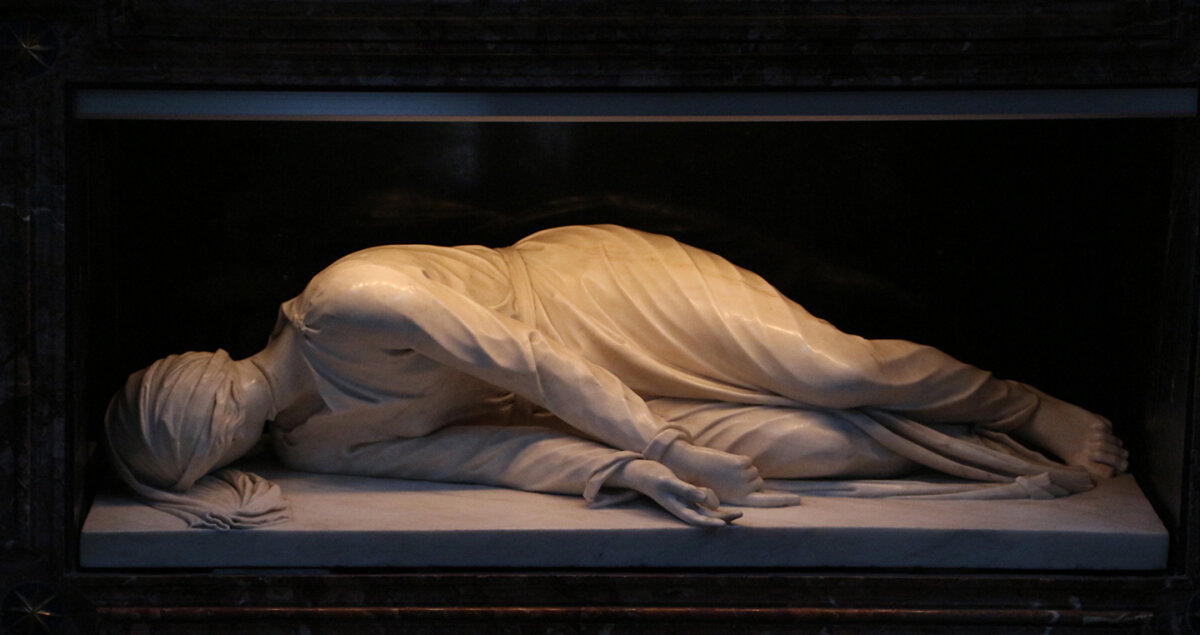
Lying on her right side, she extends her three right fingers and her left index finger, affirming the Trinity even in eternal slumber. With her face turned down toward the earth, the deep gashes the executioner left on the back of her neck are fully visible. Despite these extensive wounds at the time of her execution, St. Cecilia lived for three days before passing away.
In front of the sculpture at the basilica of St. Cecilia in the Trastevere neighborhood of Rome, is an inscription by Cardinal Paolo Emilio Sfondrati, who commissioned the sculpture: “Gaze upon the likeness of Cecilia, which I saw myself lying in an entire state in the sepulcher. I had this same likeness, precisely in the same position her body lay, expressed for you in marble.”
With the sacrificial gesture of martyred St. Cecilia compressed into the posture of the merino lamb in Zurbarán’s “Agnus Dei,” the oil painting gains another level of symbolic significance.
Sacrificial Lamb

Inspired by Zurbarán’s “Agnus Dei,” Josefa de Óbidos, a Portuguese painter born in Spain, created her own rendition of the theme in her painting “The Sacrificial Lamb” from 1670 to 1684. Originally a native of Seville, Spain, Óbidos was deeply influenced by artists in her hometown, including Diego Velázquez, Bartolomé Esteban Murillo, and Zurbarán.
One of the only female artists working in Portugal and Spain in the 17th century, most of her oeuvre consists of portraits and still lifes, subjects considered suitable for women painters.
Óbidos’s handling of paint was less sensitive than Zurbarán’s. She created a starker contrast between light and dark that flattened the composition rather than adding dimensionality. However, the allusion to “Agnus Dei” is unmistakable. Set upon the same gray slab and against the same black backdrop as Zurbarán’s composition, Óbidos’s lamb is distinct from Zurbarán’s in its lack of spiral-shaped horns and the presence of a thin golden halo hovering above the head. Óbidos added three flowers to her composition, which evoke a sense of fragility, adding to the delicate and sacrificial mood of the painting as a whole.
Throughout centuries of artistic imagination, the gentle lamb has symbolized sacrifice, purity, and humble acceptance of fate. Meekness and humility are exalted as ideals, memorialized as precious characteristics of faith that will earn the soul eternal life.
Would you like to see other kinds of arts and culture articles? Please email us your story ideas or feedback at features@epochtimes.nyc.