
Argentinian stocks rallied to start the trading week after the United States committed to supporting Buenos Aires during market upheaval.
The S&P MERVAL Index—a benchmark stock market index for Argentina—registered its best single-session performance in six months, increasing by 7.55 percent on Sept. 22.
Before the rebound, Argentina’s stock market had been one of the world’s worst performers this month.
In September, the index had plummeted by more than 10 percent, driven by concerns that President Javier Milei’s economic agenda would be more challenging to implement following recent legislative losses.
Global X MSCI Argentina ETF—an exchange-traded fund that tracks large and mid-sized companies—increased by more than 2 percent on Sept. 23 after falling by as much as 12 percent since the beginning of the month.
The Argentinian peso has also strengthened by 4 percent against the U.S. dollar but remains down by nearly 37 percent year to date.
Argentina’s dollar bonds rose by more than 6 cents, although yields remain elevated, signaling further caution among international investors.
In recent months, volatility has been pervasive in Argentina’s bond market as the government’s debt is once again in distress.
One warning sign is the Emerging Markets Bond Index, a widely used metric developed that compares the interest countries pay to U.S. Treasury securities.
A higher spread signals greater risk—and Argentina’s spread recently spiked amid investor consternation.
Near-term market conditions could improve based on U.S. support.
America to the Rescue
Ahead of U.S. President Donald Trump’s meeting with Argentine President Javier Milei on the sidelines of this week’s U.N. General Assembly, Treasury Secretary Scott Bessent announced that the United States remains committed to helping Buenos Aires during its time of transition.
“All options for stabilization are on the table,” Bessent said in a Sept. 22 X thread, pointing to currency swap lines, direct currency purchases, and tapping the Treasury’s Exchange Stabilization Fund.
“Opportunities for private investment remain expansive, and Argentina will be Great Again.
“We remain confident that President [Milei’s] support for fiscal discipline and pro-growth reforms are necessary to break Argentina’s long history of decline.”
Bessent’s remarks came as Argentina’s markets have been roiled by growing worries that local election losses will make it harder to impose economic reforms.
The posts alone were enough to spur market confidence, says Robin Brooks, senior fellow at the Brookings Institution and former chief economist at the Institute of International Finance.
“The U.S. yesterday offered to do ‘whatever it takes’ to stabilize Argentina’s peso,” Brooks said in a series of Sept. 23 X posts. “A big deal and the promise alone will lift the peso without any actual intervention having to happen.”
Over the past two years, Milei has launched sweeping reforms, likened to chainsaw economics.
These measures have included slashing government payrolls, imposing enormous budget cuts, ending money printing, and introducing deregulatory measures.
The government’s actions have led to a collapse in inflation, significant GDP growth, budget surpluses, robust consumer spending, and the lowest urban poverty rate in seven years.
But the prospect of reversing these public policy changes has increased.
Earlier this month, Milei’s party—La Libertad Avanza—experienced its first political test since ascending to the presidency in Buenos Aires province.
The region accounts for a third of the nation’s GDP and about 40 percent of Argentina’s population.
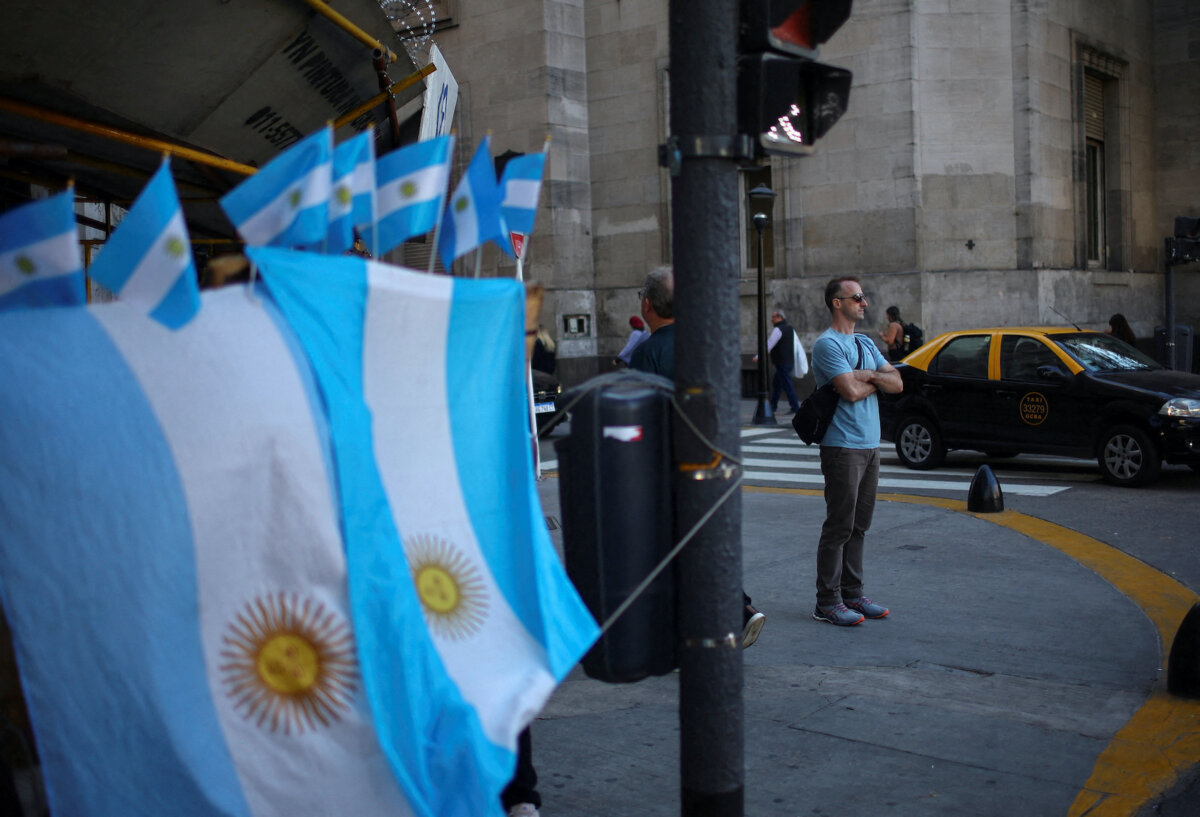
Milei’s group suffered a 13-point defeat, losing to the left-leaning Peronist coalition, which had been in charge before the libertarian’s victory in 2023.
The results may suggest waning public support for Milei’s shock therapy.
At the same time, stocks, bonds, and the peso have plummeted, fueled by institutional investors signaling fears of a return to the pre-Milei economy.
The selloff persisted until Bessent’s social media posts halted the decline.
Pesos and Dollarization
Brooks says that the Treasury’s “unconditional support” not only bails out Argentina but also the International Monetary Fund (IMF).
This past spring, Milei and IMF Director Kristalina Georgieva inked a $20 billion, four-year loan deal—one of the largest IMF programs in the organization’s history.
Key provisions of the agreement included $12 billion upfront capital to replenish the nation’s depleted reserves and a follow-up $2 billion disbursement in June.
In exchange, the IMF sought Argentina to abolish currency controls, install a floor on social spending, and remove central bank financing of government outlays.
Additionally, Georgieva and Milei agreed to float the peso, meaning to allow the currency’s value to be determined by global financial markets rather than government price fixing.
Brooks noted that Argentina must float its currency like the rest of the region.
“Argentina stands alone in Latin America in—again and again—pegging its currency to the dollar,” he added. “The rest of the region floats their currencies, which is what Argentina needs to do.”
While the nation has vast potential, Brooks notes that Argentina requires foreign capital investment, but the country has been restricted from global capital markets for the past seven years.
“The way to fix that is to float the currency, not prop it up at artificially strong levels,” he said.
Meanwhile, the economic and fiscal situation in the Latin American country might require additional measures beyond U.S. support and the IMF loan, says Monica de Bolle, senior fellow at the Peterson Institute for International Economics.
One potential near-term solution is full dollarization.
During the 2023 election campaign, Milei advocated for a complete dollarization of the Argentine economy.
However, after his government was formed, the proposal was tossed in the wastebin as Milei’s team suggested it would erode independent monetary policy.
On the other hand, the United States, says de Bolle, would benefit.
By having a dollarized ally in the region, the White House could chisel away at Argentina’s dependence on China, which has intensified significantly over the past several years.
After joining the Chinese regime’s Belt and Road Initiative, Argentina opened the door to substantial investments in energy and infrastructure projects from Beijing-backed companies.
For now, if Milei and his team of economists were to entertain dollarization again, it would be a balancing act.
“Full dollarization in Argentina, if it happens, may solve one immediate problem while inviting further chaos,” De Bolle wrote.
 Friends Read Free
Copy
Facebook
Tweet
Friends Read Free
Copy
Facebook
Tweet