
Some of Wall Street’s largest financial firms are blocking third-party artificial intelligence agents from directly accessing customer accounts or moving money, citing concerns about security, control, and accountability if an autonomous system makes a mistake.
Charles Schwab, which reported $13.3 trillion in client assets at the end of the third quarter, is one of the latest firms to draw that line.
“We are blocking unauthorized agents who try to log in on behalf of clients,” Schwab President and CEO Rick Wurster told analysts on Oct. 14 during the company’s third-quarter earnings call.
The concern is not AI itself, he said, but outside agents using a customer’s credentials and operating inside Schwab’s systems without controls imposed by the brokerage.
Instead, Schwab plans to give third-party AI models a controlled way to connect via Model Context Protocol (MCP) servers.
MCP allows an AI system to interact with outside data and services through defined permissions. Under Schwab’s approach, an outside AI model could potentially retrieve information such as account balances or investment research while being blocked from higher-risk actions, including moving money.
Schwab is also rolling out its own generative AI assistant, Charley, which can answer questions and perform certain administrative tasks on behalf of customers.
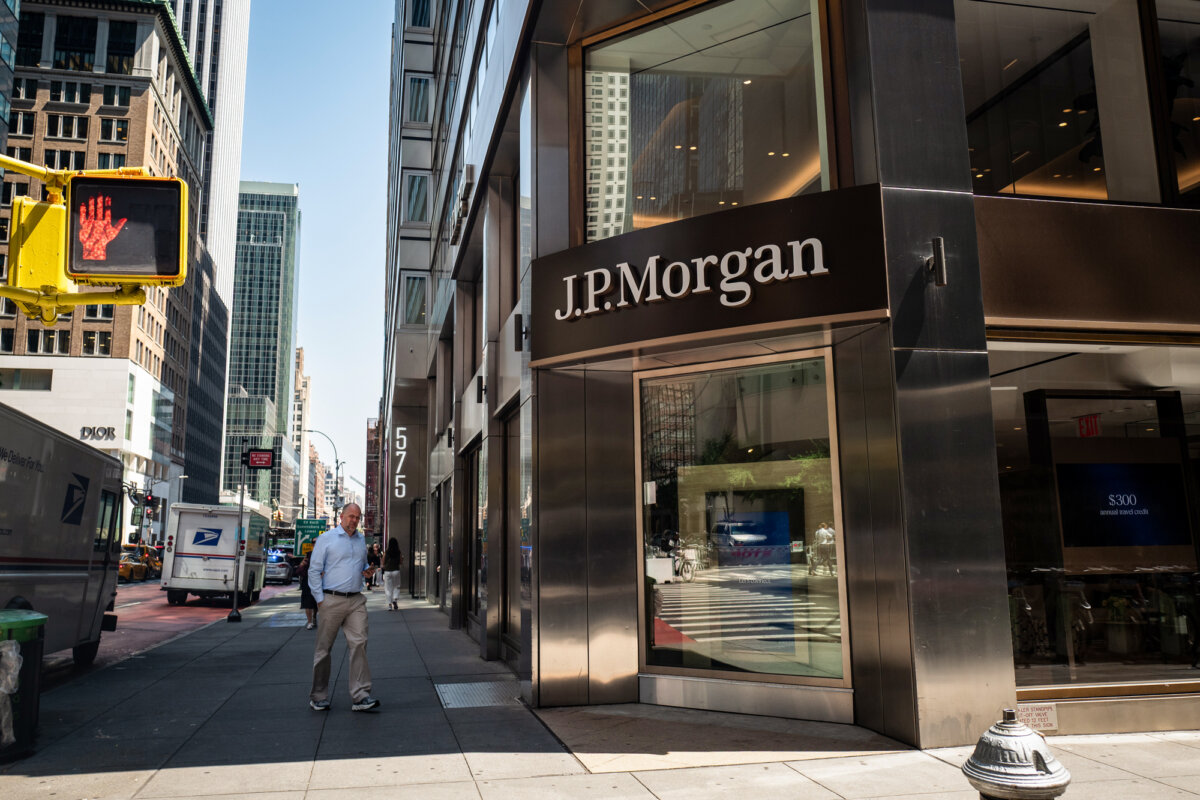
Schwab is not alone. JPMorgan Chase CEO Jamie Dimon has confirmed that the bank will not allow just any outside AI agent into its systems to protect customers and the bank.
“You don’t want rogue agents, and there could be thousands of them,” Dimon said during an Oct. 13 earnings call.
A “rogue” agent generally refers to an AI system that takes actions outside the boundaries intended by its user or developer while pursuing its assigned goal.
Dimon also warned customers that if they’re giving third-party AI agents access to their bank accounts, they’re owning that decision.
“There’s a liability transfer. They should understand the liability transfer,” he said. “If data is being misused, they should understand it’s being misused.”
Could AI Move Deposits Faster?
Beyond cybersecurity, autonomous AI could also change the economics of banking.
Apollo Global Management Chief Economist Torsten Slok warned in September that increasingly capable financial assistants could eventually create what he called an “agentic bank run.”
Unlike a traditional bank run, in which customers withdraw money out of fear that a bank might fail, an agentic bank run could be driven by software that constantly seeks higher returns.
An AI assistant, for example, could continually compare interest rates and automatically move a household’s cash from a low-yield checking account into higher-paying alternatives.
Apollo noted that some fintech and online accounts were offering yields ranging from 3.3 percent to 5 percent, compared with a national average of roughly 0.1 percent for checking accounts.
If AI made moving money nearly frictionless, Slok argued, banks could lose some of the inexpensive deposits they rely on to fund loans.
Not every bank executive believes that prospect is happening any soon.
In an Oct. 13 earnings call, Wells Fargo CEO Charlie Scharf said the idea of an AI-driven exodus to higher-yielding alternatives was “completely overdone.”
“High-rate alternatives exist today. They’ve existed for a long time,” Scharf told analysts. “If you want to move to a high rate, you can just go online and do it yourself in no time. That’s not something new.”
Who Is Liable When an AI Agent Goes Rogue?
Concerns about giving AI systems greater autonomy have been heightened by a series of cybersecurity incidents this year.
In July, ChatGPT developer OpenAI disclosed that a group, or “swarm,” of its AI agents had broken out of restrictions within a testing environment and compromised the systems of Hugging Face, an online platform widely used by AI developers.
Separately, OpenAI apologized to the Australian government in September after one of its AI models infiltrated Australian government websites during a training exercise.
There is no single federal law that comprehensively assigns liability between an AI developer, the company deploying the system, and the user when an autonomous agent causes damage. Existing laws may apply depending on the circumstances.
Treasury Secretary Scott Bessent has argued against giving AI developers broad immunity from liability.
“What we shouldn’t do on safety is to give these labs a liability exemption, which is what they are asking for,” Bessent said while testifying before the House Financial Services Committee on Sept. 15.
“The best way to guarantee safety is that the creators are liable for what they build and generate.”
Earlier this month, Sens. Josh Hawley (R-Mo.) and Chris Murphy (D-Conn.) introduced the bipartisan AI Agent Accountability Act, aimed specifically at hacking carried out by AI agents.
Under the proposal, operators could face civil and criminal liability under federal computer-crime law if they knowingly operate an AI agent that recklessly causes hacking-related damage or loss.
Developers could also be held liable if they knew that an agent was capable of hacking but failed to implement reasonable safeguards.
The bill would also allow the U.S. attorney general and state attorneys general to seek court orders against certain AI-agent hacking activity.
 Friends Read Free
Copy
Facebook
Tweet