
Commentary
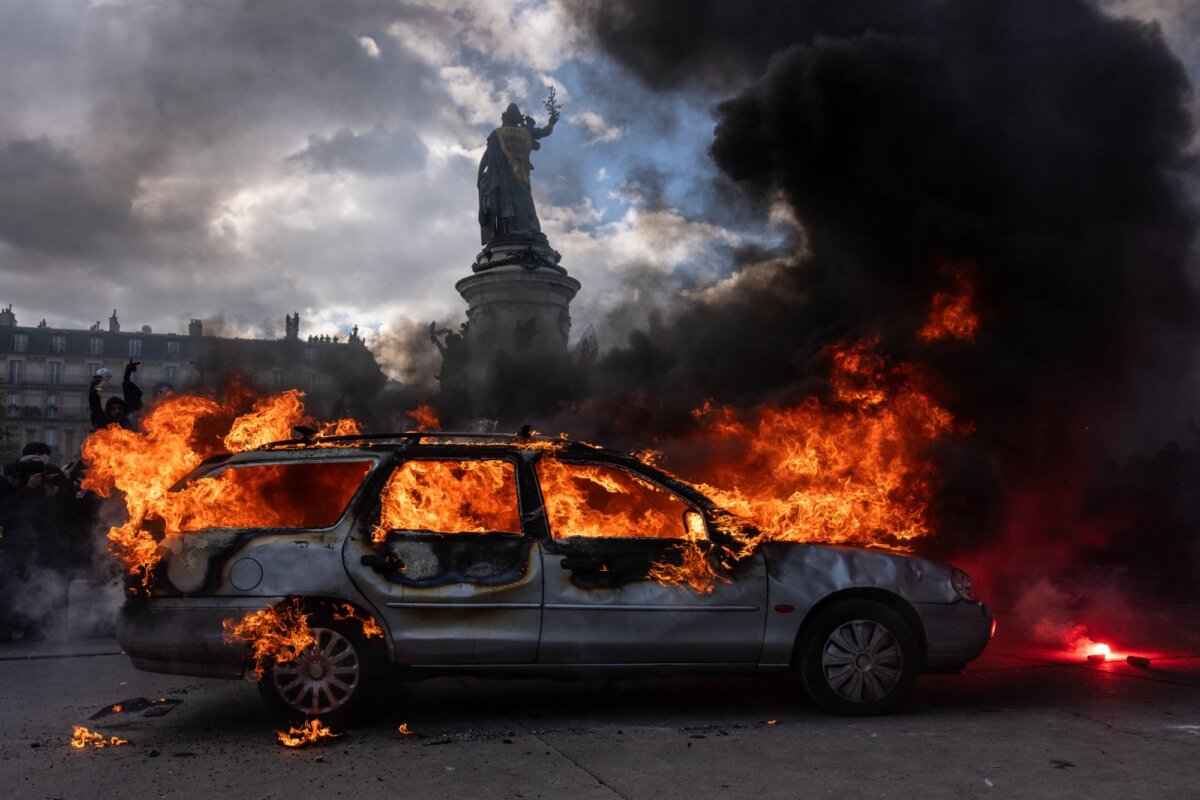
The chaos in the streets of France has a familiar ring to Americans who watched several cities burn in the summer of 2020. What started as “mostly peaceful” protests were quickly hijacked by chaos actors who whipped up excitable populations into a looting and pillaging frenzy, resulting in police crackdowns in the best cases but utter destruction in the worst cases.
The metaphor of the powder keg is one that is often invoked here. In the U.S. case, we had suffered months of COVID lockdowns that created pent-up energy on the part of an entire generation that had been shut out of schools, spilling into the streets in the name of protesting racism.
Oddly, a media that had been screaming for people to stay home and stay safe flipped on a dime to urge everyone to get out in the streets for purely political protests.
Something similar seems to have happened in France. Rising unemployment, high cost of living, underfunded and failing schools, loss of opportunity, rising crime, and frustration over waves of new immigrant populations have reached a fever pitch. Peaceful protests turned violent with masked and destructive provocateurs lighting fires and pillaging whole commercial sectors in many cities.
It was six years ago that France experimented with some of the toughest lockdowns in Europe. They kept schools open but restricted gatherings of all sorts. Bars, restaurants, and cafés faced particularly long disruptions: closed from mid-March 2020, reopened gradually in June 2020, then closed again from late October 2020 until May and June of 2021. After that, there were long capacity limits. Cultural venues, gyms, and ski resorts were also heavily restricted.
Cities were shut to the unvaccinated. France used the passe sanitaire (health pass: proof of vaccination, recent recovery, or negative test) starting in summer 2021 for restaurants, bars, cinemas, museums, long-distance transport, large events, and shopping centers. From January 2022, this became a passe vaccinal for those over 16 in many of the same places, lasting until suspension on March 2022.
All of this was totalitarian by any standard and it created a fiscal crisis as the state funded the entire mess with huge subsidies and payments to both individuals and businesses. The economy never recovered and business has struggled ever since. In the backdrop of this is one of Europe’s most generous and expensive welfare states tangled up with a regulatory apparatus that makes the United States look like a laissez-faire utopia by comparison.
The unemployment problem is particularly poignant for students with advanced degrees as funded by the state. Like the latter years of the Soviet Union, everyone seems to have a high-level credential in something but these pieces of paper are guaranteeing nothing on the real-world job markets.
Then there is the resulting inflation, the worst in 40 years. It was intensified by France’s idiotic embrace of net zero policies on energy that have resulted in high prices and rationing. This is the land of austerity, highly controlled, with a ruling class presiding over dramatically declining living standards, a forever rising welfare state, a highly regulated business sector, combined with a disastrous immigration policy that has destabilized demographics.
No French government has balanced its books in 52 years. The parasitic elites have squandered the wealth of the population while closing off opportunities for enterprise and economic growth.
France, more than any other industrialized democracy, has followed the path of Progressive policies in everything. And look where it has gotten them? No one likes the results and absolutely no one trusts the system. French voters keep rejecting establishment politicians but the establishment somehow never leaves. Reform never arrives while frustrations fester.
The 19th-century French economist Frédéric Bastiat long ago nailed the question of the participation in the public life of a nation, explaining why it cannot belong to all but only to those who have the capacity to exercise that right responsibly.
“It is not the voter alone who suffers the consequences of his vote,” he wrote, “because each vote touches and affects everyone in the entire community; because the people in the community have a right to demand some safeguards concerning the acts upon which their welfare and existence depend.”
Exactly right and this is precisely the problem in which France found itself. It never restricted participation rights even as it flung open the borders and endlessly expanded the welfare state. This is the path to national suicide in any nation.
Is it too late for a political solution? Perhaps but that raises the question of how this chaos will resolve. We could look back to the interwar period in Europe and see one possible path. The inflation and social chaos as fallout from the Great War ended up raising a generation of authoritarian politicians rallying around fascist ideology. We tend to single out Germany but often forget that the same tendencies hit Italy, Spain, and France.
This is the only real modern precedent we have for how this ends. History may not repeat and I’ve wondered for years if something more dramatic is headed to Europe, something more like 1989 and 1990 in the former Soviet empire. States unraveled in different ways but the result was the same everywhere. An entire establishment and system were washed away in a few short years, discrediting decades of rule.
The states from that period that undertook the biggest reforms—Poland, Hungary, the Czech Republic, Slovenia, and Soviet satellites Lithuania, Latvia, and Estonia—also happened to be the same states that resisted the push for open borders for several decades. They have avoided the economic sclerosis of Europe along with the social, demographic, and industrial decay. It’s possible that the next stage of Europe will involve not just the full-scale unraveling of the European Union but also the abrupt overthrow of whole political establishments.
Let France be a warning to America. The policies that inflicted so many wounds on this country are all the same policies advocated in elite and fashionable circles in the United States, pushed by the heights of academia, and celebrated by establishment media. It’s all about more controls, more corporate cartels, more regulations, higher taxes, and more immigration floods without any real standards over what constitutes citizenship.
If the United States goes this way—it very well could happen with enough voter apathy and poor policies such as those being imposed on New York City today—we’ll end up right where France is today. We face a choice. We can choose chaos or choose to return to the ideals of a constitutional republic that our Founders envisioned. This is not only a fork in the road for France. It points to a coming fork for the United States too.
Views expressed in this article are the opinions of the author and do not necessarily reflect the views of The Epoch Times.
 Friends Read Free
Copy
Facebook
Tweet