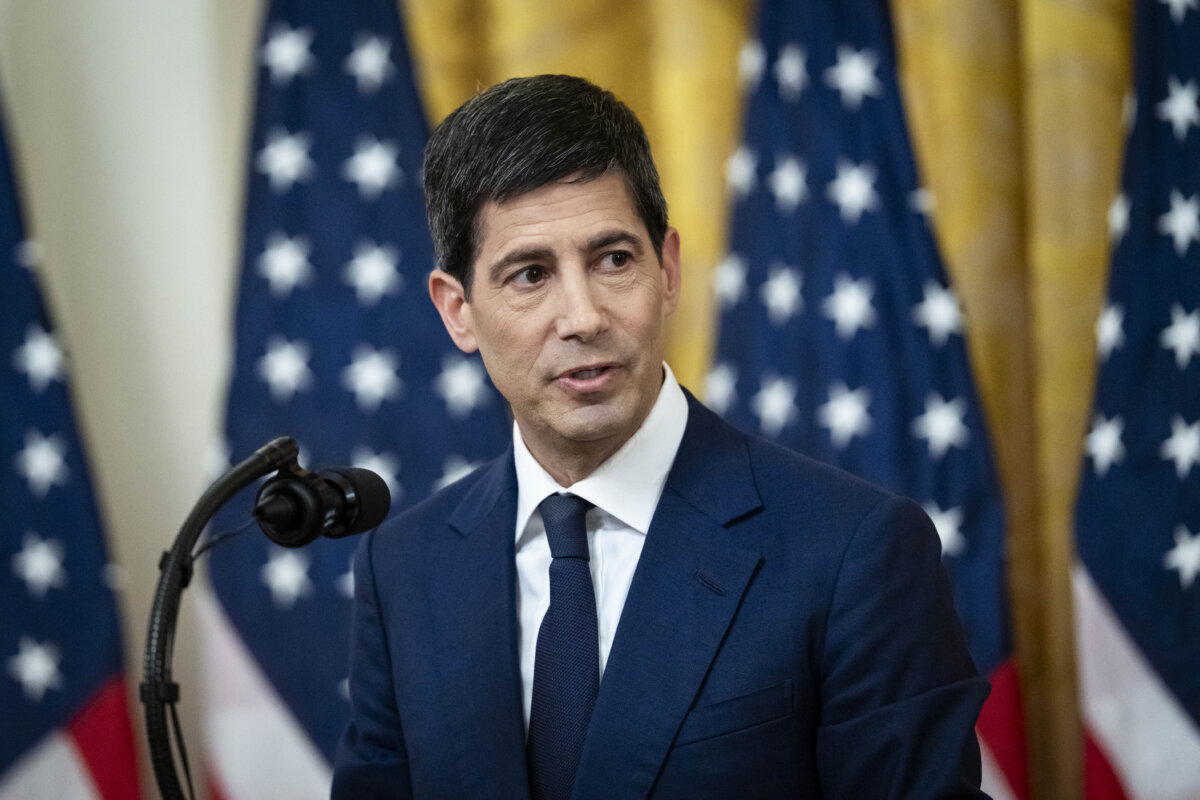

Federal Reserve Chairman Kevin Warsh released the names of the members who will be on the central bank’s task forces on July 9.
Warsh announced last month the creation of five task forces to review the Fed’s monetary policymaking framework, with officials examining everything from data utilization to the balance sheet.
Among the names are former Bank of England Gov. Mervyn King, who will be one of three individuals reviewing how the Fed communicates with the public during times of uncertainty.
As part of the new central bank leader’s reforms, communication has been a top priority, with Warsh abandoning forward guidance. Minutes from the June policy meeting suggest he has the backing of his colleagues.
Former Walmart CEO Doug McMillon will serve on the task force mandated to improve the “quality and timeliness” of economic data to bolster the Fed’s policy decisions.
Serving on the group tasked with assessing the economic impact of artificial intelligence and other new technologies will be prominent venture capitalist Marc Andreessen. He will also be joined by Xbox’s CEO Asha Sharma and Charles Jones, a professor of economics at Stanford University.
Greg Mankiw, former chairman of the White House’s Council of Economic Advisers, will revisit the Fed’s inflation frameworks and how it responds to price pressures.
The U.S. economy has evolved over the last generation, and the Fed’s goal is to ensure it achieves its “objectives in this consequential time,” Warsh said.
“Each task force will carefully consider whether policymakers’ means and methods, analytical tools and policy approaches can be improved upon,” he said in a statement. “I am honored that the best minds from a range of disciplines have agreed to work with us to sharpen our performance as an institution.”
This is consistent with last month’s announcement that these panels would begin with “first principles” by asking tough questions, considering alternatives, reviewing current practices, and proposing the next steps for Fed policymakers.
Other members include former Reserve Bank of India Gov. Raghuram Rajan, former Fed Gov. Jeremy Stein, and William White, senior fellow at the C.D. Howe Institute.
The news release reaffirmed the independence of these panels, adding that officials will carry out their duties to “follow the evidence, provide candid feedback, and produce rigorous findings” to the Federal Open Market Committee.
It is unclear when these task forces will complete their reviews.
Previous officials have commended Warsh for this initiative to ensure the Fed is doing its job well.
“I think it’s very sensible,” former Fed Gov. Randal Quarles told The Epoch Times.
While some of the topics are complex, Quarles said that forming task forces of experts to monitor the Fed is a “very useful way to make progress on these issues.”
Warshonomics Seen at the Fed
Changes have already been observed inside the Federal Reserve System, particularly on the communications front.
June’s post‑meeting statement totaled about 130 words, down sharply from approximately 400 previously. The accompanying minutes released on July 8 also ran a bit shorter, coming in at 14 pages versus 17 pages for May’s two‑day session.
Additionally, Warsh has made only one public appearance outside June’s rate-setting committee meeting. He was in Portugal for a European Central Bank panel discussion. The Fed chief will visit Capitol Hill next week for his semi-annual monetary policy report to the House Financial Services Committee and the Senate Banking Committee.
This comes as financial markets debate whether the Fed will tighten policy before the year’s end.
While the base case is that the 12‑member panel will move ahead with a quarter‑point hike, futures pricing suggests a different timeline: markets assign a 64 percent chance of an increase in September, 70 percent odds in October, and better than 80 percent by December.
“One thing is certain: future policy is heavily contingent on the political situation in the Middle East,” Jeffrey Roach, chief economist at LPL Financial, said in a note emailed to The Epoch Times.
“If we can tease out any forward guidance from the minutes, it would be the committee is working through a wide range of scenarios and will not commit to a specific scenario until the incoming data provides necessary.”
The next batch of inflation data will be released on July 14.
Early estimates suggest the June Consumer Price Index report will show the monthly inflation rate falling 0.1 percent due to stabilizing global energy markets.
 Friends Read Free
Copy
Facebook
Tweet
Friends Read Free
Copy
Facebook
Tweet