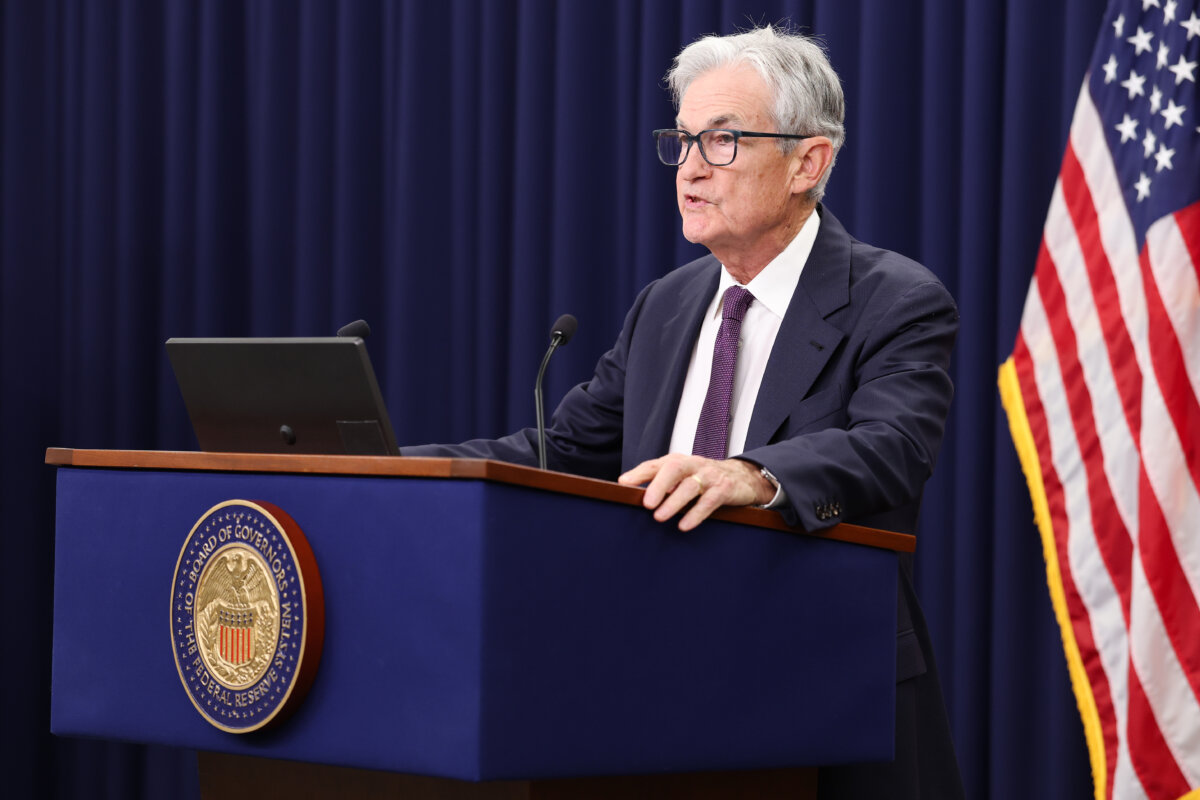
The Federal Reserve left interest rates unchanged for the third straight policy meeting on April 29, with the meeting marking the end of Fed Chairman Jerome Powell’s tenure as central bank chief.
Officials voted 8–4 to keep the benchmark federal funds rate in the current target range of 3.5 percent to 3.75 percent.
“Recent indicators suggest that economic activity has been expanding at a solid pace,” the Federal Open Market Committee said in a post-meeting statement.
“Job gains have remained low, on average, and the unemployment rate has been little changed in recent months. Inflation is elevated, in part reflecting the recent increase in global energy prices.”
Investors widely expected the Fed to hold rates steady as policymakers examine current economic conditions, from the national labor market to war-fueled inflation pressures.
Fed board member Stephen Miran dissented and instead supported a quarter-point interest rate cut.
The other three votes were Cleveland Fed President Beth Hammack, Dallas Fed President Lorie Logan, and Minneapolis Fed President Neel Kashkari. Although they supported maintaining the current target rate, they “did not support the inclusion of an easing bias in the statement at this time.”
In recent years, there have been occasional spikes in dissenting votes. But it has been rare over the past 40 years for the Fed to complete a meeting with four dissents.
The last time there were four opposing votes was October 1992, according to data collected by the St. Louis Fed.
Policy Patience
Looking ahead, traders do not expect the next rate action until later next year.
In recent weeks, a chorus of monetary policymakers has adopted a more cautious stance, waiting to see whether the oil price shock from the war in Iran will exacerbate inflation risks.
“That’s a dangerous, slippery spot to be in,” Chicago Fed President Austan Goolsbee said during a panel discussion at the Semafor World Economy summit earlier this month. “The longer this inflation disruption goes, the more likely it is that the appropriate rate cutting would be put off.”
Higher energy prices sent March’s headline inflation surging, with the 12-month rate reaching 3.3 percent. With crude oil and gasoline prices remaining elevated, the annual inflation is expected to edge higher to 3.6 percent, according to the Cleveland Fed’s Nowcasting model.
At the same time, structural inflation appears tame.
After coming in below economists’ expectations last month, core inflation, which omits volatile food and energy prices, could hold steady at 2.6 percent in the April consumer price index for the second straight month.
With data suggesting that the employment situation remains intact—the economy is projected to have added 95,000 jobs in April—the central bank has the luxury of being patient.
The next two-day Fed meeting will take place on June 16 and June 17, meaning that policymakers will have several batches of employment and inflation figures available to them heading into that gathering.
The June Federal Open Market Committee will also likely be headed by Kevin Warsh for the first time.
Kevin Warsh
President Donald Trump’s nominee to replace Powell cleared a key Senate hurdle.
Hours before the April Fed meeting, the Senate Banking Committee voted along party lines—13 Republicans and 11 Democrats—in favor of Warsh to lead the U.S. central bank.
With the GOP controlling the upper chamber, Warsh is likely to be confirmed in a full Senate vote.
Sen. Thom Tillis (R-N.C.), a committee member, confirmed on April 26 that he would no longer serve as a roadblock to Warsh’s path to confirmation now that the Department of Justice has ended its investigation of Powell.
Sen. Elizabeth Warren (D-Mass.), the ranking member, lambasted Warsh and warned of the threat of eroding the Fed’s independence.
“The Trump economy is in real trouble,” Warren said ahead of the vote. “Inflation is up, job creation is down. The stink of stagflation is in the air, and President Trump is getting desperate.
“A vote today by this committee to advance Mr. Warsh will bring the president one step closer to completing his illegal attempt to seize control of the Fed and to artificially juice the economy.”
A full Senate vote is expected to happen in the week of May 11, shortly before Powell’s term expires on May 15.
And although his term as Fed chairman expires next month, Powell will still have a seat on the board of governors until 2028 unless he resigns.
Meanwhile, the inspector general for the Federal Reserve will be investigating the cost overruns of the Fed headquarters renovations—the construction project is about $600 million over budget—and will deliver a comprehensive report to Jeanine Pirro, the top federal prosecutor in the District of Columbia.
“It is unclear that the probe is truly ‘officially’ over as it was passed off to the Inspector General for the Federal Reserve leaving the possibility that Powell could be targeted at another time,” Jay Woods, chief market strategist at Freedom Capital Markets, said in a note to The Epoch Times. “That will lead to questions for Powell as to whether he stays on as a Fed governor and voting member.”
Prediction markets suggest that Powell will remain on as Fed governor for a short time.
 Friends Read Free
Copy
Facebook
Tweet
Friends Read Free
Copy
Facebook
Tweet