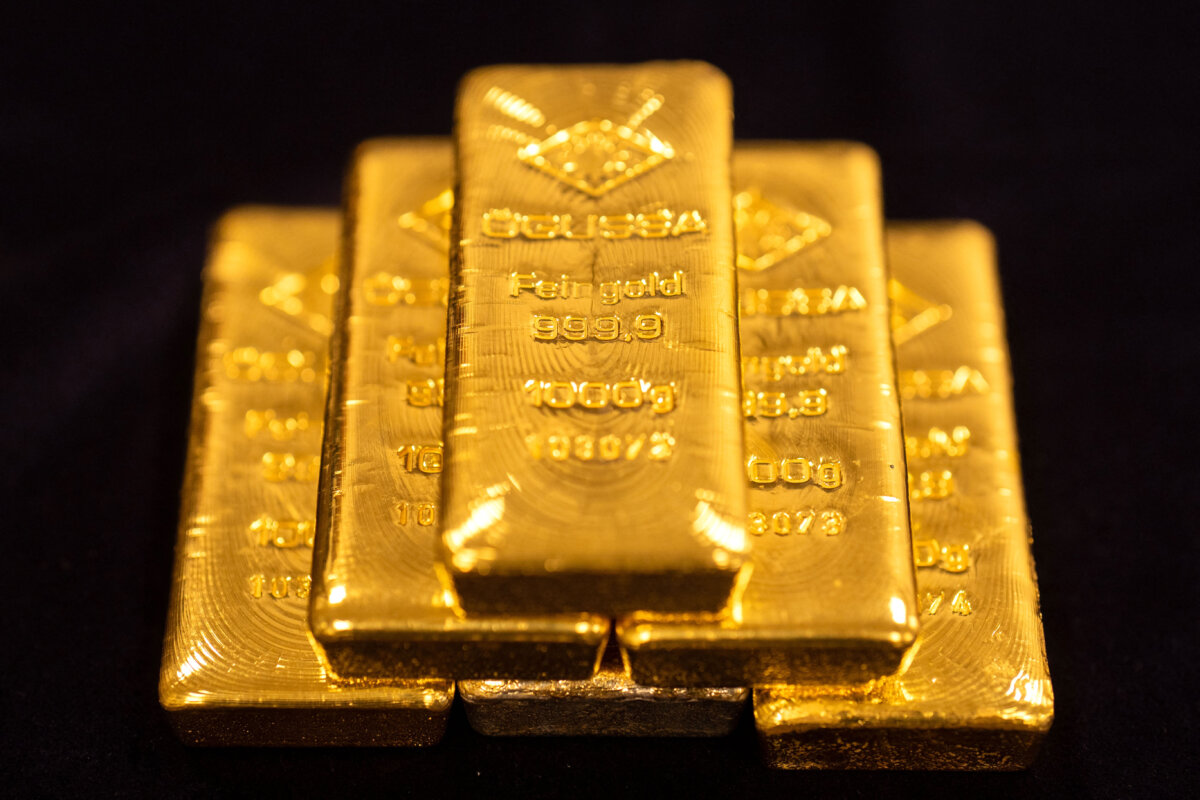

Gold prices were trading at their highest level in more than three months on Aug. 24, amid continued tensions in the Middle East and ahead of a speech this week by Federal Reserve Chairman Kevin Warsh.
Spot gold prices were trading at roughly $4,644 per oz. as of 5:50 a.m. ET on Aug. 24, up from the Aug. 21 closing price of about $4,603. This is the highest level since May 18.
Since hitting a low of about $3,959 on July 17, gold prices have increased by more than 17 percent.
The Aug. 24 spike followed comments from the Trump administration signaling a more aggressive stance regarding the U.S. war against Iran.
On Aug. 23, Treasury Secretary Scott Bessent said that an “economic D-Day” is coming for the Iranian regime, with the United States implementing measures to sever the country’s economic lifelines.
Mohsen Rezaee, secretary of Iran’s Supreme National Security Council, threatened on social media that if Tehran is targeted for economic isolation, it will block oil shipments through the Strait of Hormuz and the Persian Gulf.
The escalation of tensions between the two countries contributes to an environment of uncertainty, favoring bullishness in gold prices.
Investors are also watching out for Warsh’s speech at the 2026 Jackson Hole Economic Policy Symposium in Wyoming on Aug. 28 to gauge the potential direction of the central bank’s interest rates.
An increase in interest rates can be negative for gold and vice versa. Last month, the Federal Reserve had opted to keep the rates unchanged for the fifth straight time.
In addition to interest rates, investors are waiting for the personal consumption expenditures price index, which is set to be released this week. The index is the preferred gauge of inflation for the Fed.
“Gold is trading above $4,600. So far, over the first three weeks of August, gold is up 15 percent. This doesn’t happen with a hawkish Fed determined to do whatever it takes to lower inflation. It happens when investors realize the Fed is bluffing and intends to let inflation run away,” Peter Schiff, chief economist at Euro Pacific Asset Management, said in an Aug. 21 post on X.
In an Aug. 21 post, Ewa Manthey, commodities strategist at ING Bank, said that gold has rebounded from its July lows, supported by growing unease over the U.S. fiscal outlook and renewed investment demand for the bullion.
However, persistent inflation and the potential for the Fed to raise its benchmark interest rates mean the recovery in gold prices is “unlikely to be straightforward,” according to Manthey.
“The Fed’s annual Jackson Hole symposium from Aug. 27 to Aug. 29 will be closely watched. Any indication that policymakers are becoming more willing to raise rates would risk lifting yields and the dollar. A greater focus on growth or financial stability would be more supportive for gold,” Manthey said.
ING is forecasting fourth-quarter gold prices to average $4,150 per oz., assuming U.S. monetary policy remains restrictive due to persistent inflation and that Treasury yields do not sustain a decline.
Manthey suggested that the gold price recovery could be on a firmer footing due to renewed ETF buying. However, further gains in bullion will depend on continued investment demand and the Fed’s response to inflation.
According to an Aug. 6 report from the World Gold Council, gold ETFs saw net inflows of $3 billion in July, with global investors adding bullion to their portfolios. This reversed two consecutive months of outflows.
The report attributed the shift to investors selectively reentering the market at lower prices, alongside continued demand to diversify portfolios.
The inflows were led by European-listed funds. While North America also saw ETF inflows return last month, the increase was modest at $71 million.
Year-to-date, total global gold ETF inflows amount to $11 billion, with funds from Asia being the largest contributor, followed by Europe. North America has seen net outflows during this period, the report states.
 Friends Read Free
Copy
Facebook
Tweet
Friends Read Free
Copy
Facebook
Tweet