

Real income growth for U.S. households remained unusually weak heading into the holiday season, even as economists upgraded their outlook for next year’s economic expansion, according to a new report from the JPMorganChase Institute.
Median real income growth for Americans aged 25 to 54 slowed to 1.6 percent in October, a pace comparable to the soft labor market recovery in the 2010s following the Great Recession, the Nov. 25 analysis shows.
“With pandemic-era excess cash liquidity in the rearview mirror, consumers are facing a holiday spending season with budgets tempered by tepid income growth but augmented by strong stock market gains,” the report reads. “Importantly, nominal growth remains roughly consistent with pre-pandemic levels, but real purchasing power gains are at a relatively low level because of the higher pace of consumer price increases.”
Younger workers are lagging historical early-career norms, a reversal of the rapid job-switching-driven wage growth seen earlier in the post-COVID-19 pandemic period. Older workers are now experiencing outright erosion in purchasing power.
“Workers in their early fifties—who regularly face slower income gains—are now experiencing negative real income growth,” the report found, attributing the declines to muted wage gains colliding with persistently high inflation.
Inflation has risen in recent months, climbing to 3 percent in September after touching a recent low of 2.3 percent in April, data from the Bureau of Labor Statistics (BLS) shows.
Bank balances have been flat since early 2024, holding at levels about 23 percent above 2019 but failing to grow as households age, an unusual shift from pre-COVID-19 pandemic patterns.
“That is less than historical growth trends over a six-year period, though no longer declining,” JPMorganChase analysts said.
Overall, the report states that American households “are going into the end of the year with weak income growth and bank balances that remain flat, after adjusting for inflation.”
New federal data point to the same cooling trend. In its Nov. 21 real earnings report, the BLS stated that real average hourly earnings were unchanged in September, as a 0.2 percent wage gain was offset by a 0.3 percent rise in consumer prices. Real average weekly earnings fell by 0.1 percent with no change in the length of the workweek.
Economists More Upbeat on 2026
The sobering household data contrast with a more upbeat macroeconomic forecast from the National Association for Business Economics (NABE), whose year-end survey sees the U.S. economy growing by 2 percent in 2026, up from 1.8 percent projected in October.
“The November 2025 NABE Outlook Survey results point to a modestly stronger economic trajectory,” NABE President Gregory Daco said, citing resilient consumer spending and firmer capital investment.
NABE panelists expect inflation to ease only gradually, to 2.6 percent in late 2026 from 2.9 percent at the end of 2025, still above the Federal Reserve’s 2 percent target. Tariffs were expected to add between 0.25 and 0.75 percentage points to price growth.
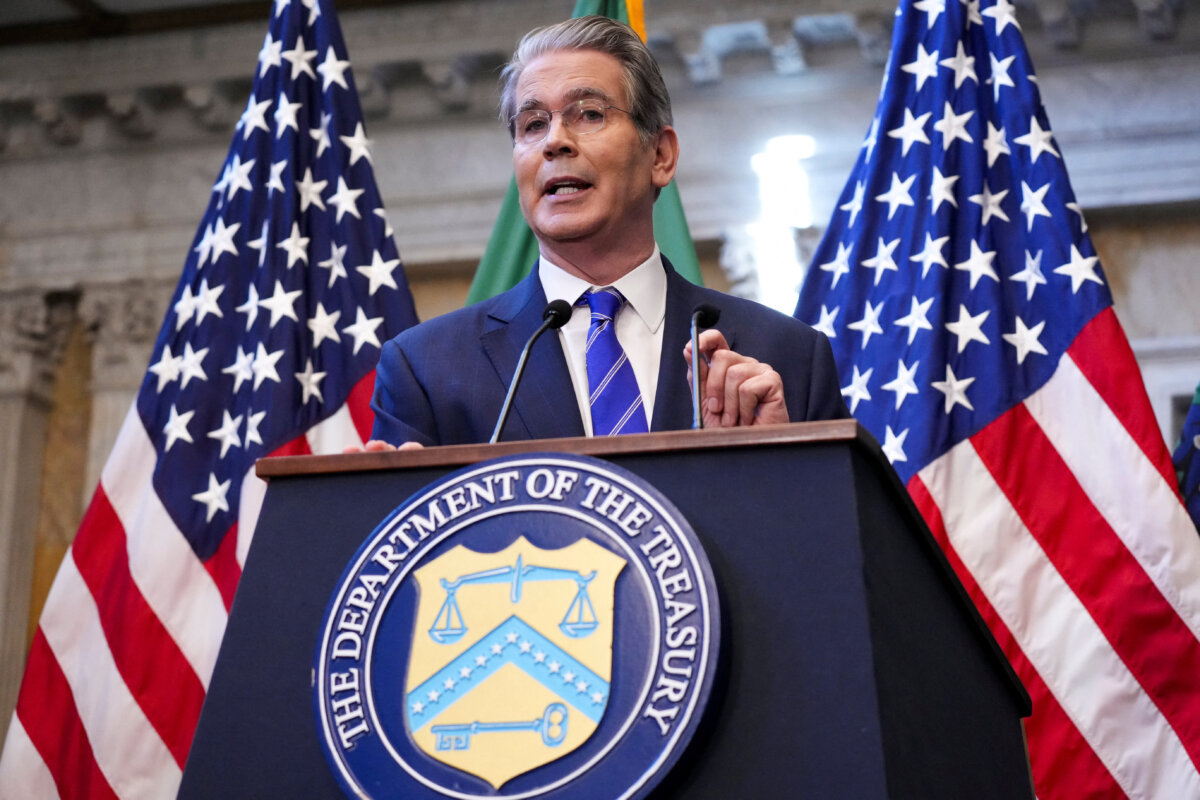
The upgraded growth forecast aligns with comments by Treasury Secretary Scott Bessent, who said in a television interview that he was “very, very optimistic” about 2026, describing the administration as having “set the table for a very strong non-inflationary growth economy.”
Bessent rejected claims that tariffs were driving recent price pressures, pointing instead to services costs and citing new data showing flat imported-goods inflation. He also pointed to a Council of Economic Advisers study suggesting that inflation was running roughly half a percentage point higher in blue states than in red ones, attributing the gap to regulatory and energy-cost differences.
Labor Market Expected to Cool
Despite firmer growth expectations, economists see a slowing job market in 2025 and 2026. The NABE survey projects job gains decelerating to about 23,000 per month by the end of this year, with unemployment hovering at about 4.5 percent throughout 2026.
NABE Outlook Chair Yelena Maleyev said that there was an unusually wide spread in job-growth forecasts among the surveyed economists, which she said underscores “elevated uncertainty about labor demand.”
Those concerns echo October Federal Reserve minutes showing that officials saw “little sign” that inflation was on a sustainable path back to 2 percent and warned that labor-market conditions had “softened” through September and October but had not “sharply deteriorated.”
Fed Vice Chair Philip Jefferson, in a Nov. 17 speech, described conditions as “mixed,” with unemployment claims moving sideways and businesses reporting both hiring delays and renewed investment.
“I expect that the unemployment rate is likely to inch up slightly,” Jefferson said, while noting that labor market risks were “skewed to the downside.”
Some major tech and retail companies have announced job cuts this year, with Intel cutting more than 20,000 positions, Amazon slashing headcount by 14,000, and Microsoft eliminating 9,000 jobs.
So far this year, American employers have announced nearly 1.1 million planned layoffs, representing a 65 percent increase from the first 10 months of last year, according to global outplacement firm Challenger, Gray and Christmas.
 Friends Read Free
Copy
Facebook
Tweet
Friends Read Free
Copy
Facebook
Tweet