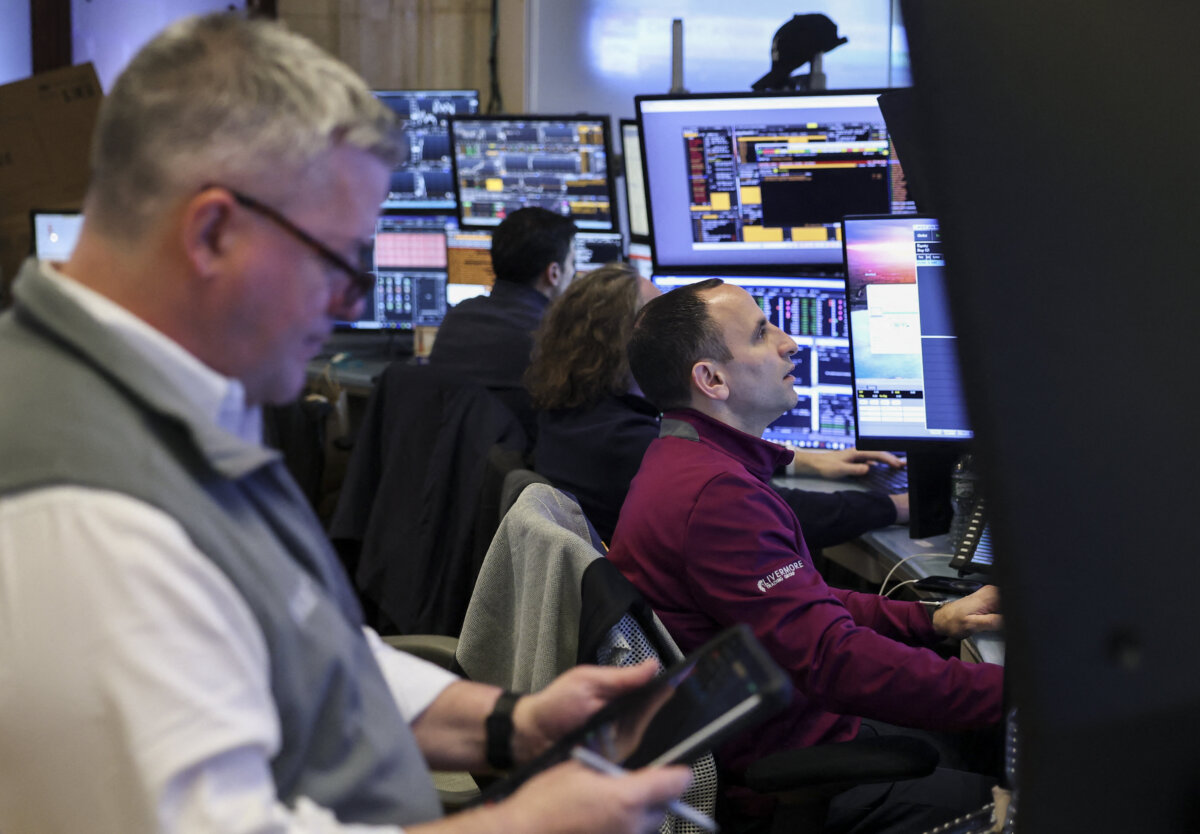

Investors unnerved by growing fears of artificial intelligence-driven disruption are rotating into asset-heavy companies such as industrials, infrastructure, and energy firms, seeking insulation from volatility in high-flying technology shares, analysts say.
A recent report from BNP Paribas Wealth Management argues that 2026 marks a turning point in how markets perceive AI-linked investments, with rising capital expenditure no longer enough to guarantee outperformance. Instead, investors are rewarding companies with tangible, hard-to-replicate assets and stable economic relevance.
The shift comes after a period of turbulence in software and other capital-light sectors, which have borne the brunt of concerns that AI could erode business models and compress margins. BNP describes a “sell first, ask questions later” environment, with long-term AI disruption risks being priced into valuations.
“Rising [capital expenditure] is no longer a sufficient condition for outperformance,” the strategists wrote, noting that U.S. hyperscalers have recently announced that they plan to spend roughly $660 billion in capital expenditure this year—roughly $120 billion, or 22 percent above prior estimates—yet their shares have struggled to respond positively.
“Those announcements have been met with increasing skepticism which is evident from the lackluster year-to-date performance of the majority of the names,” BNP analysts wrote.
Instead, the analysts highlighted what they call the “HALO effect”–heavy asset, limited obsolescence companies that own scarce physical infrastructure that cannot be digitized or easily automated away. These include power assets, metals, real estate, industrial infrastructure, data centers and semiconductor facilities, as well as companies with strong network effects or proprietary assets that serve as bottlenecks in the AI supply chain.
“In a world were AI capabilities become more powerful at lower costs … those asset classes that cannot be ‘reproduced’ by AI could likely experience an increase in value,” the report said.
The bank sees three forces driving the rotation: the HALO effect, early evidence of AI-driven productivity gains at adopting firms, and a broader cyclical recovery. Companies with rising capital expenditure ratios have begun to outperform, while capital-intensive industries have stopped lagging their capital-light peers.
In the United States, BNP upgraded industrials to overweight and lifted energy from underweight to neutral, with a preference for energy infrastructure, equipment, and services.
In Europe, it says infrastructure and defence spending aimed at enhancing strategic autonomy, leading to a “strong tailwind” for utilities, industrial goods, and basic resources, even though some sectors struggle, such as automobiles due to intense competition from China or media and software because of AI-driven automation.
Software Selloff, Valuation Reset
The rotation follows steep declines in software shares. In a Feb. 23 episode of the Goldman Sachs Exchanges podcast, portfolio strategist Ryan Hammond said a group of software stocks has fallen about 25 percent since the start of the year and more than 30 percent from October highs.
Those stocks have seen a dramatic valuation reset. Forward price-to-earnings multiples have dropped from roughly 35 times to around 20 times, shrinking their premium to the broader market from over 100 percent to about 20 percent, levels approaching those seen during the global financial crisis.
“To us, it seems like investors have gone from valuing this group of stocks in the 15 percent to 20 percent growth range to five to 10 percent growth in the span of a couple of days,” Hammond said.
Selling pressure has not been confined to software. Publishing, advertising, media, legal services, IT consulting, and even insurance names have come under pressure as investors react to new AI tools rolling out industry-specific applications, prompting questions about the long-term sustainability of some business models.
“It’s clear that AI disruption risk is really the common thread throughout a lot of these industries selling off in recent weeks,” he said.
Hammond added that the main debate is about how much long-term growth investors should expect from companies in such industries, since stock prices are based on future profits. With uncertainty rising over how AI might affect their business models, investors are starting to question how sustainable that growth really is.
At the same time, AI-linked capital spending continues to surge. Hammond noted that five large U.S. hyperscalers spent about $400 billion on capex last year. At the start of 2026, analysts expected $540 billion in spending this year. Following recent earnings updates, that estimate has climbed to roughly $660 billion.
Overall, the AI trade has become more complex, Hammond suggested, with greater dispersion likely within the group rather than uniform leadership at the top of the index.
In a recent note, Goldman Sachs analysts echoed that view, saying investors are increasingly trying to distinguish between companies that can harness AI to boost productivity and those whose business models may be undermined by it.
“Investors are searching for long-term ‘winners’ that will use AI to become more productive, but very few companies have quantified the impact on earnings,” Goldman analysts wrote.
The bank said that for companies facing fears of AI disruption, earnings trends will be critical in determining when share prices stabilize, “but disruption uncertainty is unlikely to be resolved in the near term.”
Meanwhile, even as BNP sees capital-intensive sectors as beneficiaries of the recent AI-related rotation in equities, not all strategists see it as a structural flight to hard assets.
ING analysts said in a Feb. 24 note that equity weakness linked to what they described as the “AI losers” narrative likely reflects stretched valuations and fully invested positioning rather than a decisive regime shift.
“Yesterday, it was the turn of a Citrini Research report suggesting that AI will cause mass unemployment that will continue to weigh on professional services, including the banking sector,” they wrote. “None of this, so far, has delivered the knock-out blow to equity markets, where the S&P 500 has gyrated in a narrow 6,775–7,000 range since the start of the year.”
The ING team added that global equities have also been showing “pockets of strength,” including solid performance from semiconductor-heavy indexes in Korea and Taiwan.
Reuters contributed to this report.
 Friends Read Free
Copy
Facebook
Tweet
Friends Read Free
Copy
Facebook
Tweet