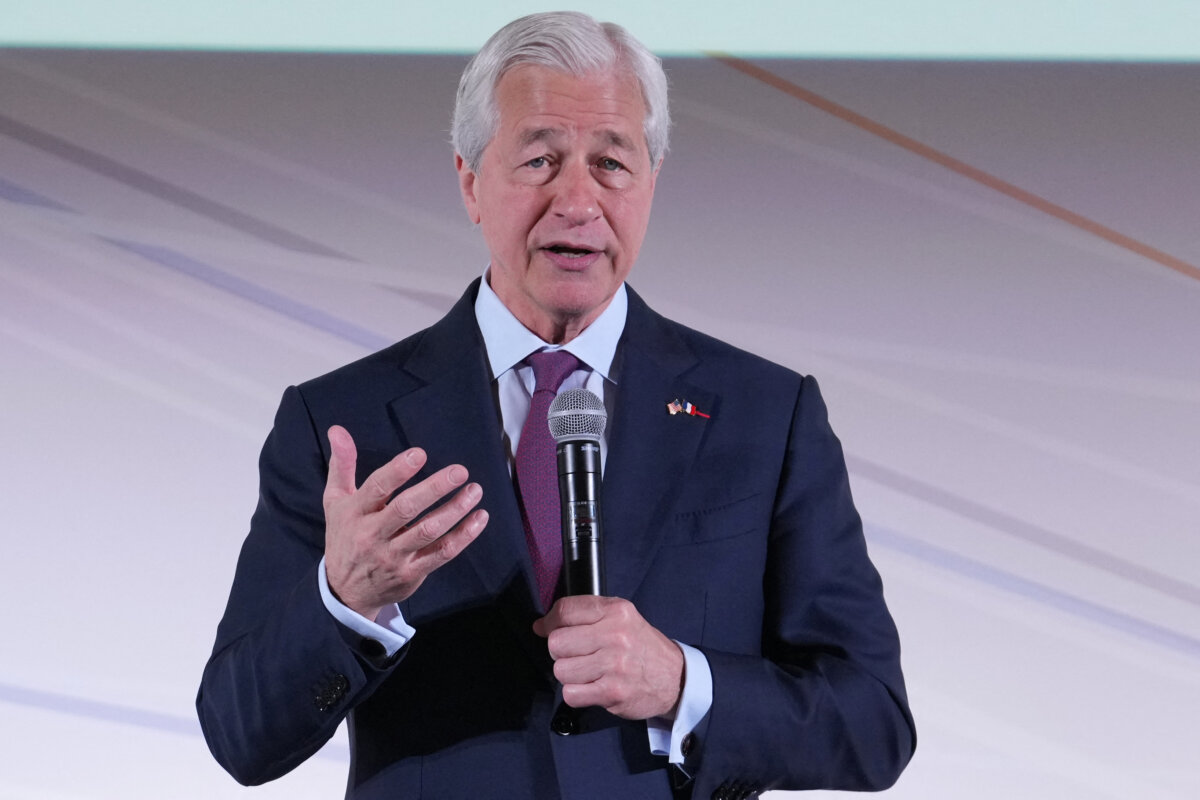

JPMorgan Chase has unveiled a $1.5 trillion investment plan to bolster core U.S. industries such as energy, defense, and advanced technology, calling it essential to restoring U.S. industrial strength and resilience.
Under the 10-year initiative, announced on Oct. 13, the bank will facilitate, finance, and invest in industries deemed vital to U.S. security, including advanced manufacturing, defense technology, energy infrastructure, critical minerals, and frontier fields such as artificial intelligence and quantum computing.
“It has become painfully clear that the United States has allowed itself to become too reliant on unreliable sources of critical minerals, products and manufacturing—all of which are essential for our national security,” Jamie Dimon, CEO of JPMorganChase, said in a statement. “Our security is predicated on the strength and resiliency of America’s economy.”
The move comes amid escalating tensions with China over supplies of rare earth minerals, materials essential to everything from fighter jets to semiconductors. U.S. President Donald Trump recently threatened an additional 100 percent tariff on Chinese goods and export controls on critical software in response to what he called Beijing’s “hostile” escalation by weaponizing rare earth exports.
With China controlling more than 90 percent of global rare earth refining capacity, the White House has launched a push to rebuild the domestic critical minerals industry, fast-tracking permitting for critical mineral-mining projects and pledging hundreds of millions of dollars to U.S. producers as it seeks to break Beijing’s grip on supply.
As part of JPMorgan’s new push, dubbed the Security and Resiliency Initiative, the bank will deploy up to $10 billion in direct equity and venture capital to help U.S. firms scale production and secure domestic supply chains, spur innovation, and accelerate strategic manufacturing.
The plan is organized around four key themes and 27 targeted sub-areas, ranging from critical minerals, nano-materials, and shipbuilding and pharmaceutical precursors to munitions, hypersonic systems, nuclear energy, battery storage, cybersecurity, artificial intelligence, and quantum computing.
JPMorgan said the initiative will focus on reshoring advanced manufacturing, strengthening defense industrial capacity, and advancing frontier technologies, all of which are key to bolstering U.S. economic and military power.
The bank said it had originally planned to deploy roughly $1 trillion over the next decade in support of these sectors, according to previously undisclosed internal figures, but is boosting that commitment by 50 percent. Alongside the capital surge, JPMorgan is pressing lawmakers to cut red tape and advance education reforms to ensure the skilled workforce needed to sustain industrial revival.
“America needs more speed and investment,” Dimon said. “It also needs to remove obstacles that stand in the way: excessive regulations, bureaucratic delay, partisan gridlock and an education system not aligned to the skills we need.”
To help execute the plan, the bank will hire additional bankers and create an external advisory council drawn from industry, defense, and policy circles.
The stakes have intensified after Beijing moved to tighten its grip on global mineral supplies. On Oct. 9, China expanded export controls to cover not only raw rare earths, but also magnets, alloys, batteries, and semiconductor materials. It requires permits for any product containing even trace amounts of Chinese-sourced minerals.
Trump responded with threats of 100 percent tariffs and export restrictions on “critical software” starting Nov. 1. He also suggested that he might cancel a planned meeting with Chinese leader Xi Jinping over the matter.
The Chinese regime appeared to back down in response to Trump’s moves. U.S. Trade Representative Jamieson Greer said on Oct. 12 that Chinese officials had “deferred” when the U.S. government contacted them about the new restrictions, and Treasury Secretary Scott Bessent said on Oct. 13 that Trump had signaled willingness to meet with the Chinese leader.
 Friends Read Free
Copy
Facebook
Tweet
Friends Read Free
Copy
Facebook
Tweet