The Trump administration is merging two Interior Department agencies into one office that will orchestrate its proposed plan to dramatically expand offshore oil and gas production and spearhead its Outer Continental Shelf critical minerals development initiatives.
Under a “phased transition” that began in April, the Bureau of Ocean Energy Management and the Bureau of Safety and Environmental Enforcement are being folded into the newly created Marine Minerals Administration.
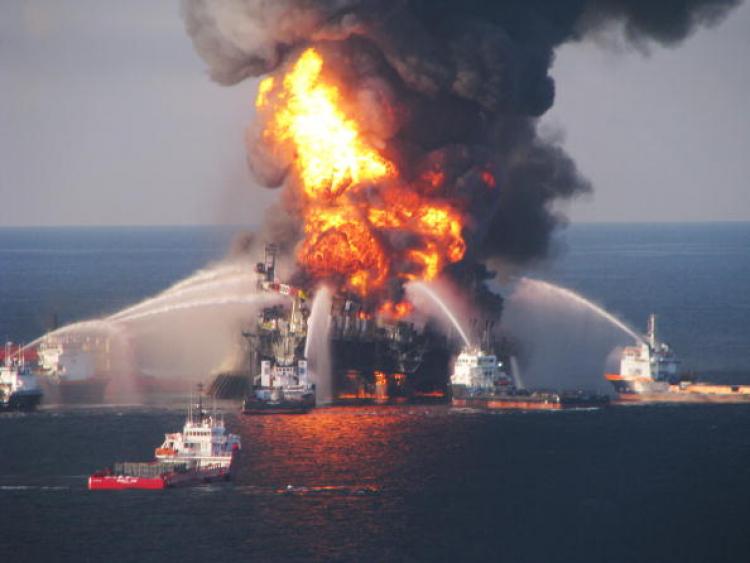
Consolidation of the agencies, which were created in the wake of the 2010 Deepwater Horizon explosion that killed 11 offshore rig workers in the Gulf of America, will require congressional approval, which is formally proposed in Interior’s $16.1 billion fiscal year 2027 spending request.
The Marine Minerals Administration’s proposed $161 million inaugural budget is $95 million less than its two originating agencies’ combined fiscal year 2026 spending plans and less than half their 2025 allocations. The administration would also have about 220 fewer employees than the number now on the two bureaus’ payrolls.
This has raised questions in April and May budget hearings before House and Senate committees; Democrats have raised safety and environmental concerns, and Republicans have asked how a reduced staff can conduct lease sales and issue permits in a timely manner.
The new Marine Minerals Administration will see a dramatic increase in its workload under Interior’s tentative amendments to the Biden administration’s 2024–2029 offshore lease sales plan.
That five-year plan limited offshore leasing to a record low three sales spanning 73 million to 80 million acres in the western and central Gulf of America, with no development in the Atlantic or Pacific.
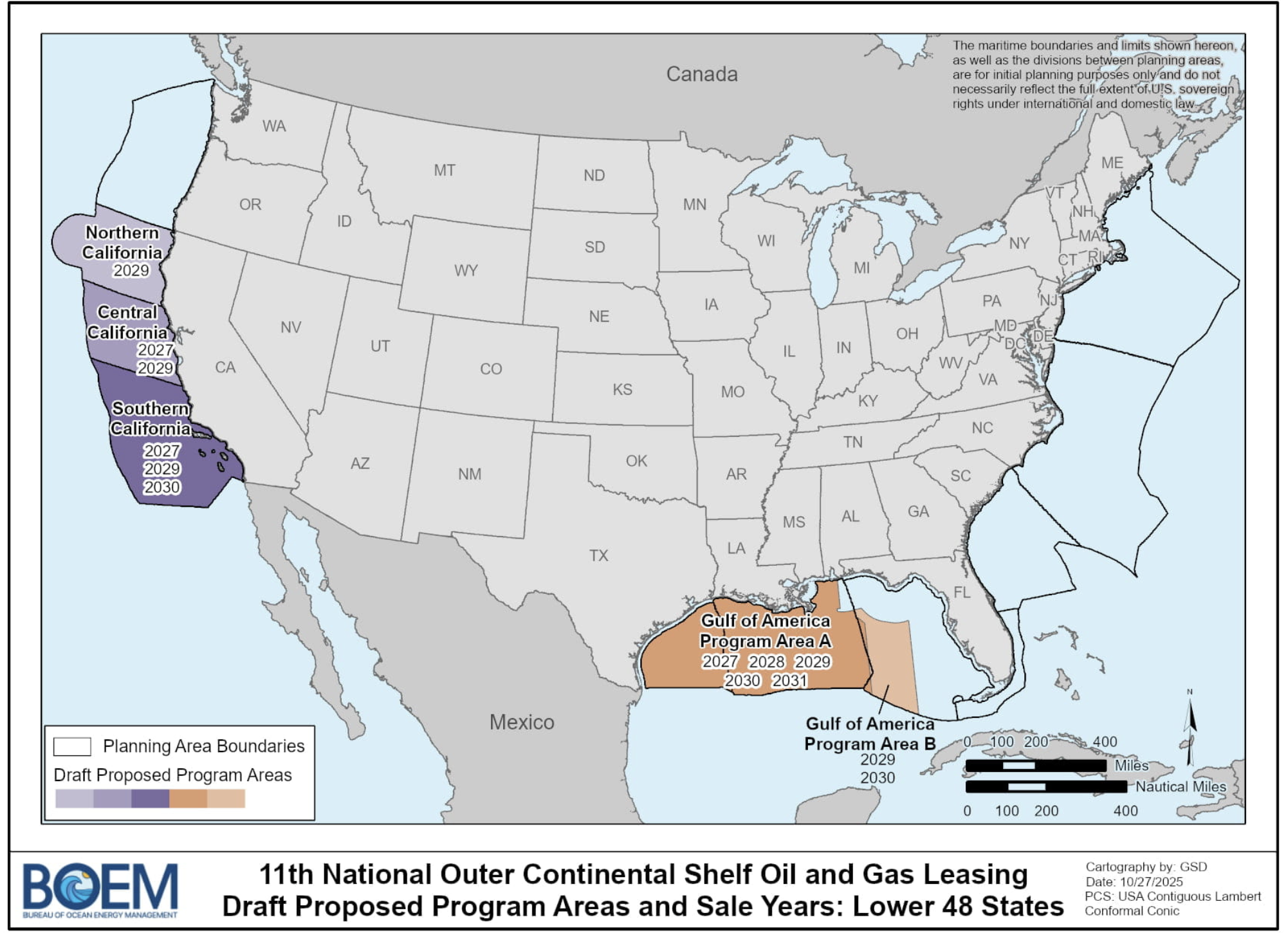
The Trump administration is replacing that plan with a tentative 2027–2032 program that proposes 34 lease sales across approximately 1.27 billion acres that include waters off the entire California coast, much of Alaska’s coast, including in the Arctic, and in the eastern Gulf of America.
The administration’s plan, the largest expansion of offshore drilling in decades, faces bipartisan pushback, including from West Coast governors and state lawmakers, and from Florida legislators who have traditionally opposed drilling off their state’s Gulf coast as potentially detrimental to the state’s tourist industry.
Florida Objections
Interior Secretary Doug Burgum issued an order in November 2025 terminating the Biden administration’s 2024–2029 plan, to be supplanted by the 11th National Outer Continental Shelf Oil and Gas Leasing Program by October 2026.
The new plan proposes opening the entire California coastline to oil leasing for the first time since 1984 with six lease sales between 2027 and 2030.
It pencils in more than 20 lease sales off Alaska, from the Arctic to Cook Inlet, and would open areas in the eastern Gulf of America now exempted by multi-administration presidential moratoriums, allowing lease sales in 2029 and 2030.
During April 20 and May 13 House hearings on Interior’s proposed budget, Burgum testified that expanded lease sales would accelerate momentum established during the Trump administration’s first year—a record 714 million barrels of oil in 2025 from Gulf of America rigs—and generate billions of dollars in federal revenue.
“By committing to a predictable lease sale schedule, the department is delivering on President [Donald] Trump’s promise to expand American energy production and strengthen U.S. energy independence,” he told the House Natural Resources Committee in the May hearing. “These lease sales will serve as the backbone of America’s energy portfolio for years to come by providing for a predictable stream of new exploration and drilling needed to facilitate future production, ensuring American citizens and industry have access to reliable, affordable energy.”
Florida’s congressional delegation, including Republican Sens. Rick Scott and Ashley Moody, as well as the state’s GOP-dominated legislature and Gov. Ron DeSantis, have objected to any proposed oil drilling in the eastern Gulf.
Rep. Randy Webster (R-Fla.) questioned Burgum in the May hearing on the proposed eastern Gulf lease sales planned for 2029 and 2030.
“Balancing is key,” the secretary said, noting the department is “in the middle” of its long-range planning with a proposed finalized plan set for October.
“If there’s specific input that you have,” Burgum told Webster, “we’d love to hear from you as we go through the next round following the law in terms of us holding required leases for offshore energy production.”
Safety, Environmental Doubts
Democrats and some Republicans have questioned, for different reasons, how the merged Maritime Minerals Administration with fewer staff can efficiently handle the dramatic increase in workload.
Rep. Luz Rivas (D-Calif.) said in early May that a fire on a natural gas rig in the Santa Barbara Channel injured two of its 26 evacuated workers. She said that with the Bureau of Safety and Environmental Enforcement’s and Bureau of Ocean Energy Management’s incorporation into the Marine Minerals Administration, many fear safety and environmental concerns will be short-circuited.
Both bureaus were created to establish “a purposeful separation” of safety from permitting and revenue collection agencies to address glaring oversights cited by an analysis made by the Interior Department’s Inspector General of the Deepwater Horizon accident, Rivas said, accusing the administration of “ignoring history” at the behest of the nation’s oil industry.
“As a Californian, I think this proposal will result in more risk for our coasts, less staff, less funding,” she said. “There are communities in California that are still recovering from these oil spills, fires, and explosions. The families along the California coast deserve answers.”
Burgum said the merger is actually a reunification of agencies under one pre-Deepwater Horizon office and is “a strategic step toward a more modern, coordinated approach to offshore resource management.”
“The agency will better align resource planning, leasing decisions and operational oversight under a unified structure, reducing duplication and improving decision-making across the full lifecycle of offshore development,” he said.
Burgum said the 220 fewer employees in the proposed fiscal year 2027 budget means “less people in HR, less people in comms, less people in overhead jobs, less managerial jobs, and more people actually doing the work” that the agencies were created to do.
“The congresswoman and I would agree we want more inspectors,” Burgum said. “We want increased safety. We want to do that.”
He also said that the permitting and revenues components remain separate from the safety and environmental regulatory operations.
“Our estimate is we can have more inspection and more inspectors with more frequent visitors in offshore locations if we unify than if we don’t,” he said. “So I think we all agree on the objective, that it’s safety first.”
The pending merger, or reunification, of the Bureau of Ocean Energy Management and Bureau of Safety and Environmental Enforcement into the Marine Minerals Administration is one of three intertwined agency consolidations outlined in Interior’s proposed budget, itself one of 12 annual appropriations bills that constitute the federal budget for the fiscal year that begins on Oct. 1.
Also included in the proposed annual spending plan is the consolidation of wildland firefighters from the Department of Agriculture’s Forest Service with those from Interior’s Bureau of Land Management, Fish and Wildlife Service, Bureau of Indian Affairs, and National Park Service, and the partial incorporation of the Commerce Department’s National Oceanic and Atmospheric Administration’s fishery offices’ responsibilities under the Endangered Species Act into Interior’s Fish and Wildlife Service.
 Friends Read Free
Copy
Facebook
Tweet
Friends Read Free
Copy
Facebook
Tweet