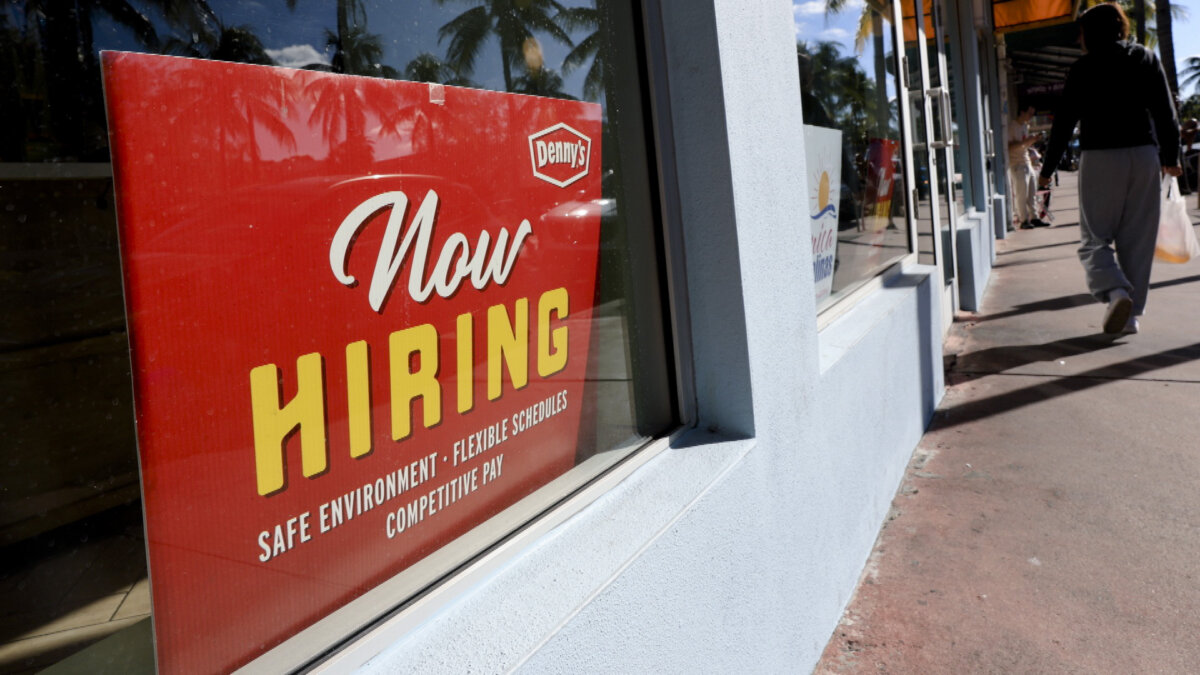

U.S. private-sector payroll losses accelerated in the past four weeks, signaling further deterioration in the national labor market, new data released on Nov. 25 reveal.
For the four-week period that ended on Nov. 8, private companies lost an average of 13,500 jobs per week, according to payroll processor ADP’s weekly running estimate.
This is up from the previous update, suggesting that firms shed an average of 2,500 positions per week.
Due to the government shutdown, key economic indicators such as employment and inflation have been delayed, forcing economic observers to place greater emphasis on alternative measures. The monthly nonfarm payrolls report for November will not be released until late December.
Looking ahead, job growth might remain slow amid easing labor demand and a shrinking pool of workers, according to Nela Richardson, chief economist at ADP.
“With labor supply and demand both slowing, economists are on the lookout for a new break-even rate. That’s the minimum number of jobs the economy needs to add each month to keep the unemployment rate steady,” Richardson said in the report.
“But over the next decade, it will be difficult to find and maintain a balance in the labor market.”
For now, a plethora of government and private-sector data have presented a mixed view of employment conditions.
In September, for example, the U.S. economy created 119,000 new jobs, topping market expectations, while the unemployment rate edged up to 4.4 percent, from 4.3 percent in the previous month.
Even with the better-than-expected payroll growth, the jobless rate rose because more people entered the workforce and started looking for jobs. If the number of job seekers outpaced the number of jobs created, the unemployment rate would increase.
But Federal Reserve Board member Christopher Waller expects that the September gain will be revised by as much as 60,000 in the spring when the Quarterly Census of Employment and Wages is released.
Waller has struck a more dovish tone in recent months, regularly ringing alarm bells about a further softening in the U.S. labor market and citing indicators that point to deteriorating employment conditions.
For example, September’s job gains were centered mainly in health care and leisure and hospitality: 43,000 and 37,000, respectively. Social assistance also added 14,000 to the final tally.
“That’s not a good sign for the health of the labor market across the board,” Waller said in a Nov. 24 interview with Fox Business. “[Artificial intelligence] is clearly an issue that everybody’s talking about in terms of labor. So, it’s just not something I see turning around. I’m hearing no anecdotal evidence whatsoever that firms are going to start going on a hiring binge.”
The U.S. central bank has been ensconced in debate as to which side of the dual mandate—maximum employment and price stability—to focus on moving forward.
Employment or Inflation
A growing chorus of monetary policymakers has joined Waller in concentrating on the labor market.
In a Nov. 21 speech in Chile, New York Federal Reserve Bank President John Williams said that the downside risks to employment have intensified, while upside risks to inflation have diminished.
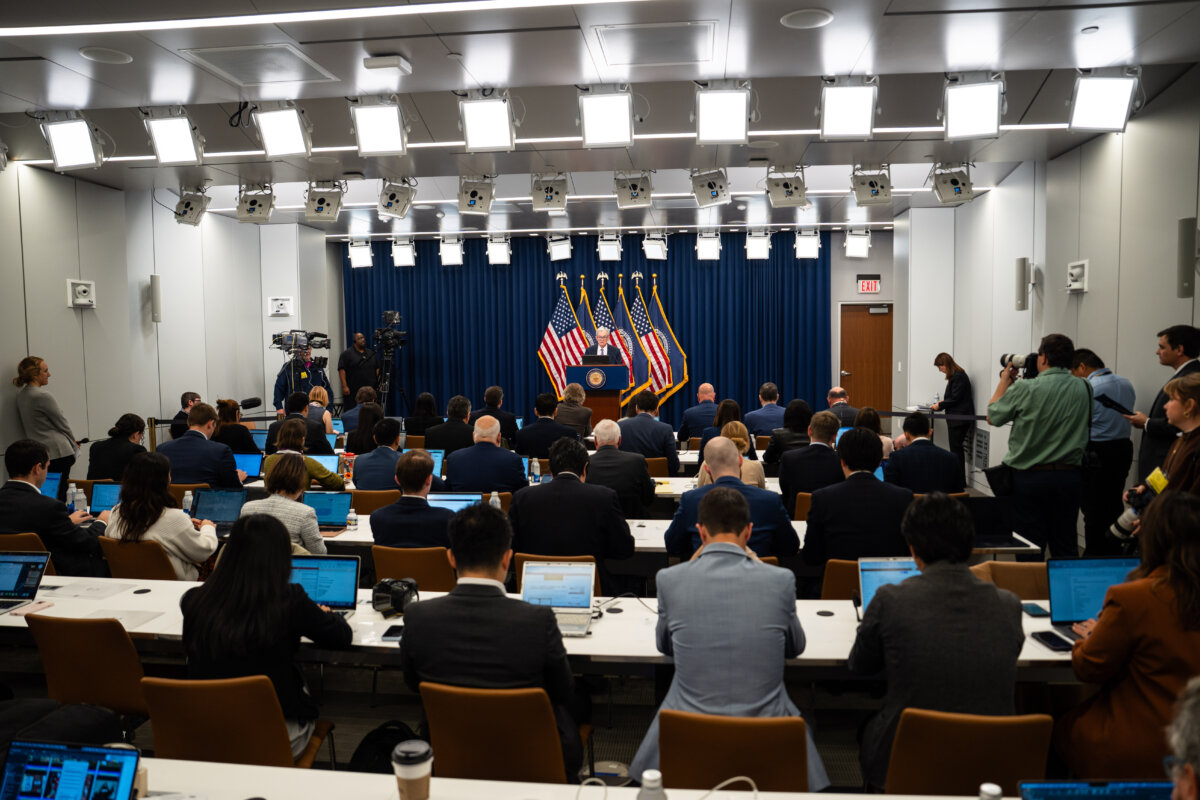
“Economic growth has slowed from its pace last year, and the labor market has gradually cooled,” Williams said in prepared remarks.
“In particular, indicators of the balance between labor demand and supply, including the unemployment rate, have gradually softened over the past year, reaching levels seen prior to the pandemic when the labor market was not overheated.”
Absent of government economic data, it has been harder to gauge inflation.
The September producer price index (PPI)—a measure of prices paid by businesses for goods and services—rose by 0.3 percent, from a 0.1 percent decline in August, the Bureau of Labor Statistics reported on Nov. 25. Core producer inflation, which strips out the volatile energy and food components, ticked up at a lower-than-expected pace of 0.1 percent.
Economists pay close attention to the PPI because it can serve as a pipeline indicator of future consumer inflation while companies pass their costs onto customers.
Market watchers and Fed officials will not get the next batch of inflation data until Dec. 5, when the personal consumption expenditures (PCE) price index for September is released. The PCE is the central bank’s preferred inflation gauge because it is broader, updated more frequently, and better aligned with the gross domestic product.
The 12-month PCE price index is expected to come in at 2.8 percent, according to the Cleveland Fed’s Inflation Nowcasting Model. The October and November annual PCE inflation readings are projected to be 2.7 percent and 2.9 percent, respectively.
Boston Fed President Susan Collins recently said she opposes lowering interest rates at next month’s meeting because of persistent inflation challenges and employment staying “relatively healthy.”
“Inflation remains elevated, largely goods, largely tariff-associated,” Collins said during an interview with CNBC’s “Squawk Box” on Nov. 21.
Investors are betting on an 83 percent chance that the Fed will follow through on a third consecutive quarter-point interest-rate cut at the conclusion of its Federal Open Market Committee policy meeting on Dec. 9 and Dec. 10, according to the CME FedWatch Tool.
Such an action would lower the benchmark federal funds rate—a key interest rate that influences borrowing costs for businesses and households—to a new target range of between 3.5 percent and 3.75 percent.
 Friends Read Free
Copy
Facebook
Tweet
Friends Read Free
Copy
Facebook
Tweet