
The recent jump in oil prices due to the Iran war is “a very small price to pay for U.S.A., and World, Safety and Peace,” President Donald Trump said in a March 8 post on Truth Social amid oil prices shooting past the $100 per barrel level.
“Only fools would think differently!” Trump said. The short-term rise in oil prices “will drop rapidly when the destruction of the Iran nuclear threat is over.”
Brent crude oil futures ended trading on March 6 at around $92.69 per barrel. On Monday, it opened trading at $101.69.
West Texas Intermediate crude oil futures surged from Friday’s closing price of around $90.90 to open trading on Monday at $101.10.
The Iran conflict began after U.S. and Israeli forces launched coordinated strikes against the Iranian regime on Feb. 28 under Operation Epic Fury. The war entered its 10th day on Monday.
According to data from the American Automobile Association, the national average price for regular gasoline was $3.47 per gallon on March 9, up over 16 percent from a week back.
In California, gas prices have exceeded $5 per gallon. Prices in four states—Washington, Hawaii, Nevada, and Oregon—have crossed $4 per gallon.
The continued conflict in the Middle East has “injected a significant geopolitical risk premium into energy markets,” Patrick De Haan, head of Petroleum Analysis at GasBuddy, said in a March 8 post on X.
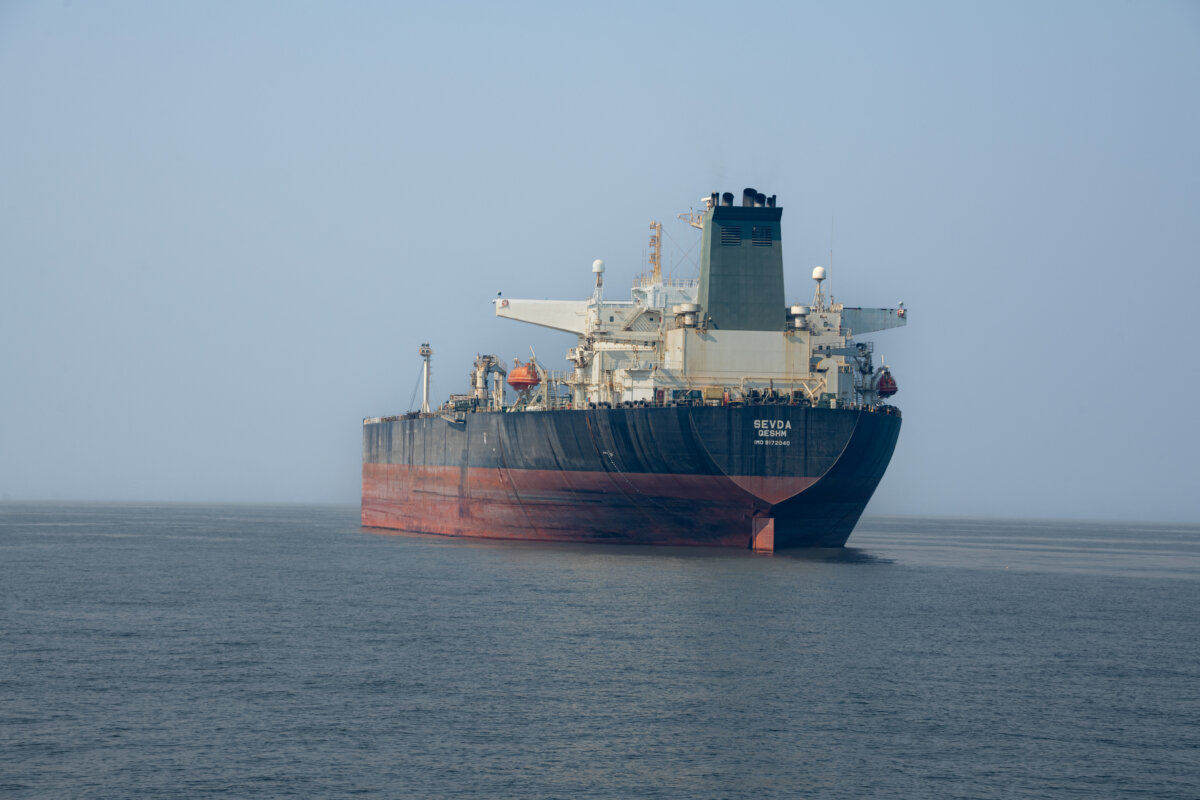
“Traders are increasingly concerned about the possibility of supply disruptions in the region, particularly involving shipping through the Strait of Hormuz, a critical chokepoint through which roughly a fifth of the world’s oil supply moves,” De Haan wrote.
“Despite the large jump already seen, gasoline prices are likely to rise further this week,” the energy expert said. “Wholesalers and refiners may implement rare ‘intra-day’ price increases at fuel terminals starting Monday morning as they move to pass along the higher cost of crude oil. This could trigger a second wave of gasoline price increases, particularly in states that use price cycling systems such as Michigan, Indiana, Ohio, Illinois, Kentucky, Texas, Florida, Colorado, North Carolina, and South Carolina.”
De Haan suggested an 80 percent chance that the national average gasoline price hits $4 per gallon within the next month or sooner, which would be the first time since August 2022 that Americans have faced such prices. This week alone, prices could jump to a range of $3.75–$3.95 per gallon.
Every one-cent jump in national average gasoline prices requires Americans to shell out roughly $3.7 million more per day, De Haan wrote.
Supply Disruption
In a March 9 report, ING Bank said the oil market was increasingly pricing in a longer supply disruption from the Persian Gulf. With signs of the conflict deteriorating further, oil output from the region has started getting curtailed.
“Iraq, Kuwait, and the UAE began reducing oil production. Iraq, the first to start cutting supplies last week, has reportedly reduced output by around 1.5m b/d. Meanwhile, over the weekend, Kuwait reportedly cut output by as much as 300k b/d,” ING said. B/d refers to barrels per day of oil.
“The longer this goes on, the more supply we will see shut-in. This is a concern for markets. Even if flows through the Strait of Hormuz start to resume, it will take time for upstream production to ramp up. The combination of these production shut-ins and no signs of de-escalation in the war means the market is having to aggressively price in a prolonged supply disruption.”
As such, as long as oil does not move through the Strait of Hormuz, oil prices are set to only move higher, the bank said.
The Trump administration has taken action to stabilize oil prices and ease the burden on Americans. Washington has created a $20 billion federal reinsurance program for commercial oil and gas vessels in order to restore shipments via the Strait of Hormuz.
Under the measure, the U.S. International Development Finance Corporation (DFC) will provide a maritime reinsurance facility that insures losses of up to $20 billion, the agency said in a March 6 statement.
“DFC coverage will offer a level of security no other policy can provide,” CEO Ben Black said. “We are confident that our reinsurance plan will get oil, gasoline, LNG, jet fuel, and fertilizer through the Strait of Hormuz and flowing again to the world.”
 Friends Read Free
Copy
Facebook
Tweet
Friends Read Free
Copy
Facebook
Tweet