
Kevin Hassett, National Economic Council director, has said he is “very, very confident” that the courts will support President Donald Trump’s tariff plans.
In a June 1 interview on ABC’s “This Week,” the president’s top economic adviser said he believes that the administration’s “Plan A” will be successful.
“And so we’re very thrilled,” Hassett said. “We are very confident that the judges would uphold this law. And so I think that that’s Plan A, and we’re very, very confident that Plan A is all we’re ever going to need.”
However, should judges rule against the president, the White House will “have other alternatives” to explore to ensure that it makes “American trade fair again,” Hassett said.
A federal court recently ruled that the president cannot invoke the International Emergency Economic Powers Act to impose universal baseline and “reciprocal” tariffs. An appeals court paused the U.S. Court of International Trade’s ruling.
If the White House fails to convince the court that the United States will be harmed if the injunction is allowed to remain in place, there are other tools that U.S. officials can employ, according to experts.
The Trade Act of 1974
In 1973, Rep. Al Ullman (D-Ore.) introduced the Trade Act of 1974, which was signed into law by President Gerald Ford in 1975.
The legislation’s purpose was to grant the president more authority when discussing trade agreements and responding to unfair trade practices. Specifically, the legislation fast-tracks negotiating power, which enhances the United States’ bargaining advantage.
Over the past week, experts have focused on two key provisions: Section 122 and Section 301.
Section 122 permits a president to impose tariffs of up to 15 percent for 150 days on imports from countries with large trade surpluses. A president can also institute quantitative limits on goods arriving from foreign markets.
While it is a short-term trade remedy, experts said the chief advantage for the administration is that Section 122 does not require a formal investigation.
“Such a move would be the quickest workaround but would require congressional approval after 150 days,” Bernard Yaros, lead U.S. economist at Oxford Economics, said in a May 29 research note. “Nevertheless, it would effectively buy the administration time to pursue higher tariffs through other, more durable, legal means.”
To date, this part of the 1974 law has not been invoked.
Section 301, meanwhile, extends to the president broad authority to tackle unfair trade practices, such as tariffs, sanctions, and other countermeasures.
Additionally, the U.S. trade representative is empowered to investigate and respond to policies that the administration views as violating trade agreements or discriminating against U.S. goods and services.
However, if the provision is implemented, there are two challenges for the administration to overcome.
First, the U.S. trade representative is required to try to negotiate a resolution before slapping penalties on other countries. Second, the United States must also pursue a resolution through the World Trade Organization before taking unilateral action.
Over the past four decades, presidents have used it in selective cases. For example, in the 1980s and 1990s, the United States tapped the measure to pressure Japan to open its markets to U.S. goods. Moreover, during his first term, Trump used Section 301 against China regarding intellectual property theft.
Section 232
In October 1962, President John F. Kennedy signed the Trade Expansion Act of 1962, considered a historic trade law. A vital provision in the legislation is Section 232, which allows the president to implement levies on imports that threaten national security.
Presidents on both sides of the aisle have regularly invoked Section 232, from Libya’s crude oil shipments in 1982 to Japan’s metal-cutting and forming machine tools in 1986.
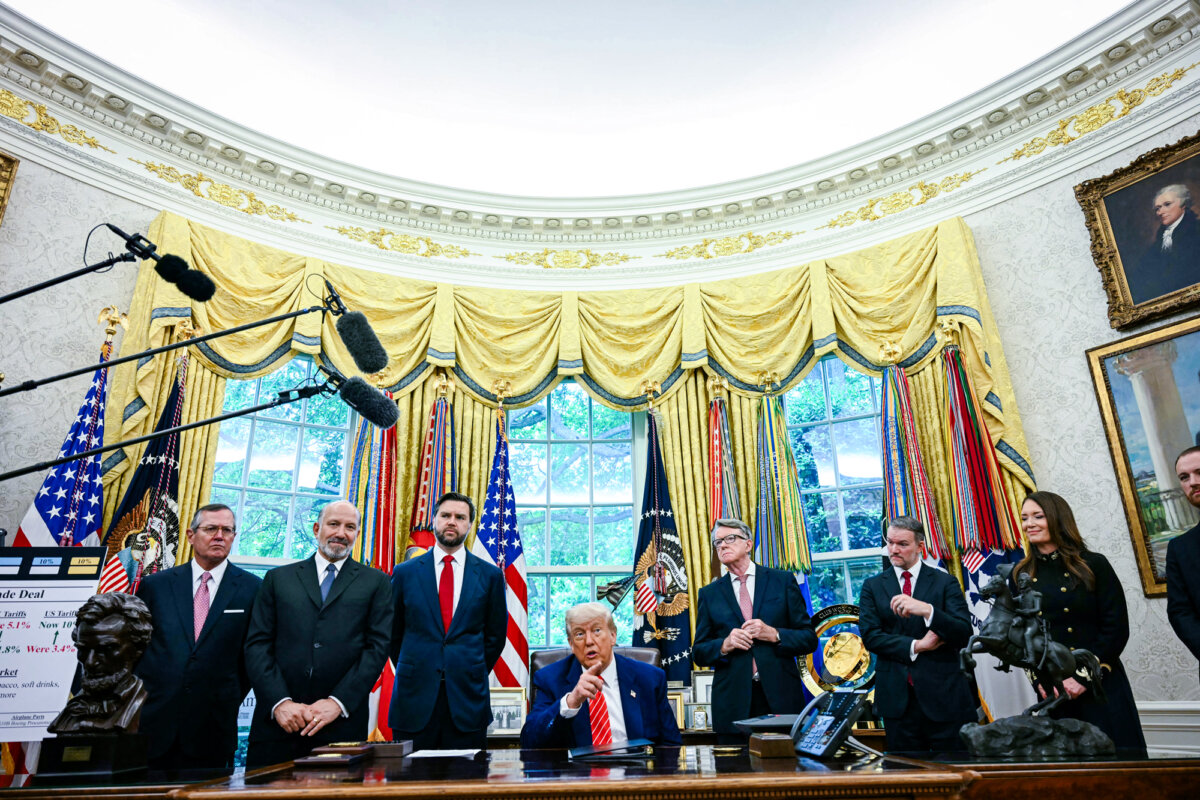
Trump has used Section 232 to justify tariffs on foreign automobiles, aluminum, and steel. Experts said the president could rely on Section 232 but would need to broaden the provision to other sectors.
While the current administration will focus its efforts on fighting the court ruling, officials will start to prepare “for a more surgical increase in tariffs beginning this summer following Section 232 trade investigations into strategic industries like pharmaceuticals, critical minerals, lumber, copper, and semiconductors,” UBS strategists said on May 28.
“These sectors were initially excluded from the 10 percent baseline tariff because President Trump had intended to levy separate tariffs to reduce the U.S.’s reliance on foreign producers of these products by encouraging domestic production,” the strategists wrote.
Section 338
The Tariff Act of 1930, also known as the Smoot-Hawley Tariff Act, contains Section 338, a trade provision that authorizes the president to implement new tariffs or additional duties of up to 50 percent on foreign products entering the United States.
A president can invoke this measure if it has been determined that a foreign country has imposed hefty tariffs or erected nontariff trade barriers.
In the 1930s, President Franklin Delano Roosevelt considered invoking the law against Australia and Germany.
The Roosevelt administration ultimately refrained from applying higher tariff rates on Australian goods. However, Roosevelt did withdraw several trade benefits, including favorable treatment; investment incentives; and access to key markets, such as minerals, wheat, and wool.
This forced Australia to reconsider its trade strategy, focusing on improving trade relations with China and the UK.
Germany, meanwhile, also saw its trade benefits reduced. At the time, Berlin bolstered trade relations with European countries, particularly Italy and the Soviet Union. The United States gradually stripped away the country’s trade privileges, resulting in a sharp decline in German shipments.
One last road to travel, experts at Fisher Investments said, is to abandon the president’s comprehensive tariff agenda.
“The administration could do a 180 and use this as an offramp to ditch tariffs during the appeals process, bowing to political pressure ahead of next year’s midterms,” they said in a May 29 note, alluding to various polls indicating lackluster support for these levies.
While the president’s approval rating has trended upward in recent weeks—a new Rasmussen Reports survey highlighted a 53 percent approval rating—various surveys have indicated deteriorating support for tariffs.
A new Marquette University poll found that 37 percent of respondents approved of tariffs, and 63 percent disapproved of the president’s tariff plans.
Still, last week’s consumer survey results spotlighted recovering attitudes about the broader economy.
The University of Michigan’s May Consumer Sentiment Index was revised slightly higher from the preliminary estimate earlier in the month. The Conference Board’s May Consumer Confidence Index registered its sharpest monthly increase in more than four years.
 Friends Read Free
Copy
Facebook
Tweet
Friends Read Free
Copy
Facebook
Tweet