
President Donald Trump said on Feb. 23 that he may implement higher tariffs on countries that “play games” following last week’s Supreme Court ruling.
Over the weekend, the president rolled out a new round of tariff hikes, raising the temporary import duty on all foreign goods entering the United States to 15 percent from 10 percent.
But Trump suggested that nations choosing not to proceed with trade deals they agreed to could face higher tariff rates.
“Any Country that wants to ‘play games’ with the ridiculous Supreme Court decision, especially those that have ‘Ripped Off’ the U.S.A. for years, and even decades, will be met with a much higher Tariff, and worse, than that which they just recently agreed to,” he said in a Feb. 23 Truth Social post.
“Buyer beware!”
The high court ruled 6–3 on Feb. 20 that some of the president’s global tariffs exceeded the authority granted by an emergency powers law passed by Congress.
Shortly after the decision, Trump told reporters that his administration would pursue alternatives to ensure that his trade agenda is implemented.
He signed an executive order invoking Sections 122 and 301 of the Trade Act of 1974 hours later, effectively imposing a 10 percent global tariff rate for 150 days.
Extending the levy will require congressional approval, although the president disputed this provision.
“As President, I do not have to go back to Congress to get approval of Tariffs,” Trump said on his social media platform.
“It has already been gotten, in many forms, a long time ago! They were also just reaffirmed by the ridiculous and poorly crafted Supreme Court decision!”
Earlier in the day, Trump continued criticizing the Supreme Court’s decision, calling it a “very internationally divisive ruling.”
U.S. stocks tanked after Trump’s latest Truth Social post.
The blue-chip Dow Jones Industrial Average fell by more than 600 points amid growing trade confusion.
The tech-driven Nasdaq composite index and the broader S&P 500 fell by about 0.6 percent.
State of Trade Deals
Questions have been raised about whether countries will stick to the agreements they established with the Trump administration over the past several months.
“So in places like Vietnam or India, are they going to keep their side of the arrangement that gives us much more fair access to their markets and also the investments in the United States?” Arthur Laffer Jr., president of Laffer Tengler Investments, said in a note emailed to The Epoch Times.
U.S. Trade Representative Jamieson Greer said no country has signaled plans to withdraw from these deals.
The bilateral pacts were not made on the premise of the Supreme Court’s ruling, he said in an interview with CBS’s “Face the Nation” on Feb. 22.
“We expect our partners to stand by them,” Greer said. “I haven’t heard anyone yet come to me and say, ‘The deal is off.’”
Foreign officials have reached out to the White House seeking clarity, according to Greer.
“They want to see how this plays out,” he said.
Countries have suggested that they will assess the high court’s decision and wait for more information.
The Chinese Ministry of Commerce said on Feb. 23 that it would perform a “comprehensive assessment,” noting that reciprocal tariffs violate U.S. and international laws.
Trump will make a three-day visit to China next month, the White House said last week.
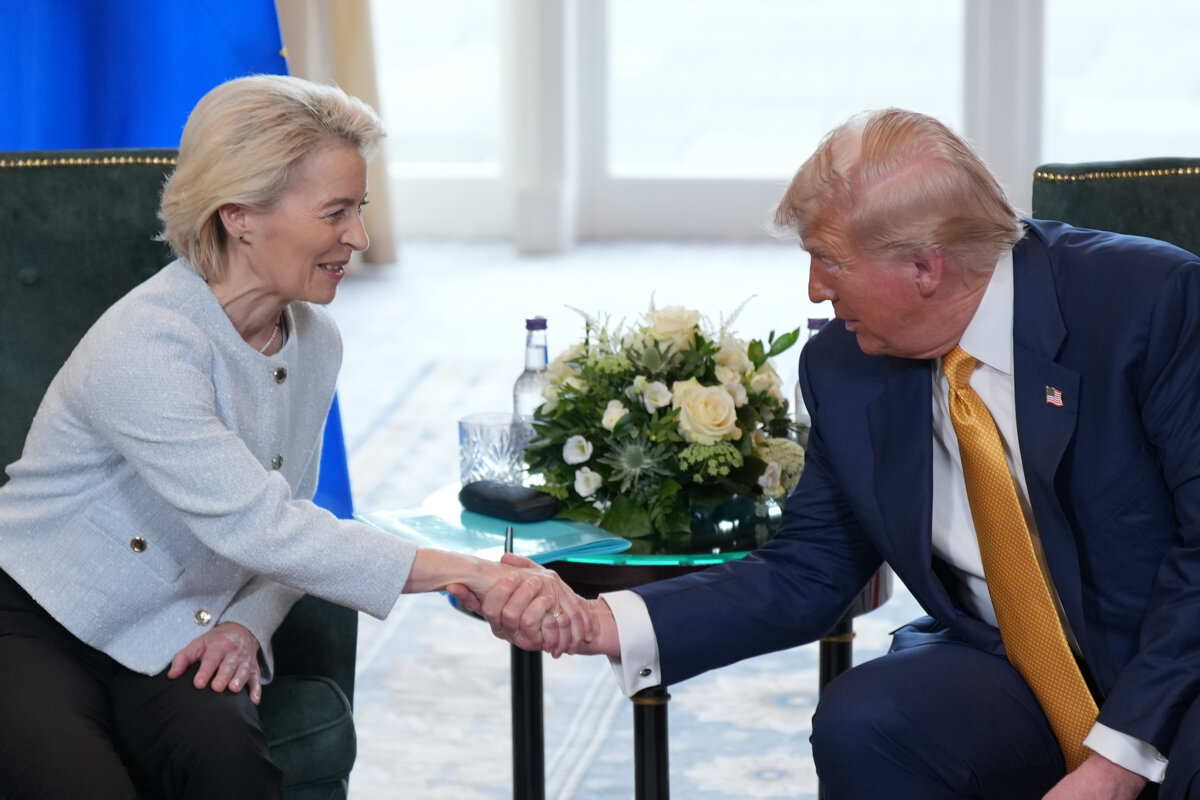
The European Commission, in a weekend statement, said the bloc’s leaders would not accept higher U.S. tariffs.
“The commission will always ensure that the interests of the European Union are fully protected,” the European Commission said in a Feb. 21 statement.
“EU companies and exporters must have fair treatment, predictability, and legal certainty.
“A deal is a deal. As the United States’ largest trading partner, the EU expects the U.S. to honour its commitments set out in the Joint Statement—just as the EU stands by its commitments.”
In July, the United States and the European Union reached a trade agreement that would ease tensions on both sides of the Atlantic and bolster market access for U.S. goods.
European Central Bank President Christine Lagarde, appearing on CBS’s “Face the Nation,” said it is essential for countries’ economic stability to have greater “clarity” on the future of their trade relationships with the United States.
Given that this administration has concentrated on carrying out the president’s trade objectives, foreign governments may need to be careful about reneging on these deals, according to Laffer.
“This president is laser-focused on this agenda because it really is the pillar to the rest of his political agenda,” he said.
Until then, the United States is adapting to the new tariff rules.
Customs and Border Protection said the administration will end collections of tariffs deemed illegal “on or after 12:00 a.m. Eastern Time” on Feb. 24.
Jacob Burg, Sam Dorman, and Aldgra Fredly contributed to this report.
 Friends Read Free
Copy
Facebook
Tweet
Friends Read Free
Copy
Facebook
Tweet