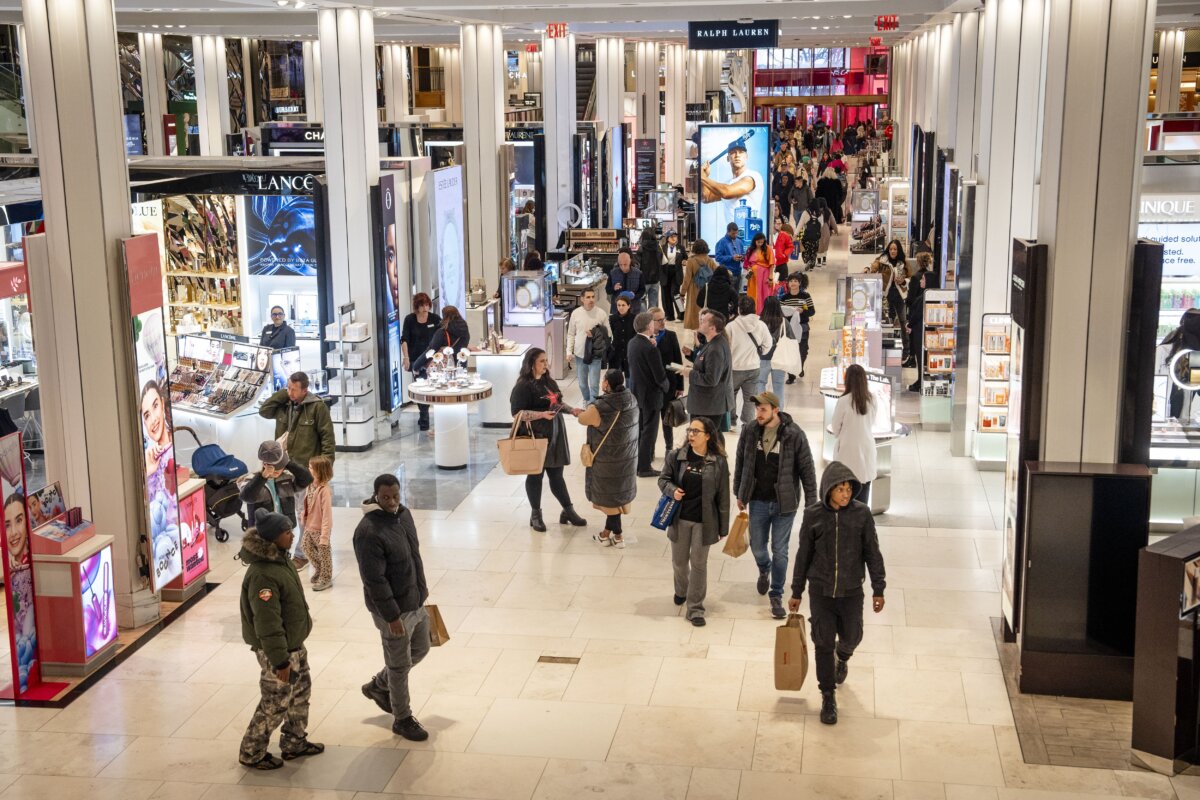

U.S. business activity accelerated in October even as consumers turned slightly more downbeat, a split tone that points to steady corporate output and fragile household confidence amid lingering inflation pressures and the ongoing federal government shutdown.
S&P Global’s flash U.S. composite purchasing managers’ index, released on Oct. 24, rose to 54.8 in October from 53.9 in September, marking the strongest pace of growth since July. Readings higher than 50 indicate expansion, and the October reading suggests a quickening of economic activity heading into the final quarter of the year.
“October’s flash [purchasing managers’ index] data point to sustained strong economic growth at the start of the fourth quarter, with business activity picking up momentum across both manufacturing and services despite some reports of businesses being adversely impacted by the government shutdown,” Chris Williamson, chief business economist at S&P Global Market Intelligence, said in a statement.
“The survey data are consistent with the economy expanding at a 2.5 [percent] annualized rate in October after a similar rise was signalled for the third quarter.”
Businesses reported further gains in new orders and hiring, although both advanced at a more moderate pace. Firms cited higher input costs, yet selling prices rose at the slowest rate since April, suggesting that companies were reluctant to pass on costs to customers.
“Although input costs continued to rise sharply again in October, principally reflecting the pass-through of tariffs, average selling price inflation has cooled to the lowest since April as firms compete on price to win sales,” Williamson said.
The survey also found that manufacturing inventories swelled at a record pace as sales growth weakened, an imbalance that could further ease goods inflation in the coming months if firms begin discounting excess stock.
Meanwhile, business confidence deteriorated to one of the lowest levels in three years, with companies citing concerns over tariffs and government policies even as lower Federal Reserve interest rates offered some support to sentiment.
“Companies are also concerned over disappointing export sales, especially in manufacturing, and factories are seeing an unprecedented rise in unsold stock,” Williamson said.
“Having bought excess inputs earlier in the year to front-run tariffs, producers are making more goods to use up these inputs but are often struggling to sell the end product to customers.”
The Fed lowered its benchmark interest rate by 25 basis points during its most recent policy meeting at the end of September to a range of 4 percent to 4.25 percent and signaled more cuts ahead.
Central bank officials have said job gains have slowed, inflation remains “somewhat elevated,” and the unemployment rate has “edged up but remains low.”
Consumers and Corporate Leaders More Guarded
In contrast with the upbeat business data, the University of Michigan’s final October survey showed consumer sentiment slipping to 53.6 from 55.1 in September, a 2.7 percentage point monthly drop and down 24 points from a year earlier.
The index of current conditions fell to 58.6 from 60.4, and the expectations gauge declined to 50.3 from 51.7. The university’s director of consumer surveys, Joanne Hsu, said that Americans perceive “few material changes in economic circumstances from last month” but that concerns about high prices remain dominant.
“Inflation and high prices remain at the forefront of consumers’ minds,” Hsu said in a statement.
“There was little evidence this month that consumers connect the federal government shutdown to the economy.”
Short-term inflation expectations dipped to 4.6 percent from 4.7 percent in October, but long-run expectations rose to 3.9 percent from 3.7 percent, a move driven primarily by independents and Republicans, according to Hsu. Inflation uncertainty ticked up for both time horizons.
The University of Michigan survey suggests greater household caution, which could temper consumer spending, even as corporate output and hiring remain steady.
That divergence was also reflected in The Conference Board’s CEO confidence index, which fell to 48 in the fourth quarter from 49 in the previous quarter, with nearly two-thirds of corporate leaders expecting mild stagflation—a mix of slow growth and persistent inflation—over the next year.
“CEO confidence weakened slightly in the fourth quarter, signaling continued caution among leaders of large firms,” Stephanie Guichard, senior economist at The Conference Board, said in a statement.
“Views of general economic conditions now versus six months ago remained slightly negative, while [CEOs’] six-month expectations for the economy turned from neutral to pessimistic.”
Even so, some signs of resilience emerged. Twenty-two percent of CEOs said they plan to increase capital spending, up from 15 percent in the previous quarter, and more firms expect to expand headcounts rather than cut them.
 Friends Read Free
Copy
Facebook
Tweet
Friends Read Free
Copy
Facebook
Tweet