
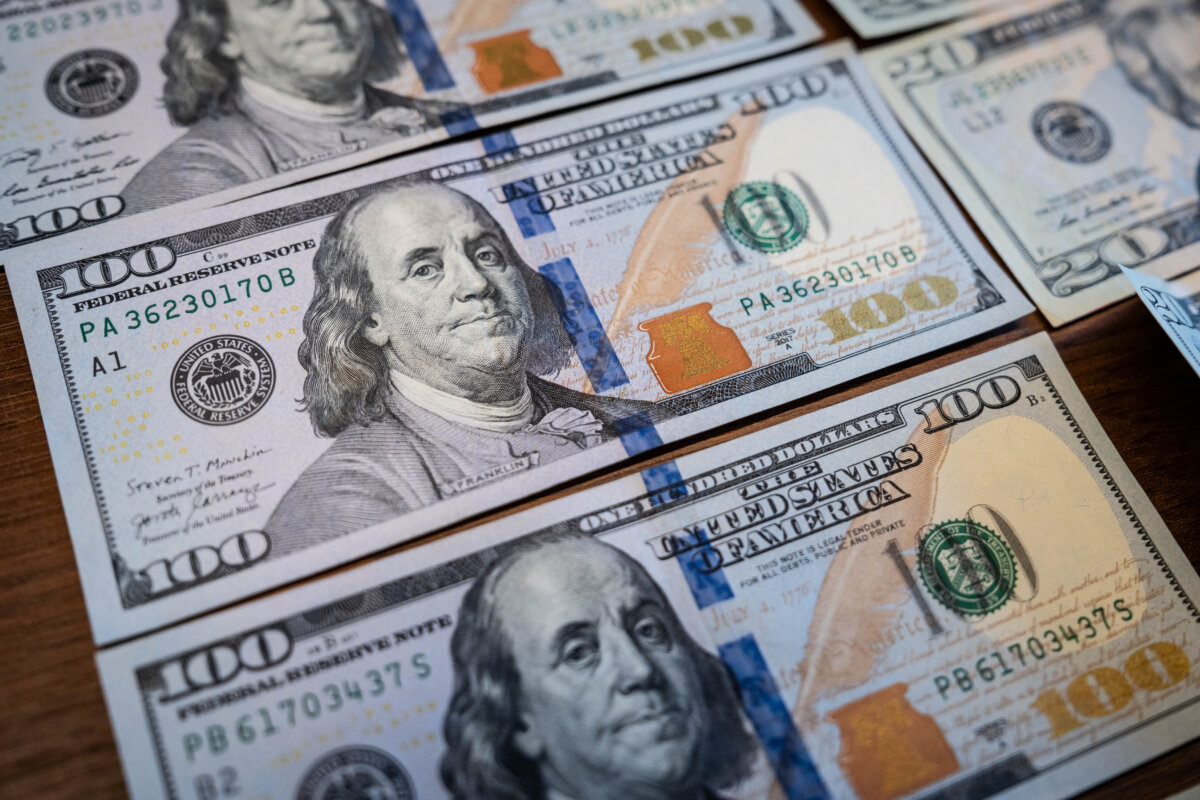
The U.S. dollar surged during the March 20 trading session after investors began pricing in a Federal Reserve rate hike later this year.
The U.S. Dollar Index—a measure of the greenback against a weighted basket of currencies—climbed 0.5 percent, adding to its year-to-date gain of 1.4 percent.
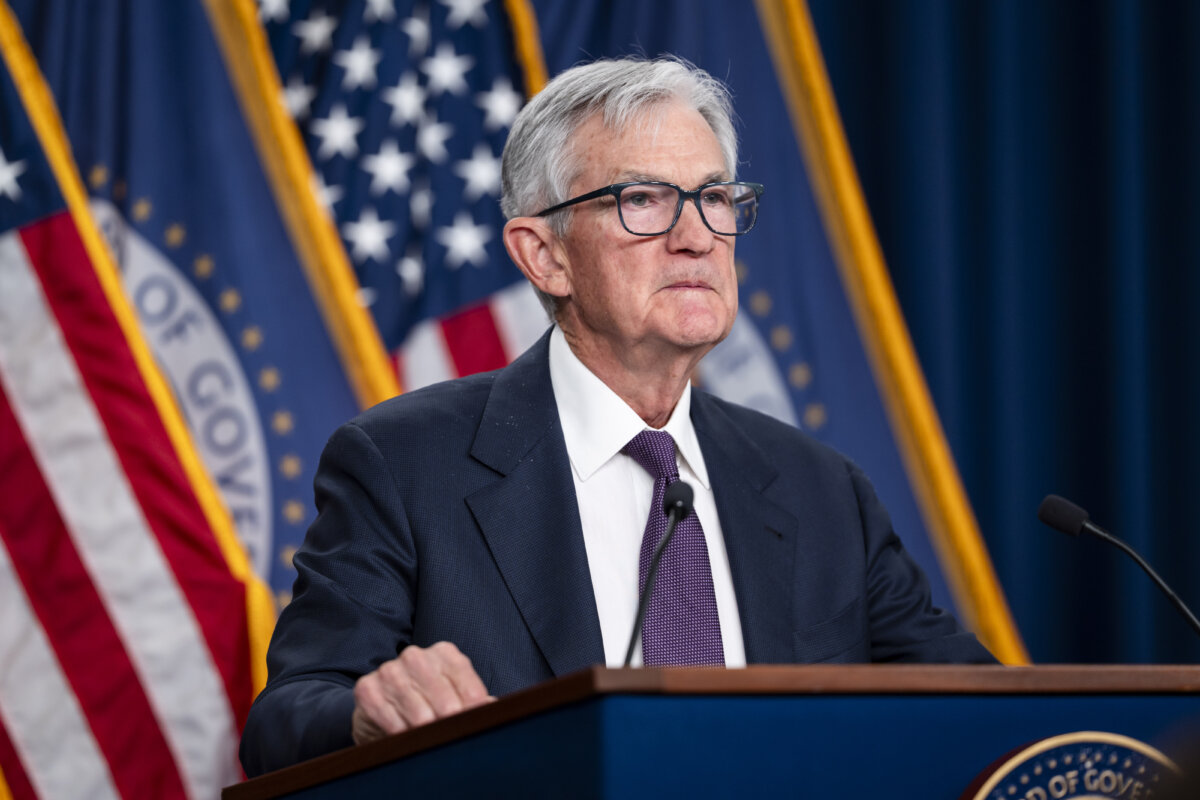
For the second consecutive meeting, monetary policymakers discussed that the next action could be raising interest rates, Fed Chair Jerome Powell said at the post-meeting news conference.
“The possibility that our next move might be an increase did come up at the meeting, as it did at the last meeting,” Powell said.
“The vast majority of participants don’t see that as their base case. And of course, we don’t take things off the table.”
While the idea of a rate hike may have been inconceivable several months ago, this is the first time since the easing cycle began that Powell has not definitively ruled out an increase.
Futures market data indicate that investors are gradually pricing in a tighter monetary policy stance.
Traders are betting on a 50 percent chance of a quarter-point jump to the target federal funds rate at either the October or December Federal Open Market Committee meeting, according to the CME FedWatch tool.
Fed officials and financial markets are spooked by elevated inflation and the potential oil price shock from the war in Iran.
The central bank is also waiting for President Donald Trump’s tariffs to work their way through the economy.
Before the Iranian conflict, renewed price pressures emerged, particularly in producer inflation.
February’s Producer Price Index—a gauge of prices paid for goods and services by businesses—rose at a higher-than-expected pace of 0.7 percent. The metric had also climbed 0.5 percent in the previous month.
Economists consider this a pipeline indicator for future consumer inflation trends.
Despite the war-driven spike in energy costs, Fed Governor Christopher Waller recommends a cautious approach before overreacting.
“But I just want to wait and see where this goes, and if things go reasonably well and the labor market continues to be weak, I would start advocating again for cutting the policy rate later this year,” Waller told CNBC’s “Squawk Box” on March 20.
Waller has previously advocated for lowering interest rates to support the labor market. However, he joined his colleagues in voting to stay put at the March meeting.
Fed Gov. Stephen Miran was the lone dissenting vote, preferring a quarter-point cut.
At the same time, Waller suggests that if employment conditions continue to deteriorate, he would support loosening policy restrictions.
“If we get another 90,000 jobs decline in the next jobs report, that’ll be like four negative reports out of five. To me, that’s not zero. So at that point, you need to start thinking … this labor market isn’t good,” Waller added.
“I don’t think this war is going to help in any way going forward, but we’ll have to see what happens with inflation.”
For now, the Fed and other major central banks may adopt a higher-for-longer outlook.
As the World Holds
The U.S. Dollar Index is still on track for a weekly loss of around 0.6 percent.
The greenback slipped against major currency peers this week after several advanced-economy central banks signaled they will monitor Middle East tensions before hiking or cutting interest rates.
At its March 19 policy meeting, the Bank of Japan voted to keep its key policy rate at 0.75 percent, with officials warning of upside inflation risks amid the Iranian conflict.
“Attention should also be paid to the impact of the rise in crude oil prices on the outlook for underlying CPI inflation,” the Bank of Japan stated.
A barrel of Brent—the global benchmark for oil prices—has surged 53 percent in the past month to $110 overseas. Brent will also register its fifth straight weekly gain.
West Texas Intermediate has decelerated in recent sessions and is on track for a weekly loss of about 2 percent.
The U.S. benchmark for oil prices will finish the trading week at around $97 per barrel on the New York Mercantile Exchange.
The Strait of Hormuz, a global chokepoint situated between Iran and Oman, has become the focal point of the joint U.S.-Israeli operation.
The vital artery typically handles approximately 20 million barrels of oil and petroleum products per day, but traffic has been minimal since the three-week-old conflict began.
This is causing enormous volatility in global energy markets—and headaches for central banks.
The European Central Bank and regional central banks—from the Swiss National Bank to the Riksbank—decided to keep interest rates on hold this week, noting that the war in Iran has made the outlook more uncertain.
Because European Central Bank officials warned of “upside risks for inflation and downside risks for economic growth,” traders have enhanced their bets for possible rate hikes this year.
The Bank of England has ostensibly taken the most hawkish policy stance, with Governor Andrew Bailey stating that the institution “stands ready to act” on rates to prevent rising prices.
“War in the Middle East has pushed up energy prices. You can already see that at the petrol pump and, if it lasts, it will feed into higher household energy bills later in the year,” said Bailey.
“Whatever happens, our job is to make sure inflation gets back to its 2 percent target.”
The United Kingdom’s inflation rate presently stands at 3 percent.
Even if the Bank of England refrains from hiking rates, investors are betting that it will keep policy tighter for longer, say ING strategists.
“The interesting takeaway from this is that markets are happy to price in different reaction functions per central bank,” they wrote in a March 20 note.
“One could say that central banks face a similar supply shock while the demand backdrop is relatively weak, which in a simplified world would argue for similar monetary policy actions.”
This year, the euro and the British pound have strengthened by almost 2 percent against the U.S. dollar.
 Friends Read Free
Copy
Facebook
Tweet
Friends Read Free
Copy
Facebook
Tweet