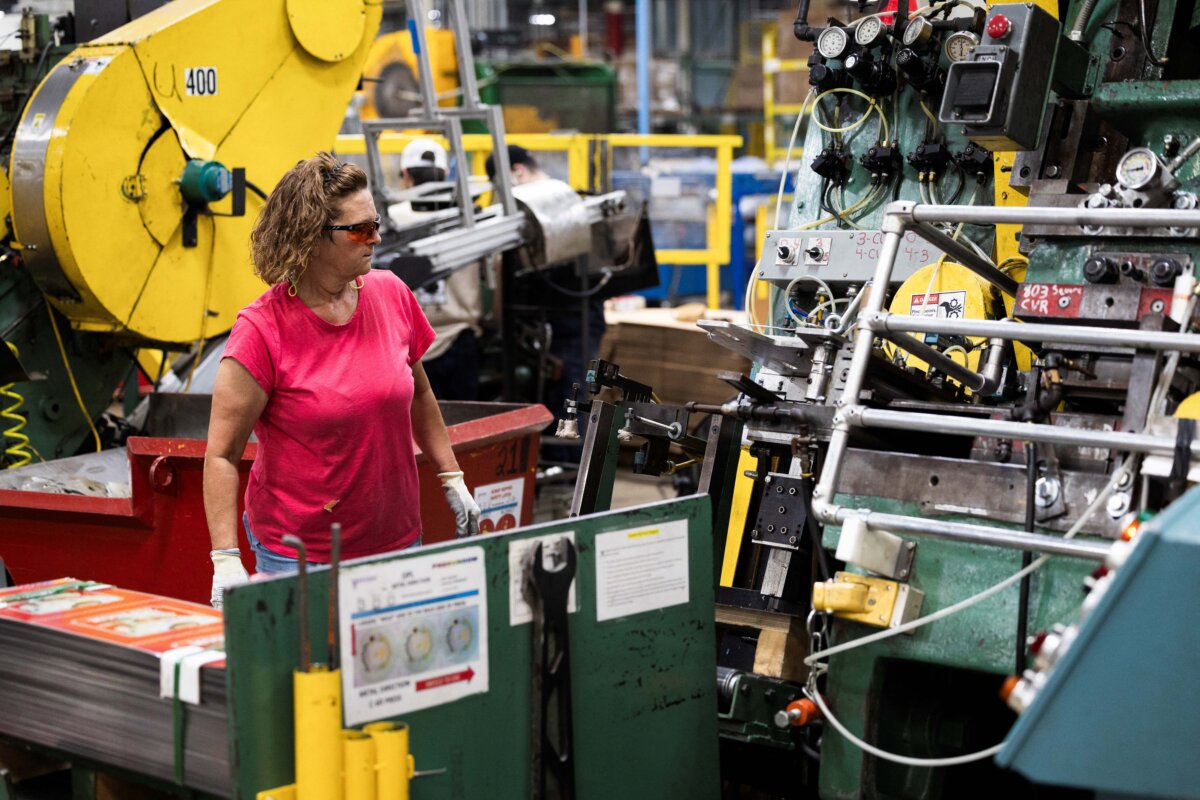

U.S. industrial production rose in January by the most in nearly a year, and orders for key business equipment increased more than expected in December 2025, pointing to firm capital spending and signs of a pickup in domestic manufacturing.
Industrial production increased by 0.7 percent in January after rising by 0.2 percent in December, according to the Federal Reserve’s G.17 report released on Feb. 18. This is a significant improvement compared with the lackluster performance over the past six months, which included numbers as low as a 0.4 percent contraction in industrial production in October.
Manufacturing output, which accounts for roughly three-quarters of total production, advanced by 0.6 percent, the largest gain since February 2025. Gains were widespread across industry groups, suggesting a broad-based lift in production.
Durable manufacturing output surged by 0.8 percent, including gains in nearly all industries, such as motor vehicles and parts, which rose for the first time in five months.
“After the AI boom sustained the business spending category of [gross domestic product] in the first three quarters of the year, firms outside of the tech space began to reengage late last year, setting the stage for a noticeable pickup in investment outlays in 2026,” said Stephen Stanley, chief U.S. economist at Santander U.S. Capital Markets.
“This has been and continues to be my main justification for expecting an above-consensus economic performance in 2026.”
The factory output jump aligns with recent survey-based reports from the Institute of Supply Management and S&P Global, which showed January production at U.S. factories growing at its fastest pace since mid-2022, following months of mixed readings marked by weak growth or bouts of contraction.
All major market groups had output gains in January; consumer goods production was up by 0.7 percent, and business equipment rose by 0.9 percent.
Capacity utilization for total industry rose to 76.2 percent in January, up from 75.7 percent in December, although still below its long-run average.
Separate data from the Commerce Department’s Census Bureau, released on Feb. 18, showed that orders for nondefense capital goods excluding aircraft—a closely watched proxy for business equipment spending—rose by 0.6 percent in December, above economists’ expectations for a 0.4 percent increase. November’s gain was revised up to 0.8 percent.
Shipments of these so-called core capital goods jumped by 0.9 percent in December after rising by 0.2 percent in November, suggesting solid equipment investment heading into the end of the year. Core capital goods shipments feed directly into the equipment component of gross domestic product.
There were patches of softness in the Census Bureau’s manufacturing data, however: New orders for durable goods fell by 1.4 percent in December to $319.6 billion, dragged down by a 5.3 percent drop in transportation equipment bookings.
The Census Bureau’s durable goods report was released ahead of the Bureau of Economic Analysis’s advance estimate of fourth-quarter gross domestic product, scheduled for publication at the end of the week. Economists surveyed by Reuters expect the economy to have grown at a 3.0 percent annualized rate in the October–December period, slowing from a 4.4 percent pace in the third quarter.
Other recent reports point to improving factory conditions. Manufacturing employment rose in January for the first time since late 2024. The Institute for Supply Management’s manufacturing index returned to expansion territory, and S&P Global’s U.S. manufacturing purchasing managers’ index signaled the strongest pace of factory output growth since May 2022.
Freight data also have suggested a shift toward domestically driven industrial activity. Truckload volumes in the Midwest are up about 8 percent from a year earlier, according to industry data, and they are especially strong in auto and heavy machinery corridors such as Detroit, Indianapolis, and Columbus, Ohio. By contrast, freight flows tied to imports and port-adjacent hubs have been weaker.
Analysts often view freight activity as an early indicator of industrial turning points because the movement of raw materials and finished goods tends to shift before broader measures such as gross domestic product and employment.
Still, not all indicators are strong. Manufacturing construction spending has cooled from a peak reached last year, although it remains near record levels. Some regional Federal Reserve surveys reported mixed capital spending trends late last year, and contacts in several districts expect a pickup in 2026.
 Friends Read Free
Copy
Facebook
Tweet
Friends Read Free
Copy
Facebook
Tweet