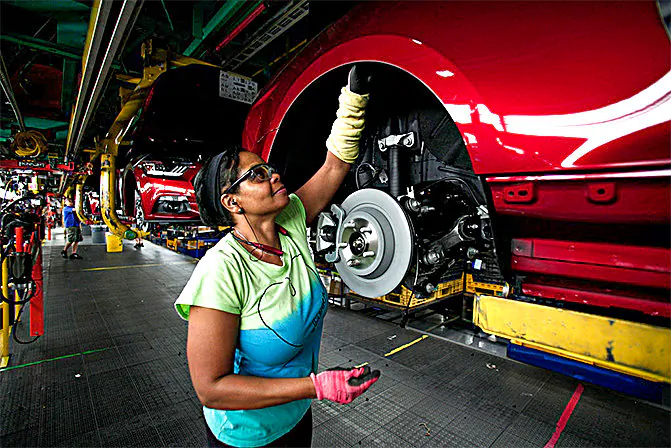
The U.S. manufacturing sector’s economic activity shrank for the fourth straight month in June as businesses tackled tariff concerns, the Institute for Supply Management (ISM) said in a July 1 statement.
While ISM’s Purchasing Managers’ Index (PMI) rose 0.5 percentage points in June from May, it remained at 49 percent, below the 50 percent threshold. A PMI reading below 50 percent is an indication that industries in the manufacturing sector are generally contracting.
Prior to June, the PMI expanded for two months, which had followed 26 consecutive months of declines.
“Looking at the manufacturing economy, 46 percent of the sector’s gross domestic product (GDP) contracted in June, down from 57 percent in May,” said Susan Spence, chair of the ISM manufacturing business survey committee. “However, 25 percent of GDP is strongly contracting,” which is up from 5 percent in May.
Nine manufacturing industries reported growth last month compared to six that shrank.
Out of the six largest manufacturing industries, four expanded in June—petroleum and coal products, computer and electronic products, machinery, and food, beverage, and tobacco products—compared to just two in May, Spence said.
ISM’s PMI report is based on a survey of manufacturing supply executives. Many respondents in the survey said the Trump administration’s tariff policies were negatively affecting their operations.
“Business has notably slowed in last four to six weeks. Customers do not want to make commitments in the wake of massive tariff uncertainty,” said a respondent from the fabricated metal products sector.
Another survey participant, from the computer and electronic products sector, said tariffs were causing “confusion and uncertainty for long-term procurement decisions. The situation remains too volatile to firmly put such plans into place.”
In April, the Trump administration imposed a universal 10 percent tariff as well as reciprocal tariffs on several nations based on their trade barriers against the United States. The reciprocal tariffs were paused for a 90-day period, which expires on July 9.
The tariff worries could ease over the coming weeks and months as Washington secures trade deals with its partners, which could eliminate most of the tariffs and bring a sense of economic certainty among business owners.
The Trump administration has so far reached trade deals with China and the United Kingdom, with negotiations ongoing with India, Japan, Mexico, Canada, and the European Union.
Meanwhile, a U.S. manufacturing PMI report released by S&P Global on July 1 paints a more positive picture of the domestic manufacturing industry’s performance in June compared to the ISM report.
“The U.S. manufacturing sector expanded again in June, with operating conditions improving to the greatest degree in over three years,” S&P said. “Output increased for the first time since February, and to a solid degree, whilst new orders increased for a sixth successive month due to improved domestic and international demand.”
The U.S. PMI rose to 52.9 in June from 52 in May, the highest since May 2022. This was the sixth successive month that S&P’s PMI registered a reading above the 50 level.
The report admitted tariffs remained a “prevalent theme,” affecting purchasing decisions and prices of manufacturers.
Chris Williamson, chief business economist at S&P Global, said that “business confidence has continued to improve from the low-point seen in April, with U.S. manufacturers becoming more optimistic in the face of fewer trade and tariff worries compared to the heightened uncertainty seen in April.”
“That said, many firms remain cautious as they await news of trade deals as the deadline for paused tariffs draws closer,” he said.
Increased Business Optimism
Businesses are showing increased confidence in the future of the U.S. economy.
A June 10 statement from the National Federation of Independent Business (NFIB) said its small-business optimism index rose by three points in May from the previous month.
“While the economy will continue to stumble along until the major sources of uncertainty are resolved, owners reported more positive expectations on business conditions and sales growth,” said NFIB chief economist Bill Dunkelberg.
Billions of dollars’ worth of investments have been announced in the United States this year, according to an April 23 statement from the White House.
This includes a $50 billion investment by Swiss drug manufacturer Roche in U.S.-based manufacturing and research and development, $3 billion from biotech company Regeneron Pharmaceuticals, Inc., and $1.2 billion from Greek yogurt giant Chobani to build its third American dairy processing plant in New York.
During a June 28 interview with American Thought Leaders host Jan Jekielek, Eric Trump, son of President Donald Trump and executive vice president of the Trump Organization, said the United States has the potential to beat China in terms of manufacturing prowess.
“America can do it better than China. America can do it better than Asia. America can do it better than all these places,” he said, adding that while China has a large economy backed by a massive population, the United States is still more productive.
“Our productivity is not only greater, but it’s greater in terms of productivity per person. It’s like five times in America. We do it better than anybody in the world.”
On March 10, Small Business Administration Administrator Kelly Loeffler announced the Made in America Manufacturing Initiative to ensure U.S. economic dominance and boost national security.
“The great American comeback starts with restoring American industry,” Loeffler said. “With the Made in America Manufacturing Initiative, we’re slashing red tape, expanding access to capital, and fueling a manufacturing resurgence that will create high-paying jobs and revitalize communities across the country.”
 Friends Read Free
Copy
Facebook
Tweet
Friends Read Free
Copy
Facebook
Tweet