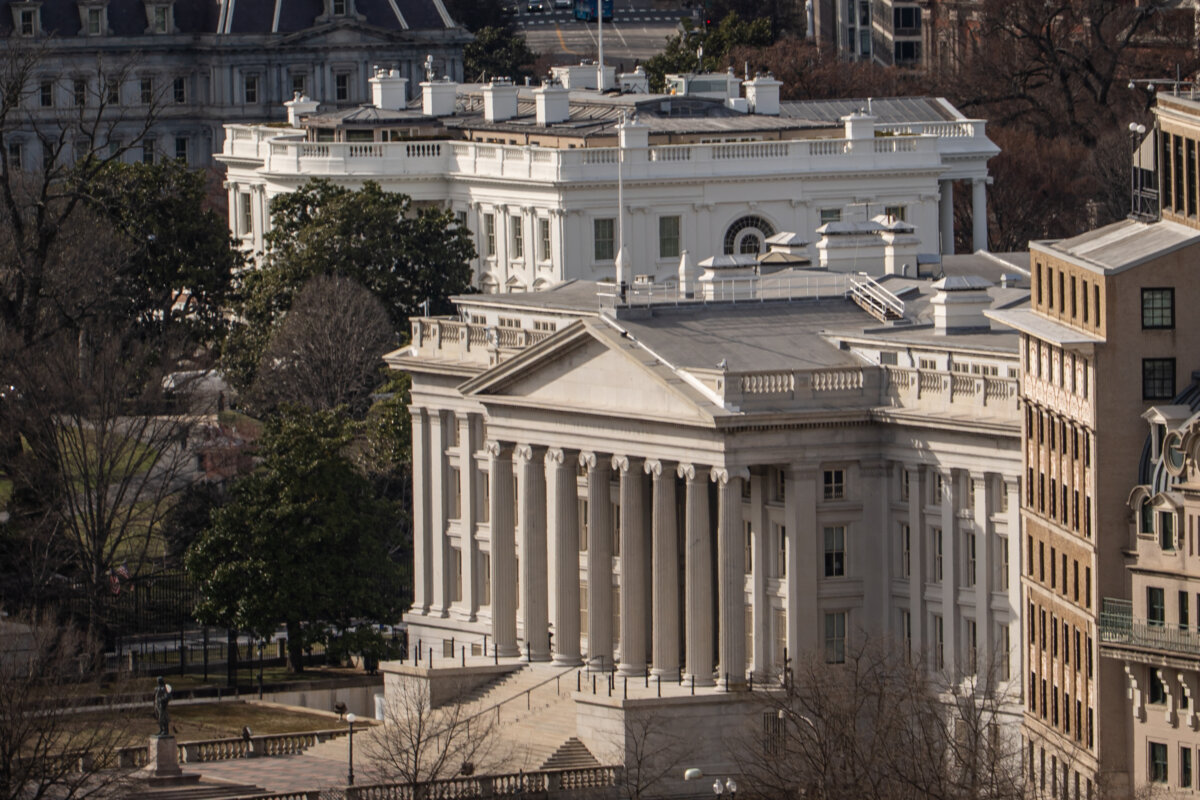

Yields on U.S. Treasury securities have sunk as investors shrug off fiscal fallout after the Supreme Court struck down President Donald Trump’s sweeping global tariffs.
The benchmark 10-year Treasury yield fell by 6 basis points to lower than 4.03 percent at 1:46 p.m. on Feb. 23. The 30-year tumbled by about 4 basis points to 4.69 percent.
The two-year yield, which typically tracks the Federal Reserve’s policy path, erased nearly 4 basis points to about 3.45 percent.
Declining yields signal investor demand for U.S. government bonds.
Last week’s Supreme Court decision to invalidate a large share of the president’s tariff agenda elicited little reaction in the U.S. government bond market.
Leading up to the announcement, market watchers had expressed concern about the impact on federal revenues.
Still, despite a tepid reaction, it might lead to short-term funding pressures, said Jeff Buchbinder, LPL Financial’s chief equity strategist.
“With less tariff income, the Treasury may need to increase issuance modestly, particularly in bills and shorter-dated notes, to offset the lost cash flow,” Buchbinder said in a note emailed to The Epoch Times.
“This could put upward pressure on yields at the margin, especially in an environment where supply and demand dynamics were already being tested.”
Earlier this month, the Treasury Department projected $574 billion in borrowing for the first quarter of 2026 and another $109 billion during the April–June period.
The high court’s ruling could reduce net revenues by $1.9 trillion over the next 10 years and increase the national debt by $2.4 trillion if tariff collections are refunded and the revenue is not replaced, according to the Committee for a Responsible Federal Budget.
Trump invoked Sections 122 and 301 of the Trade Act of 1974, imposing a 10 percent tariff on all foreign goods entering the United States. He then raised this level to 15 percent over the weekend.
It remains unclear how much these levies could salvage lost revenue.
Appearing at the Economic Club of Dallas on Feb. 20, Treasury Secretary Scott Bessent said these new tariff authorities would not affect revenue projections.
“Treasury’s estimates show that the use of Section 122 authority, combined with potentially enhanced Section 232 and Section 301 tariffs, will result in virtually unchanged tariff revenue in 2026,” Bessent said in prepared remarks.
A recent analysis by the Penn Wharton Budget Model estimates that $175 billion could be refunded to U.S. importers.
Bessent said he believes that these funds would be locked up in litigation that could be “dragged out for weeks, months, years.”
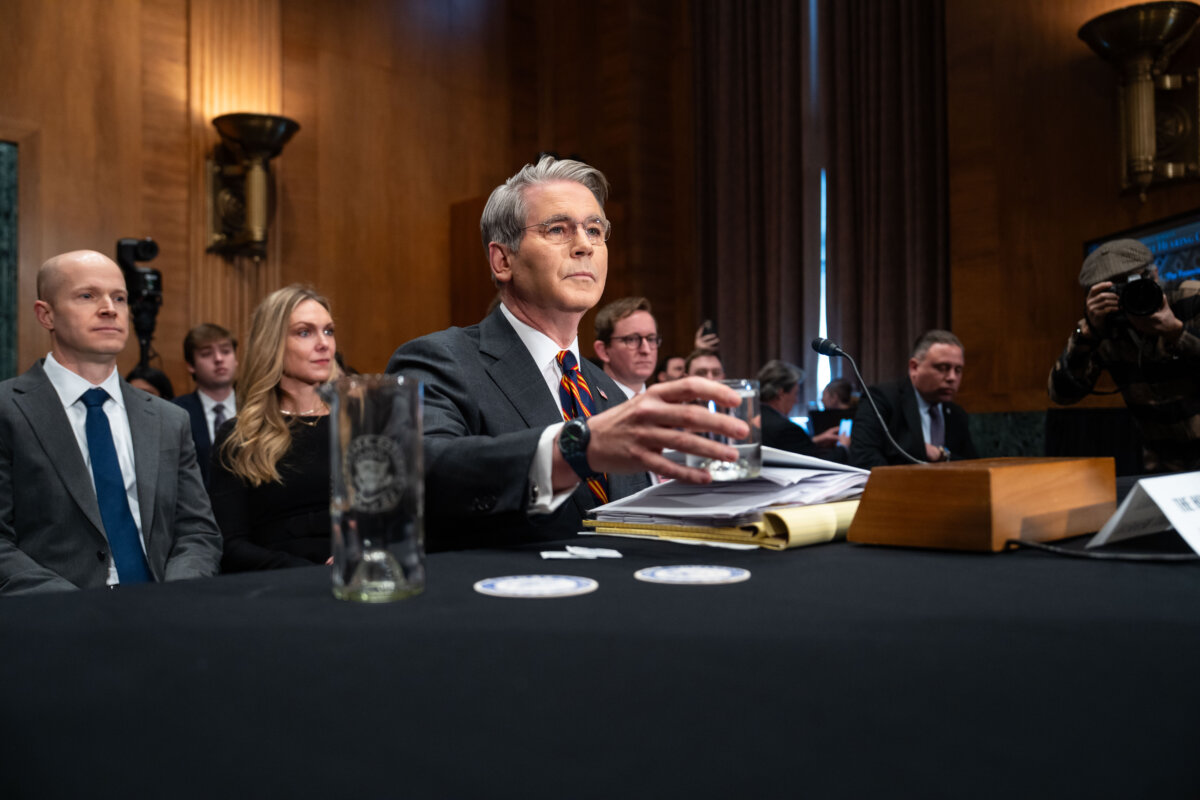
Refunds are unlikely to be extended to consumers, according to him.
“I got a feeling the American people won’t see it,” Bessent said in a follow-up Q&A session.
This past weekend, the Yale Budget Lab estimated that consumers will now face an overall average effective tariff rate of 9.1 percent without the emergency tariffs—still the highest since 1946.
Customs and Border Protection said the administration will end collections of tariffs deemed illegal “on or after 12:00 a.m. Eastern Time” on Feb. 24.
Wall Street in the Red
Equities could not escape the tariff turmoil.
Trump’s threat to raise temporary tariffs on countries that renege on their trade agreements with the United States triggered a sell-off in stocks.
To kick off the trading week, the blue-chip Dow Jones Industrial Average erased as much as 830 basis points—the worst single-session performance in a month.
The tech-heavy Nasdaq composite index and the broader S&P 500 fell by 1 percent.
This comes a day before the president delivers his State of the Union address. Although these remarks typically do not move markets, what Trump says about tariffs or Iran could affect stocks.
“The one constant under President Trump is that we can predict the unpredictable,” Jay Woods, chief market strategist at Freedom Capital Markets, said in a note emailed to The Epoch Times.
“In his speech, we might learn more of his intent to continue to levy tariffs despite the [Supreme Court] decision, and also how close we may be to an escalation of war against Iran. Both of these issues will have an impact on the markets.”
In addition to the tariff fallout and Trump’s speech, investors will also digest the widely watched producer price index on Feb. 27.
The U.S. dollar index, a measure of the greenback against a weighted basket of currencies, tumbled by about 0.1 percent. The index is coming off a weekly gain of nearly 0.9 percent but remains down by 0.7 percent year-to-date.
 Friends Read Free
Copy
Facebook
Tweet
Friends Read Free
Copy
Facebook
Tweet