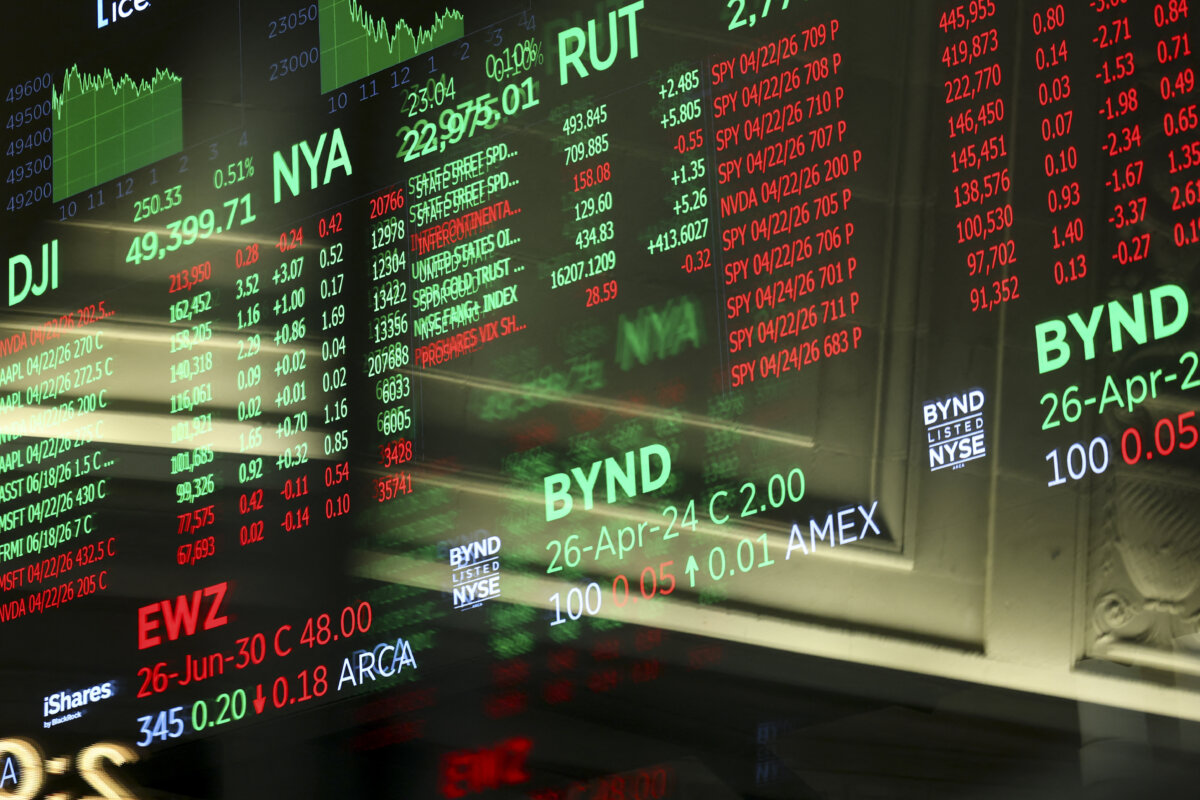

Wall Street extended its recent rally into another week, with the S&P 500 and Nasdaq reaching fresh record highs as investor focus shifted away from tensions in the Middle East and toward corporate earnings and economic fundamentals.
Market participants appeared encouraged by continued consumer spending despite elevated oil prices, as well as strong earnings reports from major companies, including UnitedHealth, Boeing, and Intel, which exceeded expectations.
Trading throughout the week remained uneven, with sentiment swinging between optimism and caution amid a steady flow of geopolitical developments and corporate news.
For the week, the Dow Jones Industrial Average declined by 0.44 percent to close at 49,230, below its April 21 peak. The S&P 500 rose by 0.55 percent to 7,165, hovering near record territory. The Nasdaq Composite led gains for a third straight week, advancing by 1.5 percent to an all-time high, while the Russell 2000 edged up by 0.36 percent.
Market volatility stayed elevated. The Chicago Board Options Exchange Volatility Index ended the week at 18.71, marking a 7.04 percent weekly increase.
Stocks began the week lower on April 20, as investors took profits following the prior week’s strong rally, while renewed tensions in the Middle East heightened uncertainty over U.S.–Iran negotiations, pushing oil prices and bond yields higher over the weekend.
However, like the previous Monday, early selling pressure eased as buyers stepped in later in the session. Major indexes recovered part of their losses, finishing mixed. The S&P 500 and Nasdaq fell by 0.25 percent, the Russell 2000 gained by 0.58 percent, and the Dow remained flat.
Stabilizing oil prices supported the rebound, with West Texas Intermediate crude trading near $88 per barrel by late afternoon, roughly unchanged from earlier levels.
Treasury yields were volatile and settled slightly higher by the end of the session, with the 10-year yield closing near 4.25 percent.
Stability in the Treasury market carried into the early trading on April 21, helping equities open higher. Additional support came from March retail sales data, which showed a 4.74 percent annual increase, exceeding expectations and signaling continued consumer resilience despite rising living costs.
The positive momentum faded as stronger retail data pushed yields higher, with the 10-year Treasury reaching 4.3 percent by early afternoon. Investors grew concerned that persistent consumer strength could fuel inflation and prompt Federal Reserve rate hikes.
By late morning, sentiment turned negative, compounded by another rise in oil prices following reports that U.S.–Iran talks had been paused.
Major indexes ended the day sharply lower, with the Russell 2000 down by 1 percent. The Dow, S&P 500, and Nasdaq each declined by about 0.6 percent.
Among notable movers, Apple fell by 2.52 percent amid concerns over a leadership transition and its potential impact on growth. UnitedHealth Group rose by 6.96 percent after reporting better-than-expected earnings.
Markets rebounded on April 22 as investors looked past higher oil prices and focused on earnings season. Strong results from Boeing, GE Vernova, AT&T, and Philip Morris International supported gains.
All major indexes closed higher, led by the Nasdaq and S&P 500, which rose by 1.6 percent and 1.1 percent, respectively, both reaching new records.
“While there is still uncertainty and saber-rattling over the Iran conflict, markets are forward-looking and currently looking past the conflict,” Rick Gardner, chief investment officer at Raleigh, North Carolina-based RGA Investments, told The Epoch Times.
Gardner pointed to easing tensions, reduced volatility fatigue from March, and a strong start to earnings season as drivers of the rally.
“Once stocks reach new highs after a correction, like the one in March, the upward trend can last for some time, as corrections reset sentiment, which allows stocks to climb higher,” he said.
On April 23, sentiment shifted again after disappointing earnings from ServiceNow triggered a sell-off in software stocks. Shares of ServiceNow dropped by 17.59 percent, while Adobe fell by 6.63 percent, Oracle by 5.98 percent, and Microsoft by 3.97 percent.
Software losses were partly offset by strength in the semiconductor sector. Texas Instruments surged by 19.43 percent after reporting strong data-center demand.
Despite that support, all major indexes closed lower, led by the Nasdaq, down by 0.89 percent. The Dow declined by 0.36 percent, the S&P 500 fell by 0.41 percent, and the Russell 2000 dropped by 0.37 percent.
Semiconductor gains continued into April 24 following a strong earnings report from Intel, reinforcing confidence in the company’s turnaround. Intel shares rose sharply, contributing to a 5.11 percent gain in the VanEck Semiconductor ETF.
The Nasdaq and S&P 500 climbed by 1.63 percent and 0.80 percent, respectively, reaching new highs. The Russell 2000 added 0.43 percent, while the Dow slipped by 0.16 percent.
“With earnings season underway, fundamentals are back, which is a welcome development for stocks, which have been tethered to the price of oil for much of the past two months,” David Laut, chief investment officer at Granite Bay, California-based Kerux Financial, told The Epoch Times.
Laut said strong earnings combined with lower expectations following recent volatility could support further gains, even amid ongoing geopolitical risks.
“Big tech earnings over the next week will help to confirm whether the sector’s share price gains in recent weeks are justified. AI capabilities continue to be adopted, driving productivity and profits,” he added.
Looking ahead, Laut said investors are likely to remain focused on major technology earnings and the upcoming Federal Reserve meeting.
Iñigo San Martín, executive director of origination and relationship management and a chartered financial analyst at Raisin, said he expects the Federal Open Market Committee to hold rates steady at 3.75 percent to 3.50 percent.
“The various models that calculate the implied probability for a rate change from traded instruments are assigning a ~0% chance to any outcome that is not a ‘hold’. Prediction markets are telling the same story,” he told The Epoch Times.
 Friends Read Free
Copy
Facebook
Tweet
Friends Read Free
Copy
Facebook
Tweet