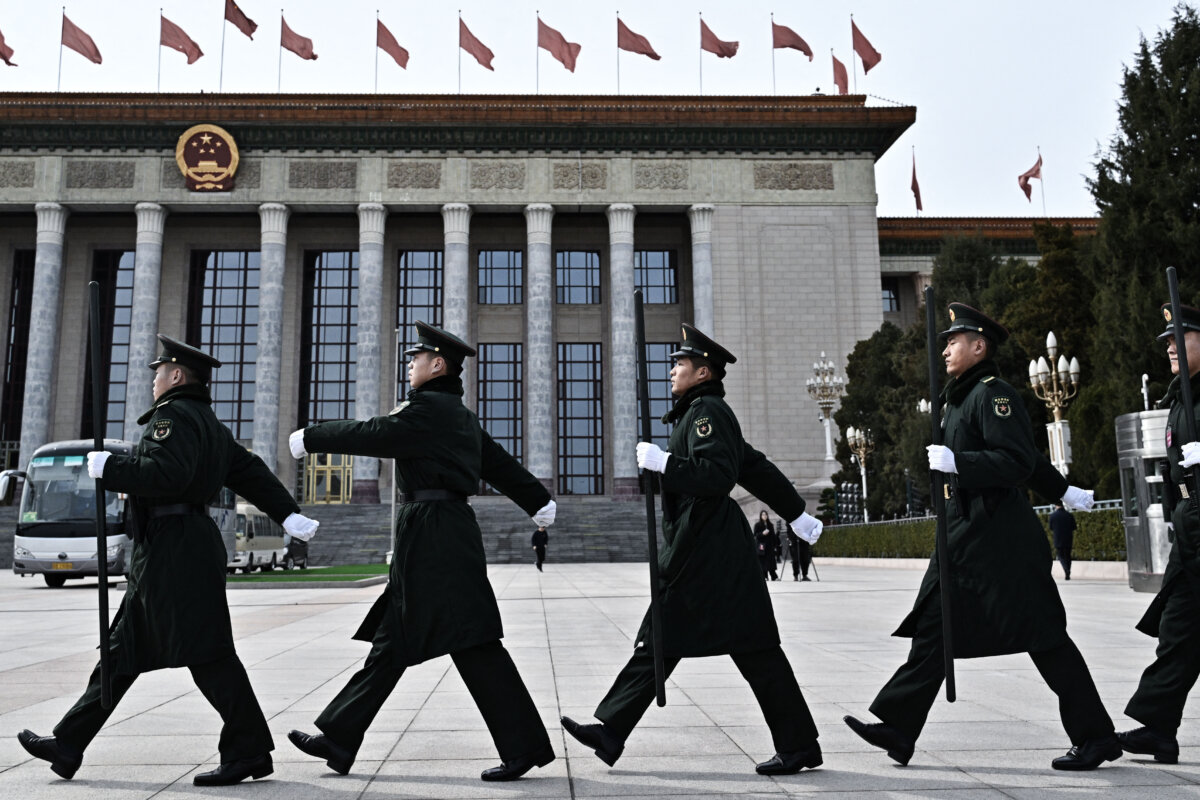

A new database of the Chinese communist regime’s military purges provides detailed information on the more than 100 senior military leaders purged since 2022.
Chinese Communist Party (CCP) leader Xi Jinping’s escalating military purges came under the international spotlight this year after two top military officials were accused of corruption. The move drew intense speculation about shifting power dynamics within the regime, as the two officials, who were among Beijing’s senior military leaders with combat experience, allegedly clashed with Xi over Taiwan, and as the regime’s follow-up actions have been highly irregular.
The database was published on Feb. 24 by the China Power Project of the Center for Strategic and International Studies. It names 101 senior People’s Liberation Army (PLA) leaders who have been purged or potentially purged since 2022; some were officially expelled, dismissed, suspended, and/or investigated, while others are missing and may have been purged.
As analysts have told The Epoch Times, Xi’s purges have left a vacuum in PLA leadership. The dataset shows that 41 out of 47 (87 percent) PLA leaders, three-star generals and admirals, have likely been purged. This includes the vast majority of leaders Xi promoted in 2020 or later, as 32 of 35 of them were investigated and 29 of them purged. The purges affected 52 percent of the 176 PLA leadership positions, according to the China Power Project.
The purges accelerated sharply last year. Only one official was potentially purged in 2022, 14 in 2023, 11 in 2024, and 62 in 2025. This year, 11 officers have already been purged or have not been seen at key meetings.
“And it’s not clear that Xi Jinping is done with his purges,” said Bonny Lin, director of the China Power Project, during a Feb. 24 webinar about the findings. “These purges have touched every part of the PLA.”
Unprecedented Purges
Experts continue to highlight the unprecedented and sweeping nature of the latest purges.
John Culver, senior fellow at the John L. Thornton China Center at Brookings, said during the seminar that Xi carried out military purges earlier in his career but that those did not “touch the operational track.”
“The closest that I can come to, in terms of the scale of what Xi’s doing, is probably the PLA turnover that followed the 1989 Tiananmen Square crisis,” he said.
Rising pro-democracy voices had split the CCP’s cohesion in terms of how to respond, according to Culver. He said that although it is well-known that the use of lethal military force on nonviolent protesters came after weeks of internal military resistance, less well-known is how tensions worsened within the military afterward and the resulting power struggle. Leaders were widely replaced and power was consolidated in the three years following the incident, with those who had opposed military action being purged.
Culver said Xi’s current purges aim to change the “loyalty network” the PLA runs on and ensure that “the PLA is absolutely subordinate and responsive to Party control.” This is vastly different from the events surrounding Tiananmen, which represented a fight between two factions.
“Today, Xi is purging an entire generation of officers,” Culver said. “This is not a factional struggle but an assertion of complete control.
“I think we’re at the beginning of this, not at the end of this.”
As for how this affects the CCP’s military readiness, political science professor Taylor Fravel, director of the Massachusetts Institute of Technology’s Security Studies Program, said areas most affected include training, equipping, and leadership.
“I would expect there to be significant institutional paralysis at the highest levels,” Fravel said. He explained that the PLA is “highly centralized,” more akin to a CCP organization than a military organization.
“You can see a lot of decisions just being stalled,” he stated.
Fravel said the pool of potential replacements for the top leadership positions has also shrunk significantly, because the amount of leaders at the next level has been reduced by one-third, which slows down how quickly the positions can be restaffed.
Sheena Chestnut Greitens, associate professor at the Lyndon B. Johnson School of Public Affairs at the University of Texas at Austin, said that purges of those who helped a leader consolidate power are general features of autocratic regimes, and that Xi appears to be trying to deal with factors similar to those that led to the Soviet Union’s downfall, including military autonomy from the Party.
Echoing Fravel’s analysis, Greitens said Xi has put himself in a position in which he will have to promote from a pool of less experienced and connected personnel, potentially creating other political problems for the rest of his tenure.
“If China ends up going to war with the PLA that it has, that PLA may have significant operational pathologies depending on where or how Xi does or does not trust these operational commanders who end up filling these now-vacant positions,” she said.
Jon Czin, fellow at the John L. Thornton China Center and the Michael H. Armacost chair in Foreign Policy Studies at Brookings, said Xi’s military purges a decade ago targeted Xi’s potential rivals, whereas the current wave of purges targets Xi’s associates on a scale that he found unexpected, given his early purges.
“I think the overall storyline, when you look at the dataset in particular, is that this is a generational culling,” Czin said.
Czin said that at some point, the political drama unfolding will start to affect CCP policy, but that that has not happened yet. He said Xi will be 79 as he heads into a fourth term next year, which “will feed a more rivalrous and contentious politics at Zhongnanhai as the people around Xi try to jockey their own people.”
 Friends Read Free
Copy
Facebook
Tweet
Friends Read Free
Copy
Facebook
Tweet