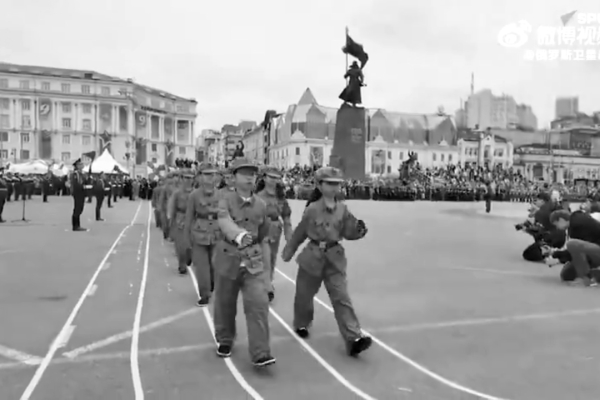
A group of Chinese elementary school students traveled to Russia’s far eastern city of Vladivostok this month to participate in a military-themed children’s parade commemorating the Soviet Union’s victory in World War II.
The event triggered a rare wave of online criticism inside China before related discussions were censored.
Critics said the spectacle of Chinese children marching in military uniforms through Vladivostok—a city established on land ceded to Russia in the 19th century—reflected how Beijing is increasingly subordinating historical grievances to its strategic partnership with Moscow.
According to Russian state-owned news agency Sputnik, Vladivostok hosted an international children’s military parade on May 3 to mark the 81st anniversary of the Soviet victory in what Russia calls the “Great Patriotic War.”
The event, titled “Great-Grandchildren of Victory,” featured about 1,500 children from Russia, China, and Laos organized into 47 marching groups, according to Sputnik.
For the first time, Chinese school children participated in the parade.
Images and video from the event showed the children dressed in uniforms resembling those worn by the CCP’s military during the Chinese Civil War and the World War II era. The children marched through the city square under the guidance of an adult leader, appearing to represent their school delegation.
The Russian-language edition of Chinese state media Xinhua quoted one student from the eastern Chinese city of Yiwu as saying he felt honored to participate in the parade and praised previous generations for sacrificing their lives for peace.
The event ignited criticism online inside China, given Vladivostok’s historical significance in Chinese nationalist memory. As criticism spread, related news reports, opinion pieces, and social media comments were gradually removed from China’s heavily censored platforms. Xinhua’s Russian-language coverage of the event remained online.
Rare Criticism
In an unusual development, a social media account affiliated with the CCP’s top propaganda newspaper, People’s Daily, published an article criticizing the parade participation. The article was published on May 6 and titled: “On the streets of Vladivostok, who exactly are Chinese children cheering for?”
The commentary compared the scene to wartime propaganda marches in Japanese-occupied China during the 1940s, arguing that Chinese families were voluntarily bringing young children to “land seized from their ancestors” to serve as “background props” for another country’s nationalist celebration.
“Diplomacy requires pragmatism, and international exchange is worth encouraging,” the article said. “But no degree of pragmatism should come at the cost of selling off national dignity and historical memory.”
The commentary further warned that such public displays were more politically significant than isolated incidents of controversial visits or symbolic gestures, as they involved children and state-backed messaging.
The article was reposted by several major Chinese online news portals, including Sina and NetEase, before disappearing along with related commentary and online discussions.
Beijing’s Strategic Priorities
Chinese human rights lawyer Wu Shaoping, now based in the United States, told The Epoch Times that the participation of Chinese schoolchildren was unlikely to have been a local initiative and instead reflected deliberate political coordination between Beijing and Moscow.
“These events were arranged officially by the CCP, at least with approval from the Party’s foreign affairs department,” he said.
Wu argued that Beijing was willing to suppress historical grievances to reinforce its increasingly close alignment with Russia.
“The CCP wants to demonstrate that China-Russia relations have ‘no limits,’” he said.
Taiwan-based scholar Dr. Tseng Chien-yuan, a board member of the New School for Democracy, offered a similar interpretation, saying Beijing’s geopolitical calculations have intensified amid growing tensions with the United States.
“Under the global strategic pressure created by President Trump’s policies, both China and Russia increasingly see value in drawing closer together,” Tseng told The Epoch Times.
He argued that Beijing is now more openly integrating itself into Russia’s historical narratives and wartime commemorations as a gesture of political solidarity.
Tseng also noted that Chinese state propaganda has long emphasized Western and Japanese imperialism while minimizing Russia’s role in China’s territorial losses during the Qing dynasty in the 19th century.
That selective historical framing, he said, reflects political necessity rather than historical consistency.
“If the Soviet Union had not entered Manchuria and transferred Japanese weapons and infrastructure to the CCP after World War II, the CCP would not have been able to consolidate power so quickly,” Tseng said. “There has always been a deep sense of political indebtedness toward Moscow within the CCP.”
History, Nationalism Collide
Wu argued that Beijing’s willingness to participate in such an event in Vladivostok—a city many Chinese nationalists still associate with territorial loss—demonstrates a conscious attempt to reshape public understanding of history.
He said the regime is trying to cultivate a generation less emotionally attached to historical grievances involving Russia, even while continuing to emphasize anti-Western nationalism domestically.
Tseng similarly warned that such political messaging, especially when directed at children, could reinforce highly selective historical narratives under the CCP’s tightly controlled information environment.
“The CCP is trying to shape how children understand both the CCP’s history and the history of China-Russia cooperation,” he said.
Tseng added that China’s increasingly closed media environment and ideological education campaigns risk pushing Chinese society further away from democratic norms embraced by much of the developed world.
The Vladivostok controversy, he said, illustrates how Beijing’s deepening alignment with Moscow is increasingly reshaping not only China’s foreign policy but also the historical narratives presented to younger generations.
Li Jing and Yi Ru contributed to this report.
 Friends Read Free
Copy
Facebook
Tweet
Friends Read Free
Copy
Facebook
Tweet