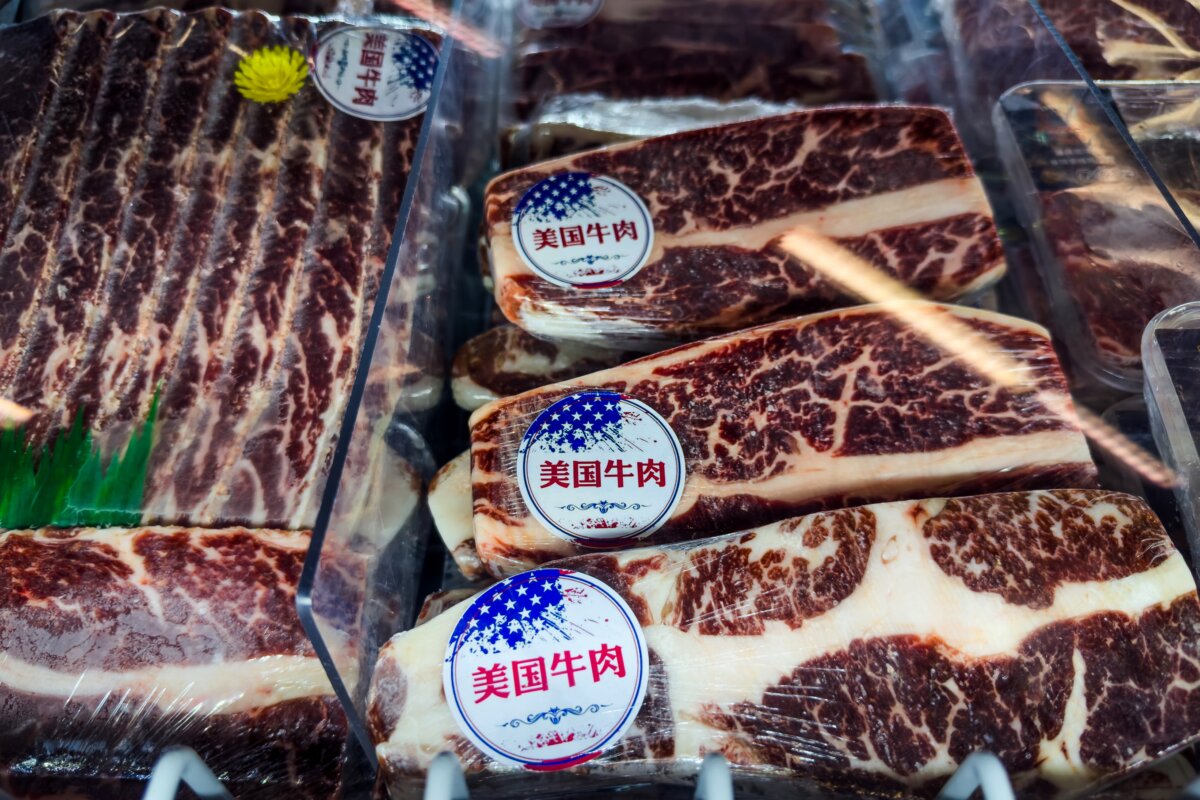

China will soon see a surge in U.S. beef products. The beef export agreement is part of a series of preliminary deals announced by the Chinese Commerce Ministry on May 16, following a two-day summit between U.S. President Donald Trump and Chinese leader Xi Jinping in Beijing.
A ministry spokesperson called the discussions “overall balanced and positive” while announcing that the countries will establish a Trade Council, create an Investment Council, and work together to remove trade barriers involving agricultural goods.
As part of the deal, Beijing will provide a pathway for more U.S.-based beef processing plants to export to the Asian country, while separately easing restrictions on U.S. poultry.
More than 400 beef plants were unable to export to China over the past year after Chinese customs halted export clearances.
“President Xi Jinping pointed out that the essence of China–U.S. economic and trade relations is mutual benefit and win-win cooperation,” the spokesperson said on May 16.
“Both sides should jointly safeguard the hard-won positive momentum at present.”
Agriculture Secretary Brooke Rollins confirmed the agreement.
“American beef—the best beef in the world!—will be back on the shelves in China soon,” Rollins wrote in an X post on May 16.
Rollins said China will allow beef imports from companies in 17 states.
“This means restoring up to $165 per head in added value for exports for our cattle ranchers,” Rollins said. “Mostly variety cuts like hoofs and tongues that Americans don’t prefer to consume.”
Neither country clarified when the agriculture deals would start.
On the flip side, China’s commerce ministry alleged that the United States agreed to reduce the number of import flags it imposes on seafood and dairy shipments from China and to make it easier for bonsai plants to enter the U.S. market. Washington hasn’t publicly confirmed this.
China also wants the United States to recognize the coastal Chinese province of Shandong as a “bird flu-free zone.”
Trump previously announced on May 14 that China had agreed to buy soybeans, energy products, and hundreds of Boeing jets from the United States following his meeting with Xi.
The U.S. president initially said China would buy 200 Boeing aircraft, but on May 15 he suggested that the order could reach as many as 750.
Emel Akan, Frank Fang, Dorothy Li, and Reuters contributed to this report.
 Friends Read Free
Copy
Facebook
Tweet
Friends Read Free
Copy
Facebook
Tweet