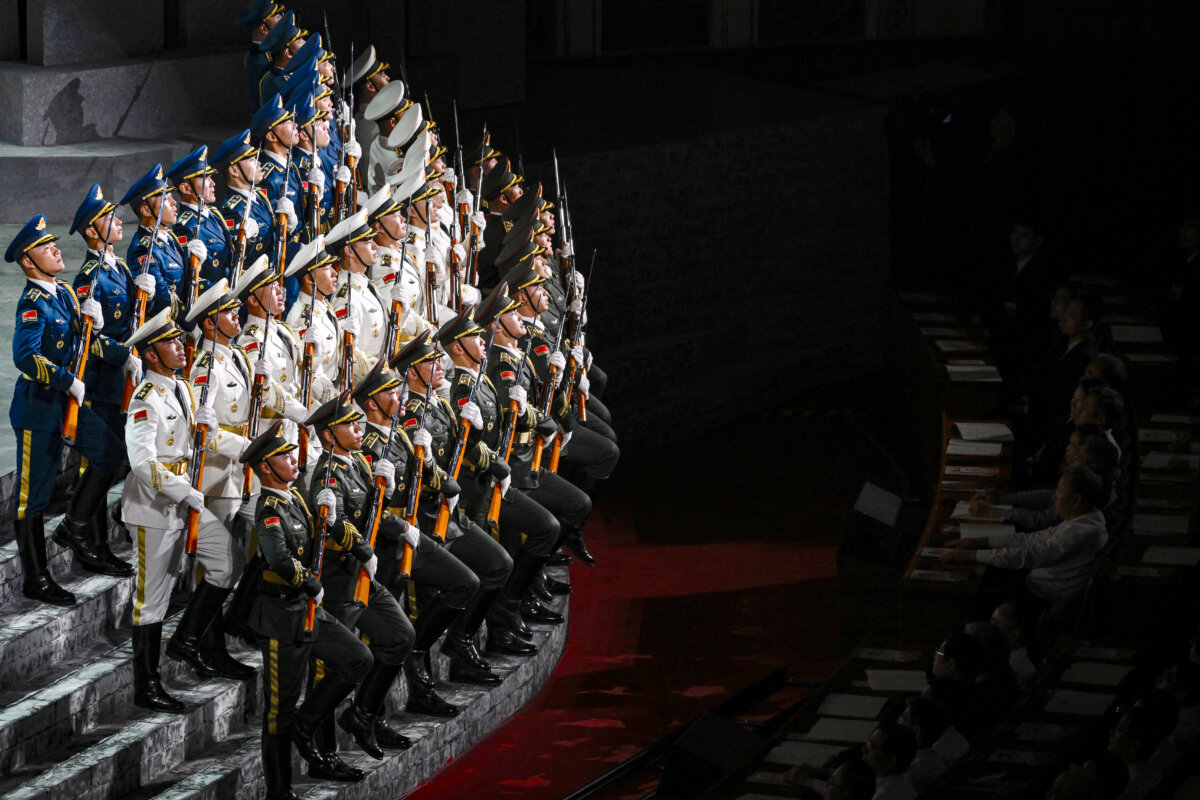

China has expelled four generals from its Communist Party-controlled legislature, as a purge in the defense establishment shows no signs of easing.
Gen. Wang Chunning, the commander of the armed police force, was the highest-ranked military figure to be removed as a delegate to the National People’s Congress (NPC), China’s rubber-stamped legislature, on Sept. 12.
The NPC’s Standing Committee announced the decision to oust the senior military officials following a meeting in Beijing. No reason was given for their departures.
Rumors have been circulating since December 2024 that Wang was caught in the anti-graft purges that have been roiling the upper echelons of the People’s Liberation Army (PLA). The Chinese regime remained silent about the case, but the probe speculation intensified in July when state media began referring to Lt. Gen. Cao Junzhang, previously deputy commander of the armed police force, as acting commander of the armed police force.
Along with Wang, the NPC also revoked the membership of Lt. Gens. Zhang Lin and Gao Daguang, the head and the political commissar of the Logistic Support Department of the Central Military Commission, respectively.
Lt. Gen. Wang Zhibin, who—according to China’s state-affiliated media—was once the army’s political commissar of the Western Theater Command, was stripped of the NPC title as well.
Taiwanese and Hong Kong-based media outlets, including the South China Morning Post, referred to Wang as the disciplinary chief of the Rocket Force, a secretive military unit that commands the country’s conventional and nuclear missiles. The Epoch Times was unable to independently verify Wang’s latest title.
The PLA, which does not regularly release its personnel changes to the public, has become increasingly secretive in recent years, particularly in the wake of numerous graft investigations into military leaders that have raised questions about the effectiveness of its fighting forces.
According to the South China Morning Post, Wang was appointed to the Rocket Force in December 2023, after Beijing abruptly replaced the unit’s two top commanders with generals who had no experience in the nuclear forces.
Since then, Beijing has unseated more than a dozen senior commanders and defense leaders. Launched by Xi Jinping shortly after coming into power in late 2012, the anti-graft campaign initially targeted his political rivals. The recent crackdowns in the military, however, have taken down Xi’s longtime allies, setting off speculation about political infighting among party elites and the stability of the communist regime.
Rocket Force Probes Issues Back to 2016
The campaign shows little sign of abating. The Rocket Force recently barred nearly 200 equipment suppliers and experts from participating in procurement bids, citing misconduct in contracts dating back to 2016, the first year the forces were established.
The procurement office for the Rocket Force disqualified 74 experts and 116 hardware suppliers from bidding on projects, according to an analysis of the office’s statements on the PLA procurement platform, from Aug. 29 to Sept. 1, by China Government Procurement News, which is run by the finance ministry.
Most affected experts were accused of making mistakes in reviewing tenders, which affected the bidding outcomes. The earliest identified issues date back to a project from 2016, indicating that the procurement office is scrutinizing contracts from as early as nine years ago, the news portal reported on Sept. 9.
Established on the final day of 2015, the Rocket Force was part of a broader military reform initiated by Xi. Over the past three years, three of its current and former commanders—Wei Fenghe, Zhou Yaning, and Li Yuzhao—have fallen from grace.
The high-level shake-up may instill fear among the middle- and lower-ranked military officers, according to Shen Ming-Shih, a research fellow specializing in the PLA at the Institute for National Defense and Security Research, a Taiwan-based think tank.
To avoid becoming ensnared in the investigations of their commanders, these low-ranking officers may choose to “lie flat” and do less work, Shen said. Alternatively, he said, they might resort to “extreme measures” to push back against investigators if the probes were to escalate and more colleagues were drawn into the investigations.
“In either case, the Rocket Force’s combat effectiveness will be significantly impacted,” Shen said. “If personnel feel distrusted, they won’t strive for excellence in training or in the development of equipment, and inevitably, combat effectiveness will be compromised.”
Luo Ya contributed to this report.
 Friends Read Free
Copy
Facebook
Tweet
Friends Read Free
Copy
Facebook
Tweet