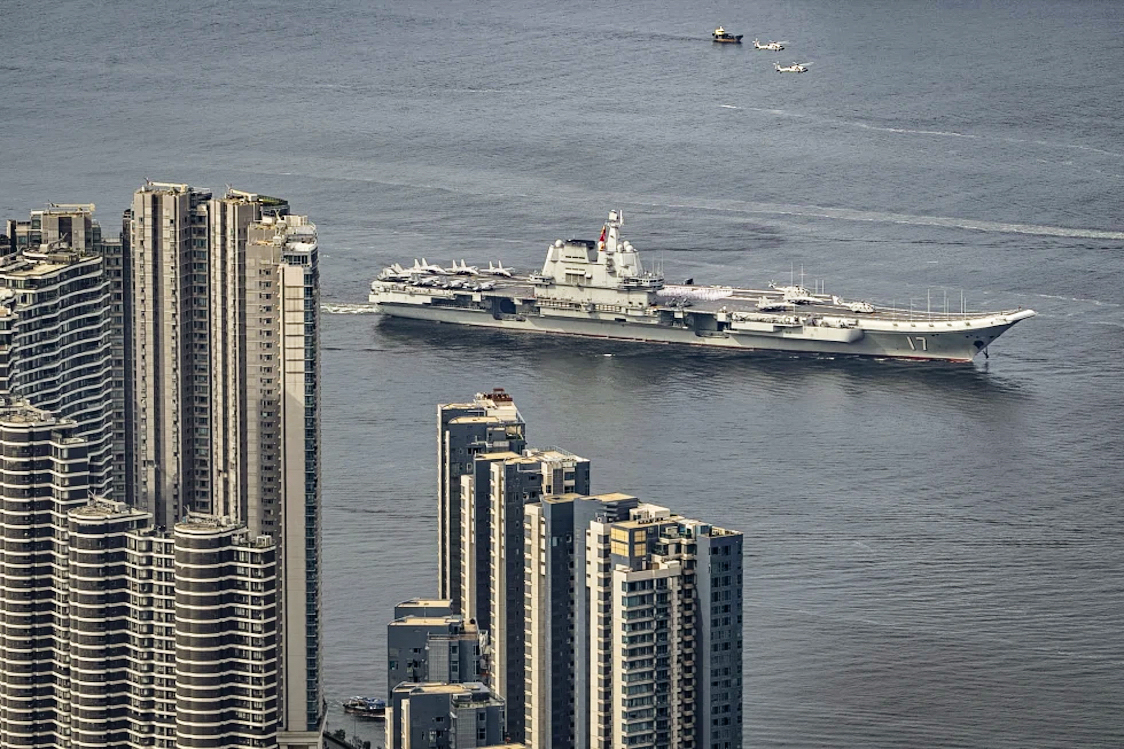

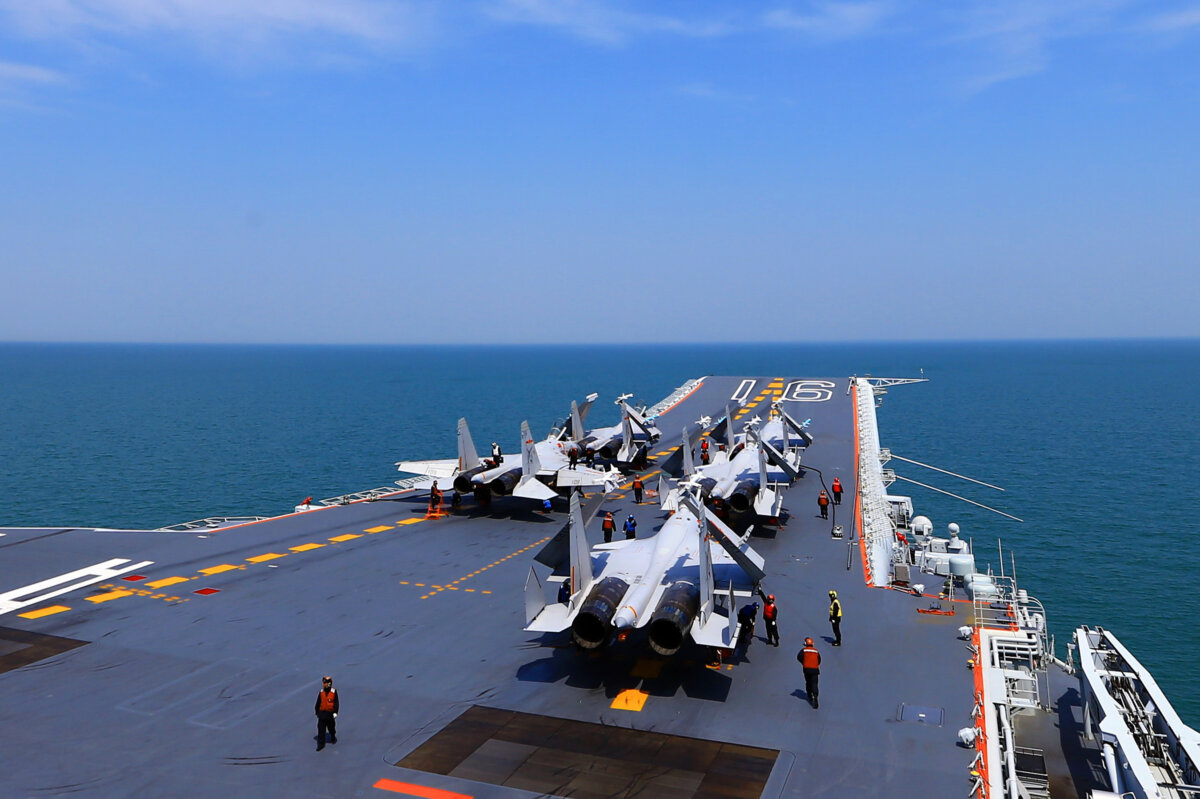
China’s first domestically built aircraft carrier, the Shandong, docked in Hong Kong on July 3, just days after the 28th anniversary of the territory being handed over to Beijing from the UK.
It comes as the Chinese communist regime continues to actively expand its naval power, which has caused concern from others in the region.
It is the second time that a Chinese aircraft carrier has come to Hong Kong. China’s first aircraft carrier, the Liaoning, docked in Hong Kong in 2017.
The Shandong is China’s second aircraft carrier and has recently been taking part in military drills in the western Pacific with the Liaoning.
The Shandong was accompanied by two destroyers and a frigate for its visit to Hong Kong, according to Chinese state media. The warships will be in Hong Kong for five days from July 3. The Shandong has been open to public visits over the weekend.
The Shandong, commissioned in 2019, is China’s second aircraft carrier and the first domestically built aircraft carrier. It is also an important part of China’s regional strategic ambitions. China’s ruling Chinese Communist Party (CCP) has been rapidly upgrading its naval power in an attempt to expand its influence in the Pacific region and challenge the U.S.-led alliance, which is based on promoting the values of freedom and liberal democracy—in contrast to the CCP’s socialist values.
A third Chinese carrier with a flat-deck design is currently undergoing sea trials, while a fourth is under construction.
The U.S. Department of Defense reported in December 2024 that China has the largest navy in the world, with more than 370 ships and submarines. China surpassed the United States in the number of battle force ships sometime between 2015 and 2020.
Japan expressed concerns in June that China’s dual-carrier exercises in the western Pacific were the first of their kind and reflected Beijing’s intention to enhance its long-range combat capabilities.
The Shandong appeared in Philippine waters during a joint U.S.–Philippines military exercise in April, heightening ongoing tensions between Manila and Beijing over disputed territorial claims in the South China Sea.
Also in April, the Shandong took part in intimidation drills off the coast of Taiwan to test the Chinese navy’s ability to “blockade” the self-ruled island nation, which is an ally to the United States and holds that it is the sole legitimate government of China.
The Chinese regime claims that Taiwan is part of its territory despite the fact that it has never ruled the island. The CCP refuses to rule out the possibility of using force to seize the island.
By docking the Shandong aircraft carrier in Hong Kong, the CCP is taking an “opportunity to show [its] military power to the outside world, especially to the West,” Shen Ming-shih, director of the Division of National Security Research at Taiwan’s Institute for National Defense and Security Research, told The Epoch Times.
The Shandong’s visit to Hong Kong is an attempt to carry out “soft political indoctrination,” Chung Chih-tung, assistant research fellow at Taiwan’s Institute for National Defense and Security Research, told The Epoch Times on July 6.
“It hopes to convey the impression of China being a strong power to Hong Kong society and to show the supremacy of its national security and to inspire ‘patriotism’ of Hong Kong people,” he said.
Soviet Union Blueprints
Shen Ming-shih said the Chinese are “confident about the Shandong’s combat ability.”
However, the Chinese aircraft carriers are still lagging behind U.S. aircraft carriers in terms of technology and quality.
Both the Shandong and the Liaoning are using Soviet Union aircraft carrier designs that date from 1922 to 1991, with China’s J-15 fighters and helicopters on deck.
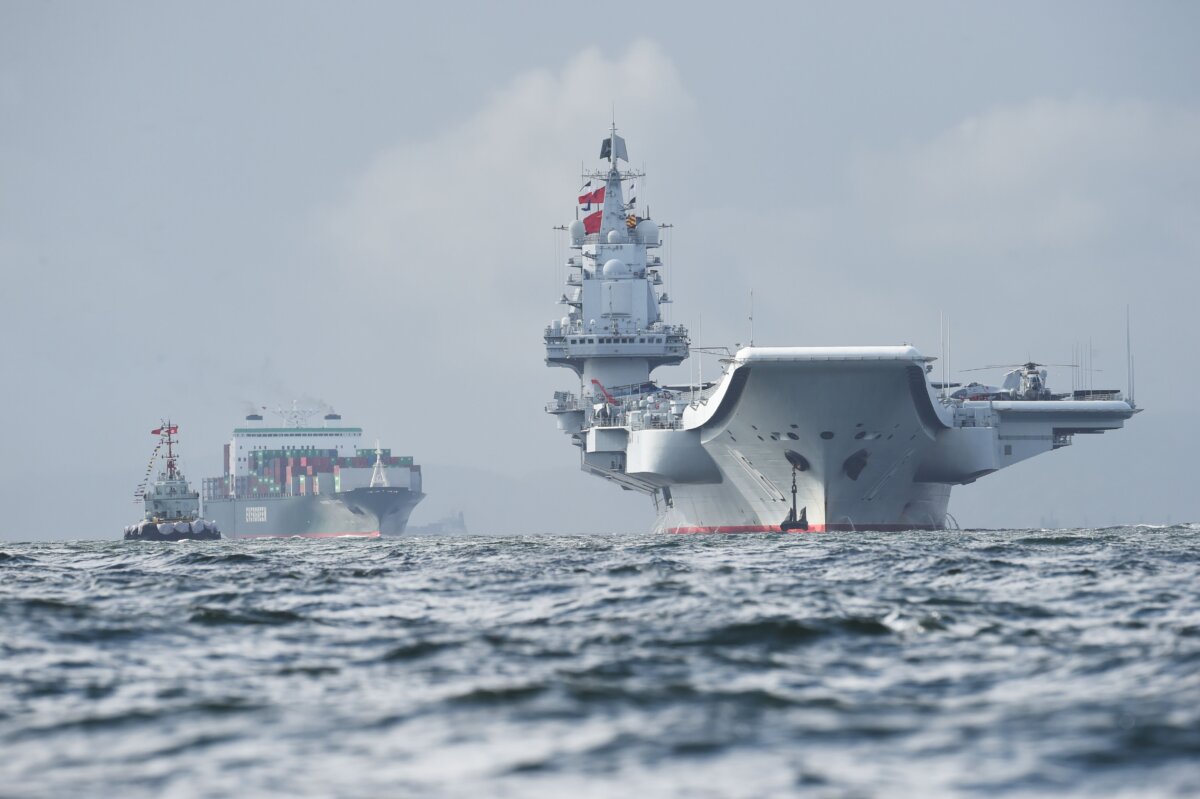
The Shandong is actually based on the Valk, the Liaoning’s predecessor, according to Shen Ming-shih.
“It’s based on the blueprint designed in the 1980s,” he said. “Its performance and quality are not as good as those of the U.S. aircraft carriers, especially the number of aircraft it carries, which is about 40 to 50 in total. The U.S. aircraft carrier can actually carry twice as many fighter jets as the CCP’s.
“The combat capability of the Shandong aircraft carrier is about 15 to 20 years behind that of the current U.S. aircraft carrier, so I think the CCP will not use their aircraft carriers to act rashly.”
Shen Zhou, a columnist for the Chinese language edition of The Epoch Times, noted in a July 5 commentary that after returning from the first island chain (including the Japanese archipelago, the Ryukyu Islands, Taiwan, the northern Philippines, and parts of Borneo), “the Shandong did not visit Hong Kong directly, but returned to its base in Sanya, Hainan, first for maintenance, and then returned to Hong Kong.”
“This back-and-forth arrangement would be unthinkable for a U.S. aircraft carrier,” he wrote.
Shen Zhou compared it to the U.S. aircraft carriers deployed in the western Pacific, “which can dock at ports in many countries at any time, including Guam, Japan, the Philippines, Vietnam, Singapore, etc.”
“In November 2018, the USS Ronald Reagan also docked in Hong Kong,” he wrote.
In comparison, he noted, the Chinese aircraft carrier “seems to be much more fragile.”
“After a short period of long-distance drill, it has to return to its home port for repairs and cannot dock directly in Hong Kong, which also reflects the gap in combat readiness levels,” Shen Zhou wrote.
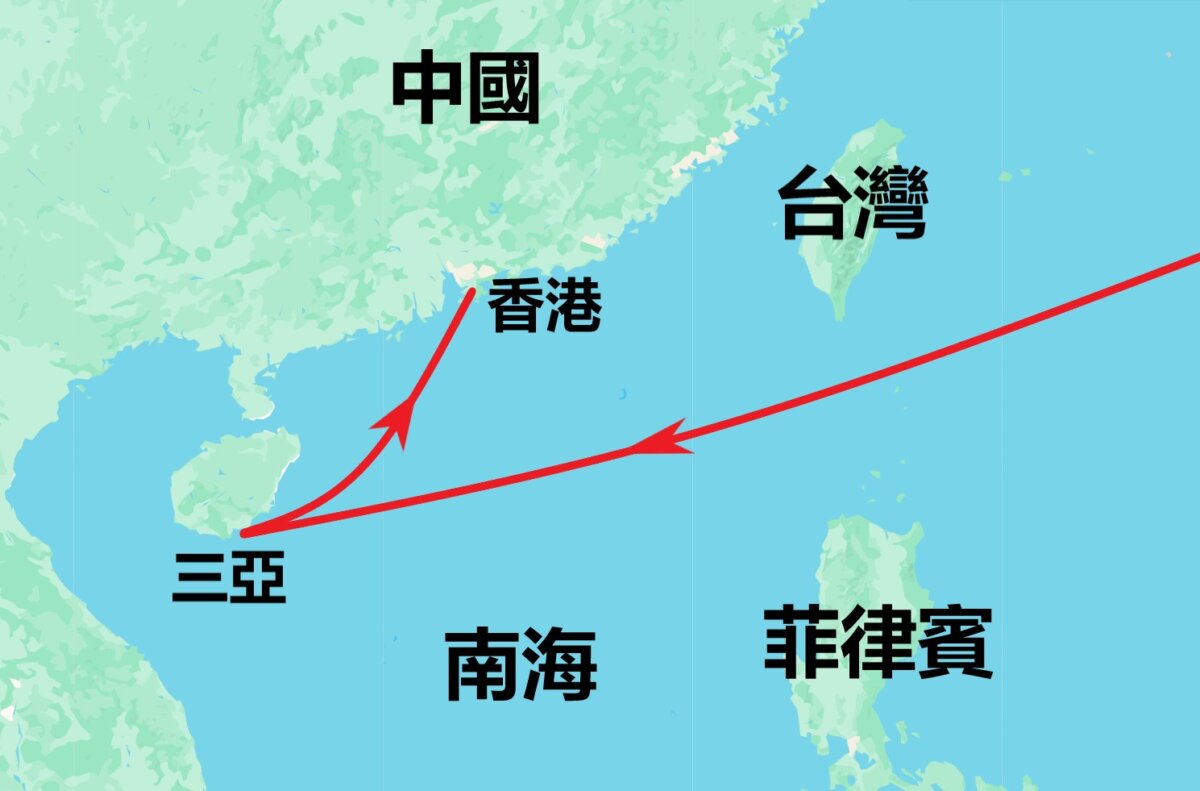
He noted that the Chinese aircraft carrier does not dare to replenish in Hong Kong, maybe for fear of security issues.
“Although the CCP has full control of Hong Kong and has manipulated many Hong Kong officials and businessmen, it does not really trust them,” he wrote. “Therefore, it sent the Shandong aircraft carrier fleet back to Sanya for replenishment and maintenance, and then to Hong Kong.”
Supply Issues
Analysts also noted supply issues for Chinese aircraft carriers, especially during battle, as China does not have a base along the first or the second island chains.
“[If a war breaks out,] the Shandong aircraft carrier fleet can only travel back and forth between Sanya or obtain supplies through supply ships, and its combat capability will be severely limited,” Shen Zhou wrote.
Both the Liaoning and the Shandong are traditionally powered aircraft carriers, Shen Ming-shih noted.
“Their fuel runs out after about seven days of sailing, so they must rely on fuel supply ships to refuel,” he said.
“[Relying only on supply ships is] a fatal weakness. Because as long as Taiwan, Japan, or the United States destroy its supply ships, the aircraft carrier will lose its supplies and become more vulnerable on the sea.”
If the Chinese aircraft carriers go farther in the sea but the CCP does not have overseas military bases, then its supplies will become a problem, Shen Ming-shih said.
“So it is unlikely for the Chinese aircraft carriers to reach the central Pacific Ocean now,” he said.
“We have not seen the Shandong and Liaoning crossing the Strait of Malacca to the Indian Ocean, because the first thing to solve is the logistics and supply.”
Shen Ming-shih pointed out that China’s third aircraft carrier, the Fujian, is also traditionally powered and has similar problems. In comparison, the U.S. Navy operates nuclear-powered aircraft carriers.
Chung shared this assessment.
“The most important thing about an aircraft carrier is its transportation support, because it is necessary for ocean-going operations,” he said. “Between the first and second island chains, China does not have any military bases that can provide supply and transportation support, unlike the United States, which can do so in Guam.
“[As the Chinese regime’s] ocean-going strategic projection is restricted by the supply issues, its current range of activities is actually mainly concentrated around the first island chain.”
Analysts pointed out that other countries have different means of responding to the CCP’s maritime expansion in the region, especially for targeting its aircraft carriers.
Shen Ming-shih noted that Japan has deployed long-range anti-ship missiles on its southwestern islands, and Taiwan has also deployed land-based anti-ship missiles from the north to the east on the island.
“In addition, the Taiwan Air Force’s F-16 launches Harpoon missiles, or the Hsiung Feng III missiles on warships, and the United States has also deployed some long-range anti-ship missiles in the northern part of Luzon Island in the Philippines,” he said. “The U.S. nuclear-powered tactical submarines, whether their heavy torpedoes or anti-ship missiles, can easily destroy these aircraft carriers.”
Chung said: “The U.S. military now has long-range anti-ship missiles in the Philippines, and of course in Taiwan and Japan as well.
“Of course, the range of attack by the fighter jets from Japan, Taiwan, and the Philippines will be further expanded, which will also pose a considerable threat to China’s current traditionally powered aircraft carriers.”
Luo Ya and The Associated Press contributed to this report.
 Friends Read Free
Copy
Facebook
Tweet
Friends Read Free
Copy
Facebook
Tweet