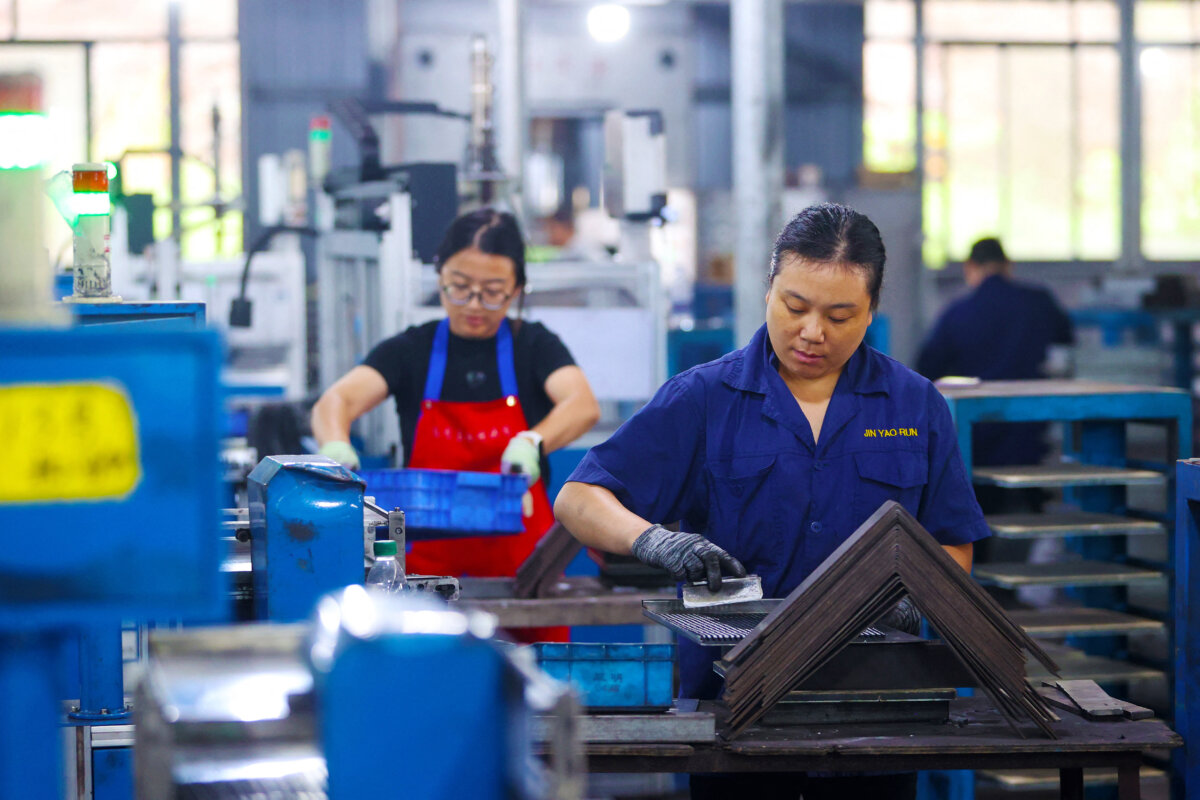

China’s official gauges of manufacturing, services, and construction fell into contraction in July, adding to evidence that shrinking orders, job insecurity, and weak household spending are weighing on much of the economy even as favored technology industries continue to expand.
The official manufacturing purchasing managers’ index (PMI) fell to 49.2 from 50.3 in June, according to data released on July 31 by China’s National Bureau of Statistics and the China Federation of Logistics and Purchasing. It was the first reading below 50 since February.
The index for nonmanufacturing activity, which covers services and construction, fell to 49.0, while the composite output index dropped to 49.3. Readings below 50 indicate that more surveyed companies reported declining activity than improvement from the preceding month.
The decline was broad: New factory orders weakened more sharply than production, companies of every size reported contraction, and construction and services both fell below 50.
The July survey also recorded a pronounced split. High-technology and equipment manufacturing remained in expansion, while consumer-goods manufacturing, energy-intensive industries, and smaller companies contracted.
That divide is visible beyond the official figures.
Factories Struggle for Orders
Hu Jianbo, who works in Guangdong’s printed-circuit-board industry, told the Chinese edition of The Epoch Times in June that smaller manufacturers were being squeezed simultaneously by fewer orders, price competition, and rising labor and material costs.
During stronger years, he said, many companies borrowed to expand factories and buy equipment. Once orders declined, the added capacity became a burden.
“The debt is still there, but the business is not coming in,” Hu said.
That month, Dongguan Wuzhu Electronics and an affiliated new-energy company announced that they were ending operations and terminating all employee contracts. The companies cited changes in the market and a failed investment strategy in their closure notice.
The July PMI recorded the same pressure in aggregate form. The new-orders index fell to 48.5, a sharper decline than the production index, which dropped to 49.9.
Fewer Orders Move Into the Labor Market
The effects of weaker factory demand are also reaching workers.
An Zhiqiang, who works in electronics trading in Hangzhou, told the Chinese edition of The Epoch Times in April that local private manufacturers were cutting staff after failing to obtain enough orders.
“Many machines have stopped,” he said.
An cited a Nordic-owned factory producing feed equipment that had reduced its workforce from 80 employees to 29 and was expected to make further cuts.
An said even temporary factory work offering 13 yuan per hour (about $1.80) had become difficult to find.
Workers Pull Back on Spending
Kang Jiancheng, who manages a manufacturing business in Hangzhou, told the Chinese edition of The Epoch Times in June that factories were closing, relocating, or reducing operations, while many migrant workers had already left the city.
“Many people have no work,” Kang said. “Where would the money for consumption come from?”
He said physical stores and shopping centers were losing customers as workers reduced discretionary purchases.
The World Bank said in its July China Economic Update that high-technology investment and exports had helped sustain growth, but cautious consumers, the property downturn, and persistent domestic-demand weakness were slowing the economy.
The bank said households were directing a larger share of their income into savings amid uncertainty over income and falling property prices.
The Conference Board’s Leading Economic Index for China edged up 0.1 percent in June from May but was still 1.3 percent lower than in December 2025. Improvements in credit, machinery imports, and construction barely offset weakness in consumer expectations, logistics, and business profitability.
Favored Industries Pull Away
The July PMI’s stronger readings for high-technology and equipment manufacturing follow years of state-directed support for industries the Chinese Communist Party considers strategically important.
A source familiar with the Jiangsu Small and Medium Enterprise Association told the Chinese edition of The Epoch Times that government resources were increasingly moving toward semiconductors, artificial intelligence, and robotics.
Xu, a person familiar with the Jiangsu Small and Medium Enterprise Association, told the Chinese edition of The Epoch Times that government resources were increasingly moving toward semiconductors, artificial intelligence, and robotics. She asked to use her last name only for fear of retaliation in China.
Traditional manufacturers were being pressed to digitalize, reduce emissions, and upgrade production, she said, but many smaller firms lacked the capital and technical capacity to do so.
Companies that continued using older production methods could face greater scrutiny involving taxes, environmental rules, energy use, and workplace safety, Xu said.
Businesses felt that failure to transform made survival increasingly difficult, she said.
Rhodium Group said in a May report that China’s capital markets and state-guided credit were being reshaped to prioritize strategic and innovative companies.
The research firm found that industrial policy increasingly emphasized equipment upgrades and higher-technology production even in mature industries where capacity utilization was falling and the number of loss-making companies was rising. Without stronger domestic demand or significant cuts to old capacity, it said, that approach was likely to entrench overcapacity.
Rhodium is a separate report said China’s financial system was directing a growing share of a shrinking pool of new credit toward state-owned companies and indebted local government entities while private investment remained weak.
As production outpaced domestic demand, Rhodium said, falling prices and surplus output increased China’s reliance on overseas markets.
S&P Global is scheduled to release its RatingDog China General Manufacturing PMI on Aug. 3, providing the first private same-month comparison with China’s official July reading.
Wang Yibo, Wang Xin, and Xia Yu contributed to this report.
 Friends Read Free
Copy
Facebook
Tweet
Friends Read Free
Copy
Facebook
Tweet