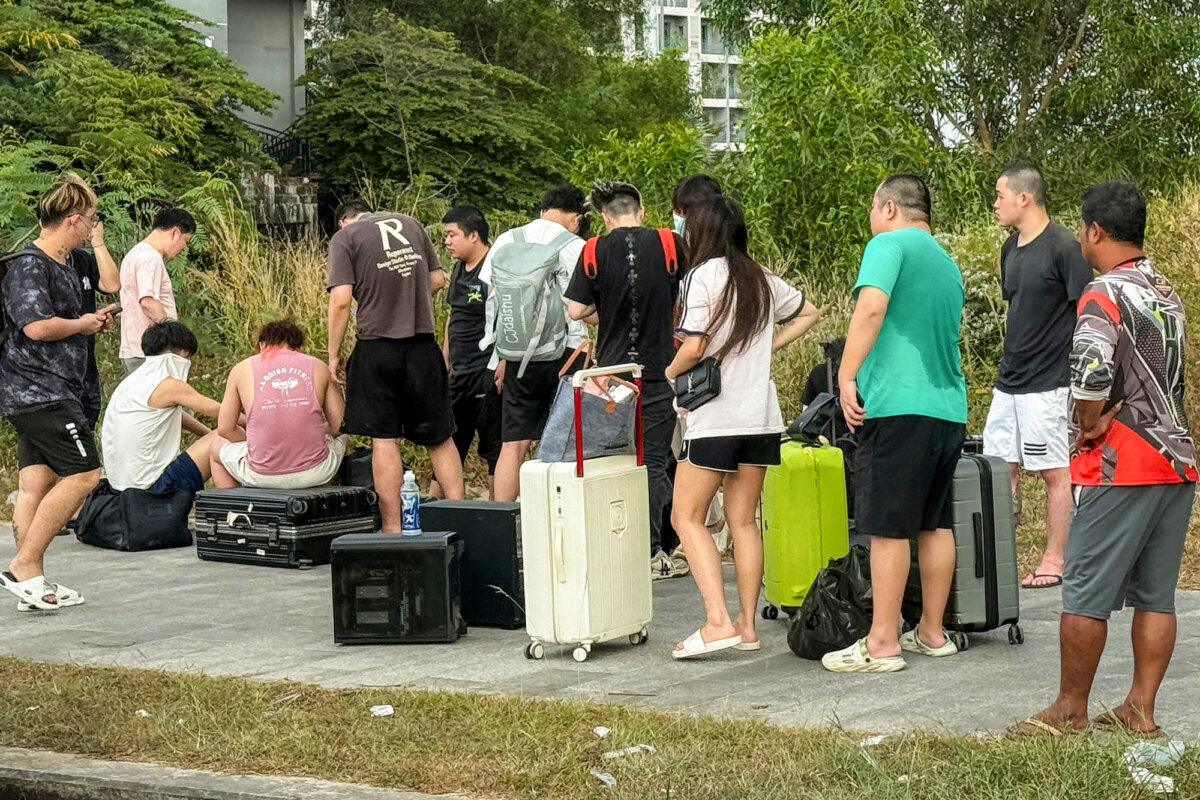

The Federal Bureau of Investigation (FBI) announced on July 31 that it dismantled four of the “largest scam compounds on Earth” under Operation Blackout, seizing $15.2 billion in assets and freeing thousands of forced laborers.
Scam compounds provide the infrastructure to carry out large-scale online fraud operations and typically employ hundreds of thousands of people, many of whom are captives. Operation Blackout freed thousands of trafficked workers, the FBI said in a post on X. In addition, roughly 10,000 Americans were reportedly saved from losing their life savings. The agency did not specify a timeline for the event.
The FBI also built new international partnerships to fight off fraud and trafficking activities, the agency said.
In a July 21 post on X, FBI director Kash Patel said that the seizure of $15.2 billion under Operation Blackout was made over a 16-month period. Dozens of scam centers were dismantled and hundreds of criminals arrested, with multiple human trafficking compounds eliminated. Patel listed four operations carried out as part of dismantling scam operations.
Operation Zephyr Exodus involved the takedown of Cambodia’s Prince Group, a transnational criminal organization. This led to the seizure of a record 127,000 Bitcoin, worth roughly $15 billion at the time.
Operation Sand Dollar, conducted in Dubai, United Arab Emirates, dismantled nine scam compounds, arrested over 300 individuals, seized around $300 million, confiscated thousands of electronic devices, and freed thousands of trafficked workers. Conducted through a joint operation with China’s Ministry of Public Security and the Dubai Police, Patel said.
In Operation Compound Fracture, authorities seized domains and malicious apps linked to scam activities. And under the Shunda Compound Takedown, the FBI and Thai law enforcement carried out a joint operation that disrupted a network responsible for hundreds of millions of dollars in losses to victims.
Last month, the Treasury Department sanctioned 35 individuals and entities linked to the Prince Group, including a Cambodia-based conglomerate that allegedly provided laundering services for scam proceeds.
U.S. authorities estimate Americans to have lost at least $10 billion to scam operations running from Southeast Asia in 2024, a 66 percent jump from the previous year, the department said.
According to the FBI’s Internet Crime Report 2025, the agency’s Internet Crime Complaint Center received more than a million complaints last year. Total losses from these complaints amounted to over $20.87 billion, a 26 percent increase from the previous year.
Scam Compound Trafficking
In a July 28 statement, the United Nations’ International Organization for Migration (IOM) highlighted the issue of trafficking victims being forced to work in scam centers.
Victims are initially lured through fake job advertisements that promise legitimate work abroad. Once they arrive, they are stripped of documents, locked inside compounds, and forced to carry out online scam operations under threat of violence and other measures. Many survivors report being subjected to sexual abuse, solitary confinement, starvation, and torture, IOM said.
“People trapped in scam compounds are victims of trafficking, forced to commit crimes through violence, threats and coercion. They deserve protection, not punishment,” IOM Director General Amy Pope said in the statement.
“We must work together to support survivors, stop traffickers and close the gaps these criminal networks exploit. No country can tackle this alone,” Pope said.
During 2022–2025, the IOM assisted over 3,500 trafficked victims of forced criminality in Southeast Asia. These people were from 39 nations, mostly from India, Bangladesh, Sri Lanka, Indonesia, Kenya, and Ethiopia.
On Sept. 30 last year, a group of lawmakers introduced the Scam Compound Accountability and Mobilization (SCAM) Act that aims to counter foreign scam operations, according to an Oct. 1, 2025, statement from the office of Sen. John Cornyn (R-Texas).
The bill also seeks to hold transnational criminal organizations that engage in human trafficking, forced criminality, and cyber scams targeting Americans accountable for their actions.
The legislation was passed by the Senate in December and sent to the House of Representatives the same month. However, no significant action has been taken on the bill since then.
 Friends Read Free
Copy
Facebook
Tweet
Friends Read Free
Copy
Facebook
Tweet