

The Chinese regime said on July 15 that its economic growth slowed slightly in the second quarter, highlighting concerns over weak domestic demand and trade tensions with the United States.
China’s economy in the April to June quarter expanded by 5.2 percent from the same period last year, Beijing’s National Statistics Bureau reported. It’s slightly above the 5.1 percent that economists polled by Reuters had projected, but slower than during the first three months, when gross domestic product (GDP) rose by 5.4 percent year over year.
“Official GDP data came in a touch weaker in Q2. But the figures still overstate the strength of growth,” analysts at Capital Economics said in a note on July 15.
“With exports set to slow and the tailwind from fiscal support on course to fade, growth is likely to soften further during the second half of this year.”
China set this year’s economic growth target at around 5 percent, a goal that many analysts viewed as ambitious due to entrenched deflation and weak domestic demand.
At the press conference releasing the economic figures on July 15, NBS Deputy Director Sheng Laiyun said that economic growth was stable in the first half of the year, but acknowledged headwinds affecting the economy.
“The external environment remains complex and changeable,” Sheng told reporters in Beijing. “The internal structural problems have not been fundamentally resolved, and the foundation of economic operation still needs to be strengthened.”
According to Sheng, 31.2 percent of China’s economic growth in the first half of the year came from exports, a figure that was more than double the 13.9 percent the bureau reported a year ago.
The Chinese authorities have been struggling to shift the economy away from exports toward growth driven by domestic demand.
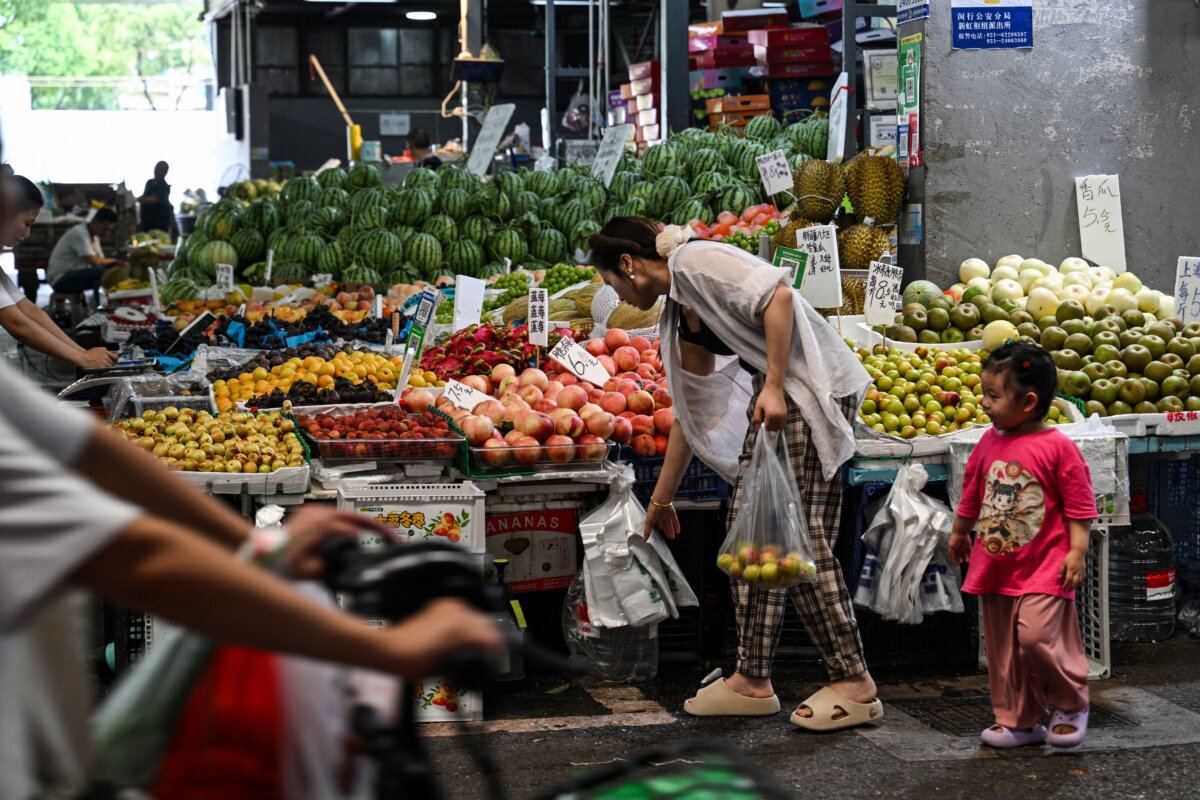
Separate June activities data, also released on July 15, indicated that consumers around the country are still tightening their belts.
Retail sales, a gauge of consumer spending, grew by 4.8 percent in June from a year earlier, slowing from a 6.4 percent increase in May and missing the 5.4 percent growth anticipated by analysts.
However, industrial output data for June came in stronger than forecasted. Year-on-year growth rose to 6.8 percent last month, accelerating from May’s 5.8 percent and beating a 5.7 percent increase forecast by analysts, according to NBS data.
China observers and analysts say stimulus alone may not be enough to tackle entrenched deflationary pressures, with producer prices in June falling at their fastest pace in nearly two years.
Trade data on July 14 showed that China’s exports regained some momentum in June as factories rushed to ship goods to capitalize on the 90-day tariff truce between Beijing and Washington ahead of a looming August deadline.
While China’s exports to the United States remained in negative territory in June, shipments to other countries continued to grow. Official data show that shipments to the Association of Southeast Asian Nations, or ASEAN, rose by 16.8 percent in June from a year earlier, accelerating from a 14.8 percent increase in May.
Property Crisis
The Chinese economy has been mired in a prolonged crisis in the real estate sector, which once accounted for a quarter of China’s economic activities. Separate data released on July 15 suggested that the downturn in the industry continued to weigh on its overall growth, despite multiple rounds of Beijing’s support measures.
NBS data show that property investment in China declined by 11.2 percent in the first half of the year from the same period last year. Meanwhile, China’s new home prices tumbled at the fastest monthly pace in eight months in June.
“We continue to view stabilisation of the housing market as one of the most important priorities in turning around the economy,” Lynn Song, chief China economist at ING Economics, said in a note on July 15.
“Given the prominent position of real estate in household balance sheets, it would be difficult to expect a turnaround in confidence as long as households’ biggest asset depreciates every month.”
The latest Reuters poll projected GDP growth to slow to 4.5 percent in the third quarter and 4 percent in the fourth quarter, underscoring the mounting economic headwinds as Washington’s trade pressures leave Beijing with the challenging task of getting households to spend more amid uncertainty.
China’s 2025 GDP growth is forecast to cool to 4.6 percent—falling short of the official target—from last year’s 5 percent and is expected to ease even further to 4.2 percent in 2026, according to the poll.
Nevertheless, the Chinese Communist Party has a record of withholding economic figures deemed harmful to its image.
Chinese citizens have accused the regime of manipulating economic data, while some analysts also expressed skepticism about the reliability of the official statistics.
Gao Shanwen, chief economist at China’s state-owned SDIC Securities, estimated last year that China’s GDP may have been overstated by as much as 10 percentage points between 2021 and 2023.
Reuters contributed to this report.
 Friends Read Free
Copy
Facebook
Tweet
Friends Read Free
Copy
Facebook
Tweet