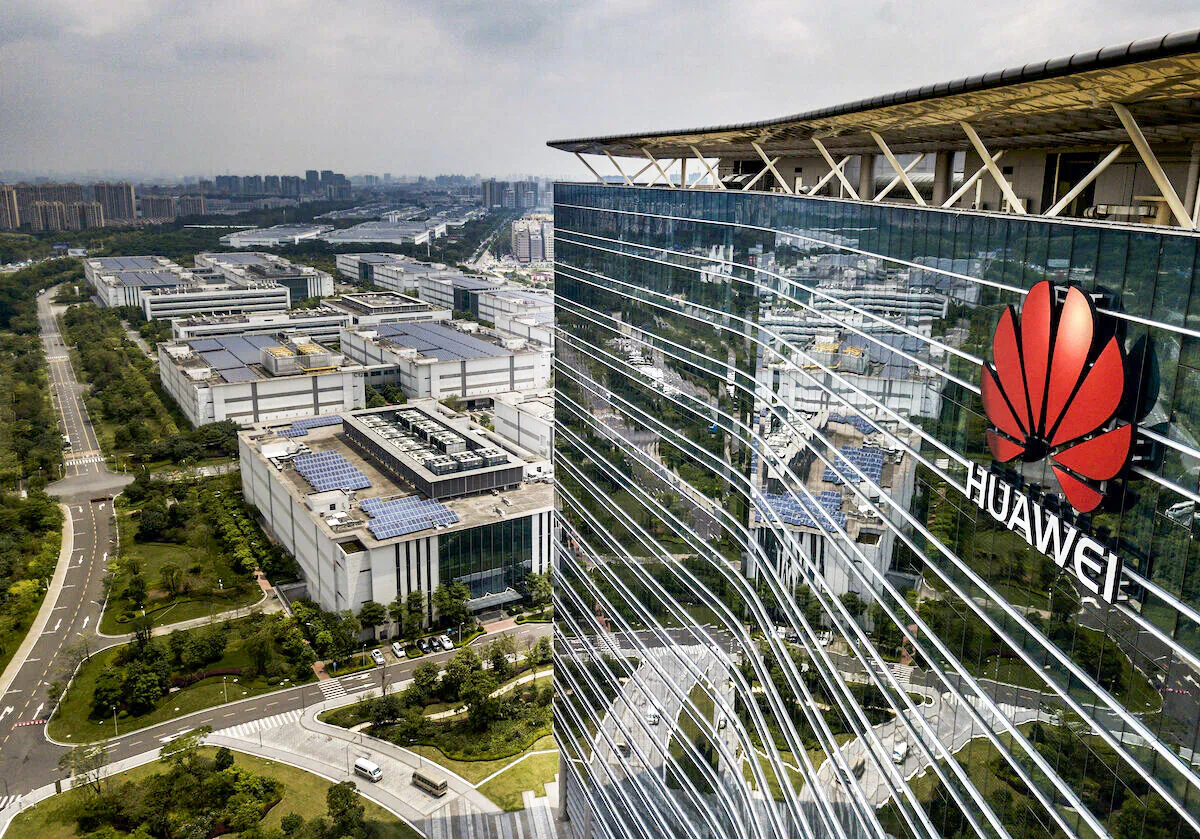

Once known as the “world’s factory floor,” Dongguan, China, in the Pearl River Delta region, is growing quiet.
Streets that once pulsed with shift changes are now largely empty. Factories have shuttered, rural migrant workers have left, and small businesses that depended on industrial traffic are disappearing. Official data points to a broader slowdown, including a deepening property slump, weakening manufacturing activity, and persistently high youth unemployment.
The Epoch Times spoke to multiple Chinese workers and insiders—who requested anonymity out of fear of reprisal—over the slowdown. They suggested a deeper problem—one that is rooted in a sustained loss of confidence in China’s economic system itself.
Vanishing Crowds in an Industrial Hub
Dongguan, the manufacturing powerhouse in southern China close to Hong Kong, was once defined by its dense clusters of factories and waves of migrant laborers from rural China.
At the end of a typical workday, factory gates would spill out thousands of workers, filling nearby streets with motorcycles, pedestrians, and bustling food stalls.
That scene has largely disappeared.
An insider familiar with China’s political system who lives in nearby Guangzhou told The Epoch Times that he revisited Dongguan last year. Arriving at about 5 p.m.—traditionally peak rush hour—he encountered deserted streets, idle delivery trucks, and rows of closed shops.
“In many places, you don’t see people at all,” the insider said. “Factories are gone. Workers have left. Restaurants and shops have no customers. [If] they can’t make money, they just shut down and leave.”
A local construction worker told The Epoch Times that by late last year, many of his neighbors had moved out, leaving apartments vacant.
“It feels like the whole society is under a kind of gloom,” the worker said.
Broad Economic Slowdown
The changes in Dongguan reflect a broader economic slowdown across China, according to official data.
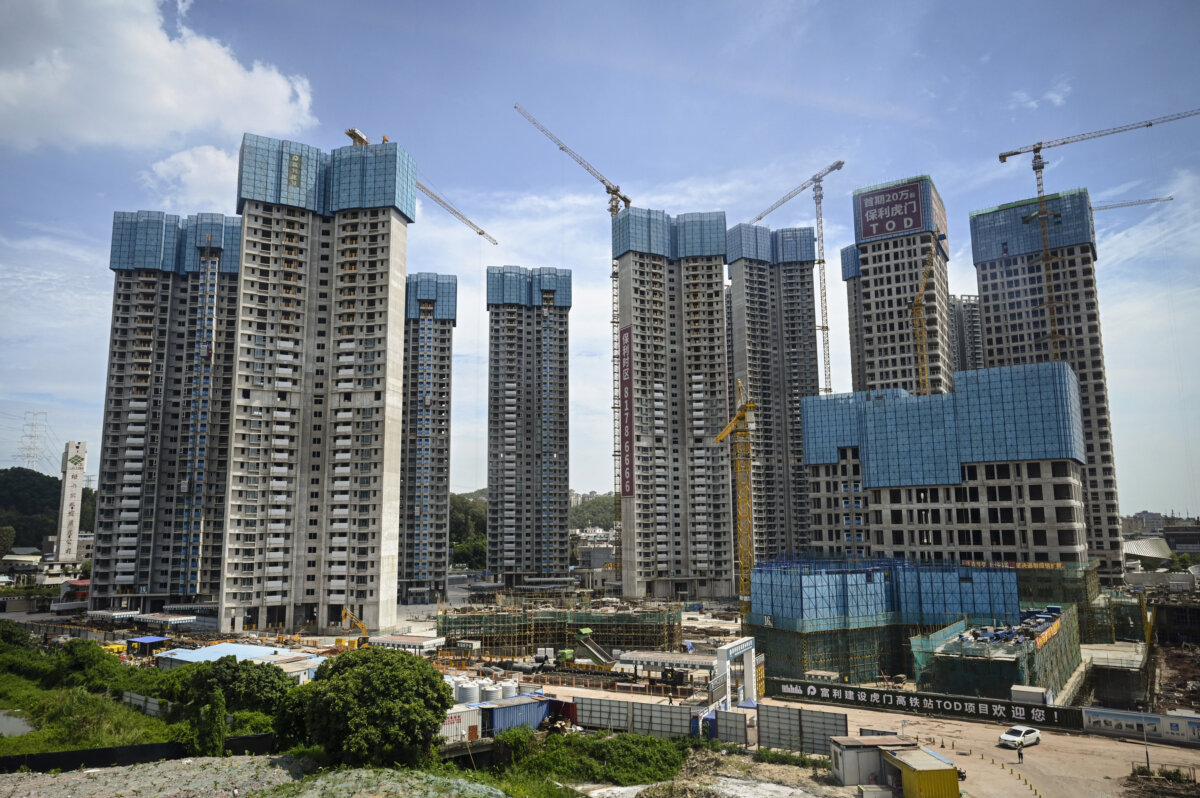
According to data released on March 16 by the National Bureau of Statistics of China (NBSC), real estate investment fell by 11.1 percent in the first two months of the year. New construction projects plunged by 23.1 percent, while sales of new housing dropped by 20.2 percent, with residential sales down by 21.8 percent.
The longer-term decline is even more striking. China’s annual property sales have fallen to roughly 8 trillion yuan by 2025 from roughly 18 trillion yuan (about $2.5 trillion) in 2021—nearly halving the market.
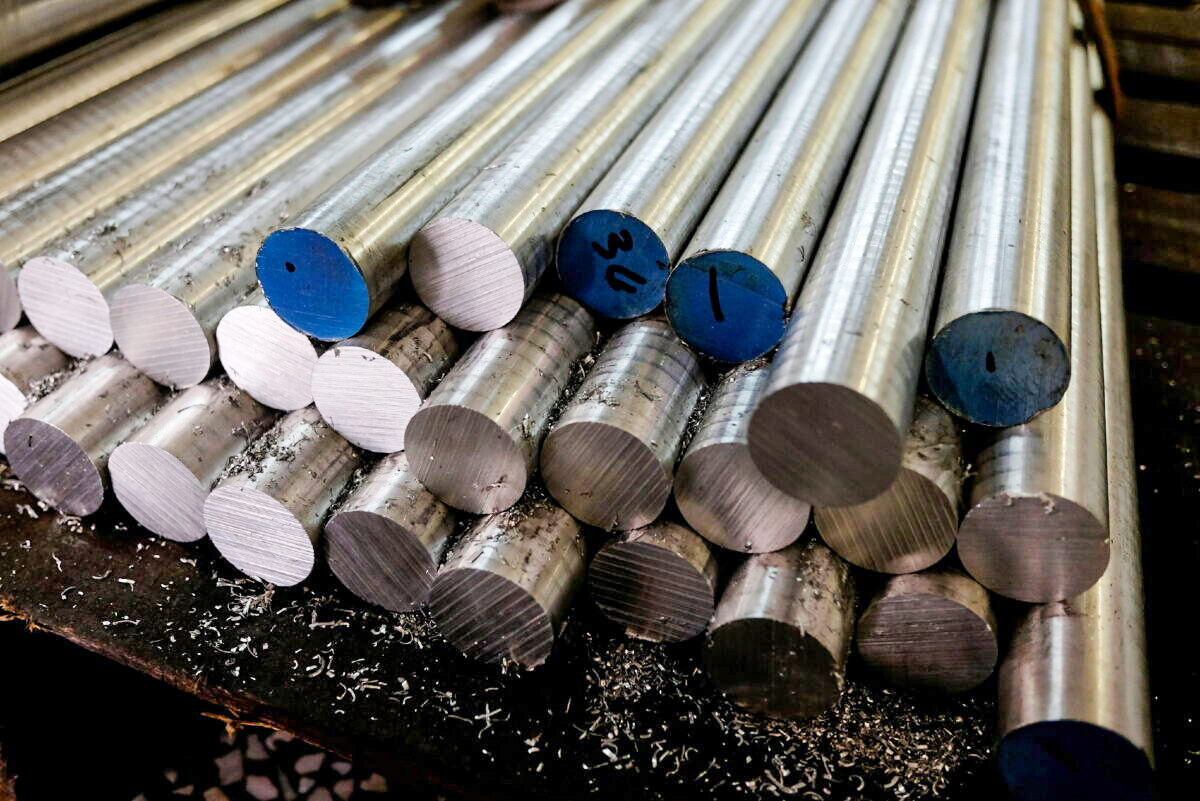
Manufacturing is also under pressure. February’s purchasing managers’ index came in at 49, below the 50-point threshold that separates expansion from contraction, according to data from the NBSC.
Facing mounting headwinds, China’s 2026 growth target has been lowered to between 4.5 percent and 5 percent—its lowest in decades.
Behind the macroeconomic data are workers grappling with falling wages, reduced hours, and job losses.
The local construction worker said that he began noticing trouble while still employed at a factory in Shenzhen, which is also part of the Pearl River Delta region. Overtime hours—once a key source of income—were cut back sharply, and weekend shifts became rare.
“[Factories] can’t afford to keep workers anymore,” the worker said.
He quit his job in April 2025 but struggled for months to find stable employment. Temporary work, once plentiful, has also dried up.
“In previous years, you could easily find short-term jobs online. Last year, hardly any factories were hiring,” the worker said.
He managed only a few days of work before orders dried up completely ahead of the Lunar New Year holidays in February.
Companies Shift Production Overseas
It is not just workers who are leaving; companies are relocating as well.
The insider said many manufacturers have gradually moved production lines to Vietnam, India, and other Southeast Asian countries, a shift years in the making.
At the core is a loss of trust in policy, he said.
He described a recurring pattern that when private firms face difficulties, the Chinese regime introduces incentives to attract investment. However, once businesses grow, they often encounter tighter regulations or political pressure.
“When the government needs investment, it encourages private entrepreneurs to build factories,” he said. “But once they succeed, they face restrictions. That erodes trust.”
He pointed to high-profile business figures who scaled back investments in China years ago after early indicators of this trend.
Financial data appear to reflect the slowdown. New bank lending in 2025 fell to a seven-year low, while January lending this year came in below both expectations and year-earlier levels.
Structural Tensions in the Economy
The insider familiar with China’s political system also highlighted what he sees as a deeper structural imbalance.
The insider said private firms account for roughly 50 percent to 60 percent of tax revenue and economic output while using only 30 percent to 40 percent of resources. Key sectors with the highest profits remain dominated by state-owned enterprises (SOEs).
“All the core, resource-rich, and highly profitable industries are controlled by SOEs,” the insider said.
The insider described a long-standing paradox: SOEs often struggle with efficiency, while private firms tend to revitalize sectors they enter. Yet as private companies grow, they frequently face increased scrutiny or constraints.
In the insider’s view, the dynamic is partly political.
“As private companies gain economic strength, they may seek greater influence. That’s something the regime is wary of,” the insider said.
Propaganda Versus Reality
Chinese state media has pushed back against pessimism, emphasizing resilience and the importance of confidence.
In a March 16 commentary, a Chinese Communist Party propaganda mouthpiece, Qiushi journal, criticized what it called “different variations of the ‘collapse theory,'” urging the public to maintain faith in China’s economic prospects.
However, for many Chinese people, the message rings hollow.
The quiet streets of Dongguan stand in stark contrast to official reassurances, highlighting a widening gap between official messaging and everyday reality.
Li Jing and Hong Ning contributed to this report.
 Friends Read Free
Copy
Facebook
Tweet
Friends Read Free
Copy
Facebook
Tweet