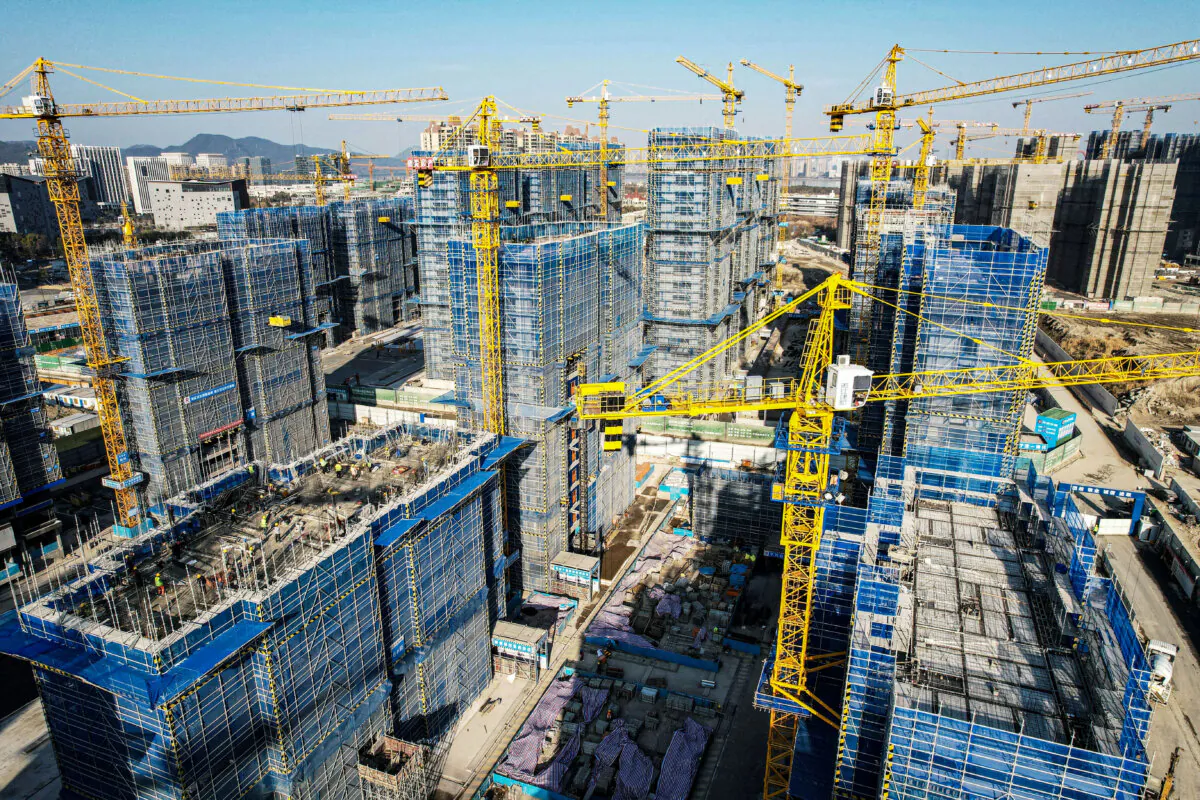

China’s official data showed on June 16 that new home prices fell in major Chinese cities in May, continuing a two-year-long trend of stagnation in its property sector.
The ongoing housing slowdown is occurring at a time when a trade war with the United States is impacting China’s factory output.
New residential property prices in China’s four first-tier cities fell by 0.2 percent in May compared with the previous month, while second-tier and third-tier cities experienced decreases of 0.2 percent and 0.3 percent, respectively, according to an analysis of official data by Wang Zhonghua, chief statistician of the urban division at China’s National Bureau of Statistics (NBS).
Overall, new home prices across 70 cities fell by 0.2 percent month-on-month in May, according to Reuters’s calculation of official data.
Since May 2023, new home prices have continued to decline despite authorities’ efforts to support the real estate sector, once a key driver of the world’s second-largest economy.
Among the major cities tracked, 53 reported declines in new home prices, up from 45 a month earlier, official data show.
In May, China introduced a series of measures to revive the economy, including trimming the interest rate on mortgages for some buyers to turn around a property crisis that began in 2021. Indebted developers have since faced challenges in repaying debts and delivering pre-sold homes, further eroding confidence in the sector.
“Stabilising housing prices remains a very important goal. Property represents 60 [percent to] 70 [percent] of China’s household balance sheets,” Lynn Song, chief economist for greater China at ING Economics, said in a June 16 note. “As long as this does not turn around, it’s difficult to expect a substantive and sustainable recovery in sentiment.”
According to ING’s analysis, home prices in China’s primary market have fallen by 10.2 percent since mid-2021, while the secondary market has seen an even steeper drop of 17.8 percent.
Factory Output Slows Amid US Tariffs
A separate set of data released on June 16 by the NBS showed industrial output grew by 5.8 percent in May from a year earlier, missing analysts’ expectations of 5.9 percent growth and marking the slowest growth since November 2024.
Retail sales picked up steam, rising by 6.4 percent in May, official data show, exceeding the 5 percent growth projected by a Reuters poll.
Fu Linghui, an NBS spokesperson, attributed the surge in sales to spending during the Labor Day holiday and a key annual e-commerce shopping event known as the 618 festival, which has seen major Chinese online shopping platforms offer discounts starting in May.
A consumer goods trade-in program that was heavily subsidized by the Chinese regime also helped lift consumption, according to Fu.
Fu said China’s economy “maintained steady momentum under pressure” in May but acknowledged the challenges in achieving the economic growth target for the second quarter.
“We should also recognize that the external environment remains complicated and severe, and that there are many unstable and uncertain factors,” Fu told reporters at a June 16 news conference where the monthly data were released.
Huang Zichun, an economist at Capital Economics, predicts that China’s economic growth will slow this year because of high U.S. tariffs, waning fiscal support, and persisting structural headwinds.
“The US–China trade truce was not enough to prevent a broader loss of economic momentum last month,” Huang said in a note on June 16.
Under a 90-day trade truce reached in Geneva in May, the United States and China have slashed most of the triple-digit tariffs that they had imposed on each other earlier in 2025.
Data released by the Chinese customs agency earlier in June showed that China’s exports grew less than expected in May. Shipments to the United States plummeted by 34.5 percent in U.S. dollar terms from the previous year, the steepest decline in more than five years, according to The Epoch Times’ calculation of official data.
Trade negotiators from China and the United States have agreed on a framework covering tariffs after talks in London on June 9 and June 10. In a Truth Social post on June 11, U.S. President Donald Trump said the trade deal with China is “done.”
According to Trump, China currently faces 55 percent U.S. tariffs, while its tariffs on U.S. goods are set at 10 percent.
Amid trade tensions with the United States, analysts have flagged challenges for China in hitting its growth target of roughly 5 percent this year and warned that imminent stimulus was unlikely.
Still, skepticism about the reliability of China’s economic data remains. Gao Shanwen, chief economist at China’s state-owned SDIC Securities, estimated in 2024 that China’s gross domestic product growth may have been overstated by as much as 10 percentage points between 2021 and 2023.
Reuters contributed to this report.
 Friends Read Free
Copy
Facebook
Tweet
Friends Read Free
Copy
Facebook
Tweet