
China’s property market continues to face significant challenges with steep declines in sales, investment, and profitability, raising new doubts about the state media’s narrative of a gradual recovery.
According to data released on July 31 by the China Index Academy, total sales by the country’s top 100 real estate developers reached 2.07 trillion yuan (about $285 billion) in the first seven months of 2025—down by 13.3 percent year over year. The pace of decline has accelerated, widening by 1.5 percentage points compared with the numbers for the first half of the year. In July alone, sales dropped by 18.2 percent from a year earlier.
Meanwhile, more than 60 percent of A-share-listed developers—41 of 65 firms—are expecting losses, according to research firm E-house China R&D Institute, which looked at their earnings forecasts for the first half of 2025.
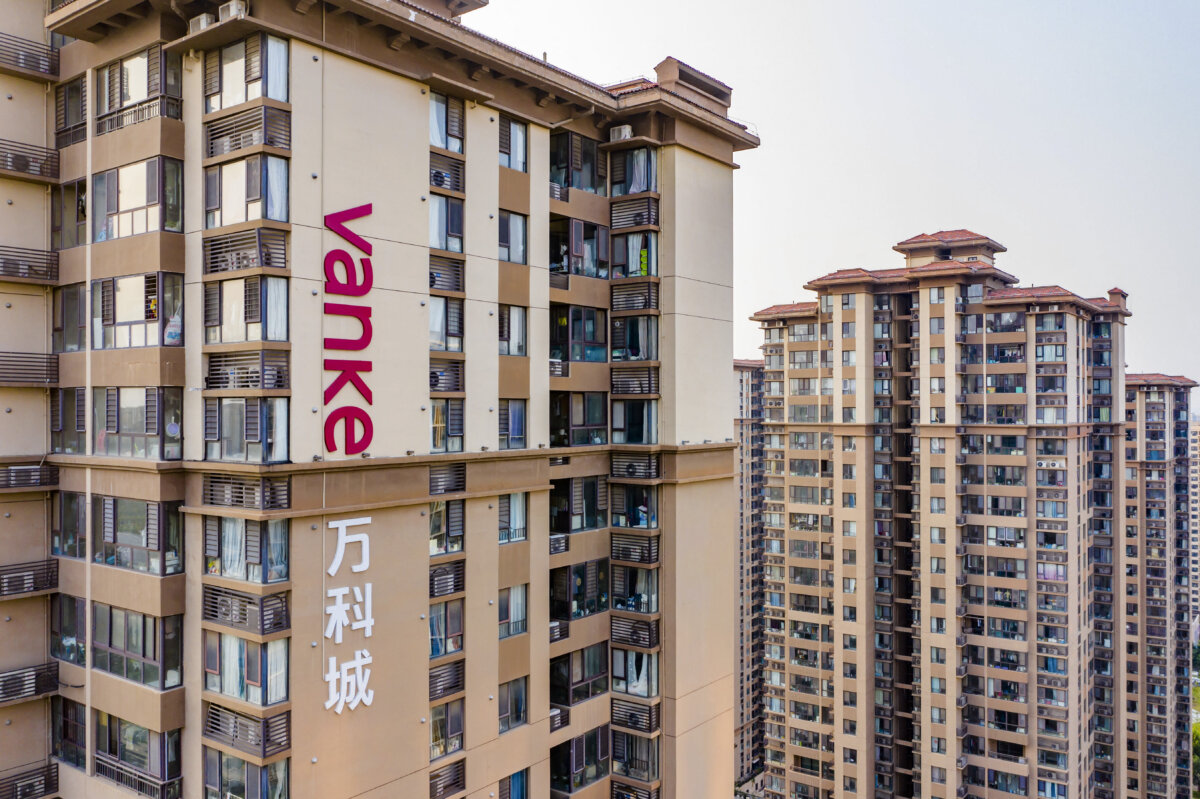
Vanke, once a bellwether of the sector, is forecasting losses of 10 billion yuan (about $1.39 billion) to 12 billion yuan (about $1.67 billion) for the period—even greater than its 9.85 billion yuan (about $1.37 billion) loss during the same period in 2024. This makes Vanke the biggest loser among its peers, according to state media reports.
China Fortune Land Development and Gemdale Corp., two former industry standouts, are also under pressure. They are projecting losses of 5.5 billion yuan to 7.5 billion yuan, and 3.4 billion yuan to 4.2 billion yuan, respectively, in the first two quarters of the fiscal year.
Vanke’s situation is especially dire. Despite major management shakeups following the Lunar New Year and a shift from a professional manager-led model to direct oversight by state-owned entities, the company continues to struggle. Even after receiving more than 21 billion yuan in financial support from Shenzhen Metro and other state-linked investors, Vanke’s contracted sales plunged by nearly 50 percent in the first half of the year, dropping from 127.3 billion yuan to 69.1 billion yuan. Its cash flow remains under severe pressure.
Many Chinese netizens and real estate bloggers have voiced skepticism over official data, saying that government figures often serve political purposes and fail to reflect the true state of the market, based on their own observations and on-the-ground experience.
For example, according to official data released by China Index Academy, the average selling price of newly built homes by the top 100 developers rose by 2.6 percent year over year in July. However, prices for existing homes plummeted by 7.3 percent.
On Chinese social media, some commentators claim that the widening gap between new and secondhand home prices indicates discrepancies in the data. They also claim that the actual transaction prices of resale homes are significantly lower than the official figures and that the real prices in the resale market may offer a more accurate reflection of housing demand and affordability.
If anecdotal reports of steeper price cuts are accurate, the 13.3 percent drop in sales volume—despite declining prices—suggests a market in which lower prices are no longer enough to rekindle buyer interest.
Property investment has also collapsed. According to China’s National Bureau of Statistics, real estate investment in the first half of 2025 totaled just 4.66 trillion yuan—down by 11.2 percent from a year ago. Residential property, which accounts for the largest share, dropped by 10.4 percent to 3.57 trillion yuan. That compares with 11 trillion yuan in total real estate investment for all of 2023—highlighting the sharp contraction.
Across nearly every key metric—corporate earnings, home prices (both new and secondhand), sales figures, and fixed investment—the industry is experiencing a widespread downturn, contradicting the official narrative about a market on the mend.
Falling Prices Erode Wealth, Confidence
In a widely circulated audio clip of a recent interview, Chinese economist Xiang Songzuo explained that the previous housing boom was driven largely by two forces: end-user demand and speculative investment. But with speculators having suffered massive losses—many properties are now worth less than their purchase prices—investor interest has all but dried up. End-user demand alone, he pointed out, is not enough to support prices.
“A decline in home prices is inevitable,” Xiang said. “Everyone will have to bear the cost.”
He noted that as property values plummet, so does consumer confidence.
“When your house is losing value, your stocks aren’t making money, your salary isn’t increasing—how can ordinary people be expected to spend?” Xiang said.
Zhang Xiaojing, director of the Institute of Finance at the Chinese Academy of Social Sciences, echoed that sentiment in a recent interview with Chinese media.
He similarly stated that working-class families—whose homes often make up 60 percent to 70 percent of their total assets—are bearing the brunt of the downturn, while wealthier households remain largely insulated.
For working-class homeowners, he said, falling property values translate into real and immediate losses in household wealth.
Fang Xiao contributed to this report.
 Friends Read Free
Copy
Facebook
Tweet
Friends Read Free
Copy
Facebook
Tweet